
Exam code:1ST0
Selecting Data Representations
What should be considered when choosing a data representation?
-
Representing data in tables, graphs, charts, diagrams, etc. can make it easier to understand the data and spot patterns in it
-
Such representations of data may be referred to as visualisations (i.e., ways of ‘seeing’ or visualising the data)
-
Statistical software and spreadsheets can create these sorts of representations from data entered into them
-
-
When choosing a representation, a number of factors should be considered:
-
The target audience
-
For an audience not especially familiar with statistics, a simple visualisation would be more appropriate
-
e.g. bar chart, pictogram or pie chart
-
-
Whereas for an audience of experienced statisticians, a more technical visualisation could be used
-
e.g. box plot, cumulative frequency diagram or histogram
-
-
-
The nature of the data
-
Some representations are or are not appropriate for certain types of data
-
e.g. bar charts are good for discrete data but should not be used for continuous data
-
Scatter diagrams are appropriate for bivariate data
-
Histograms are appropriate for grouped data
-
-
-
The particular strengths (and weaknesses) of different representations
-
Different representations can highlight or obscure different features in the data
-
e.g. bar charts and line graphs make patterns in the data clear and data values can often be read off the scale
-
Tables contain exact values but do not clearly show patterns or trends in the data
-
Pie charts show proportions clearly but do not show exact data values
-
-
-
-
On the exam you may be asked to:
-
Choose a representation that should be used for a set of data and justify your choice
-
Comment on or criticise a representation that has been used
-
Compare data sets that have been presented in different formats
-
and comment on the strengths and weaknesses of each format for the data shown
-
-
Examiner Tips and Tricks
-
If asked to choose a data representation for a data set
-
be sure to justify your decision based on the nature of the data, the intended audience, and the strengths and weaknesses of your chosen representation
-
Worked Example
The diagrams show information about the preferred pizza toppings of students at two schools, the Pescador Academy and the Gourmandiser School.
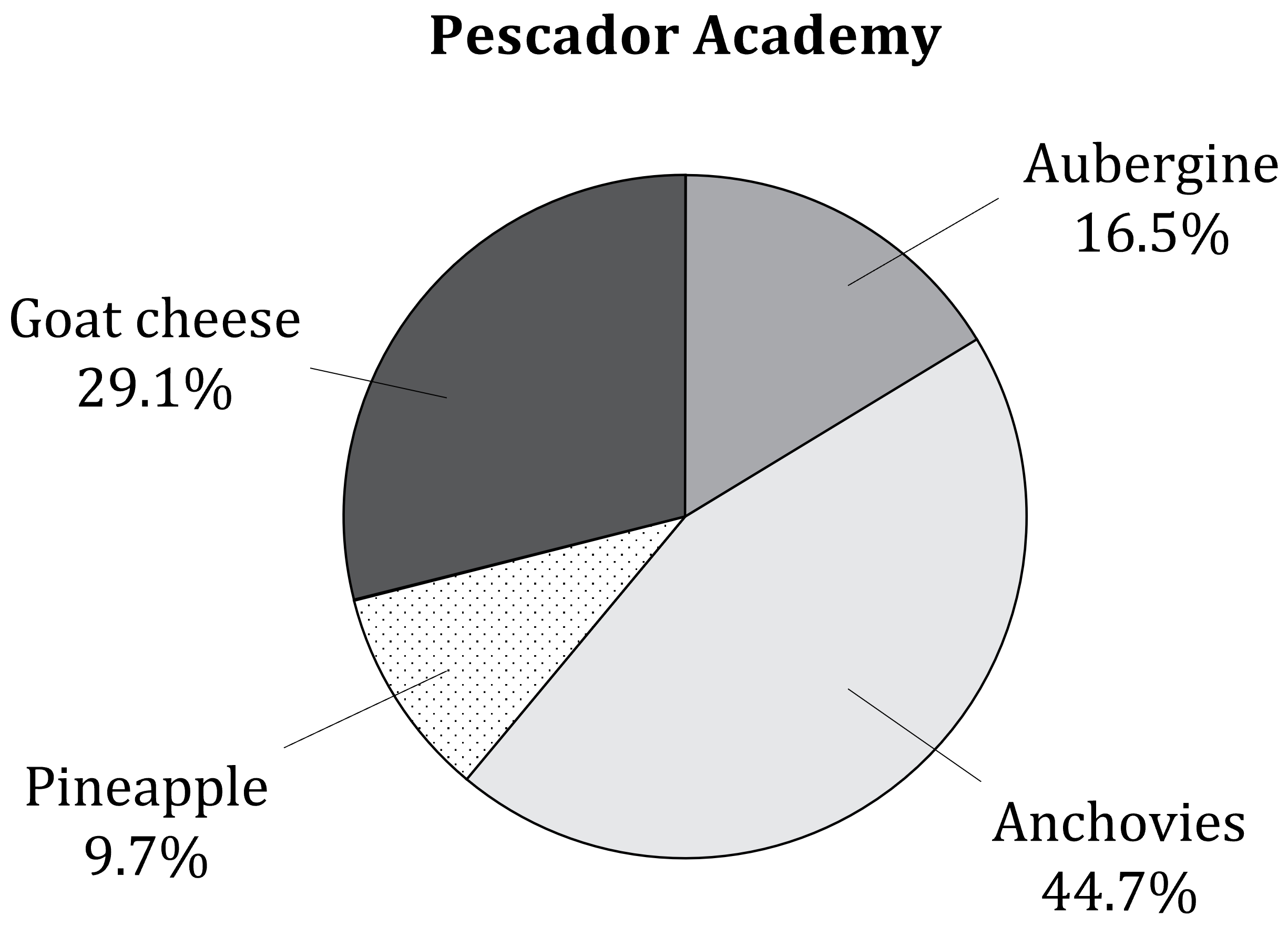
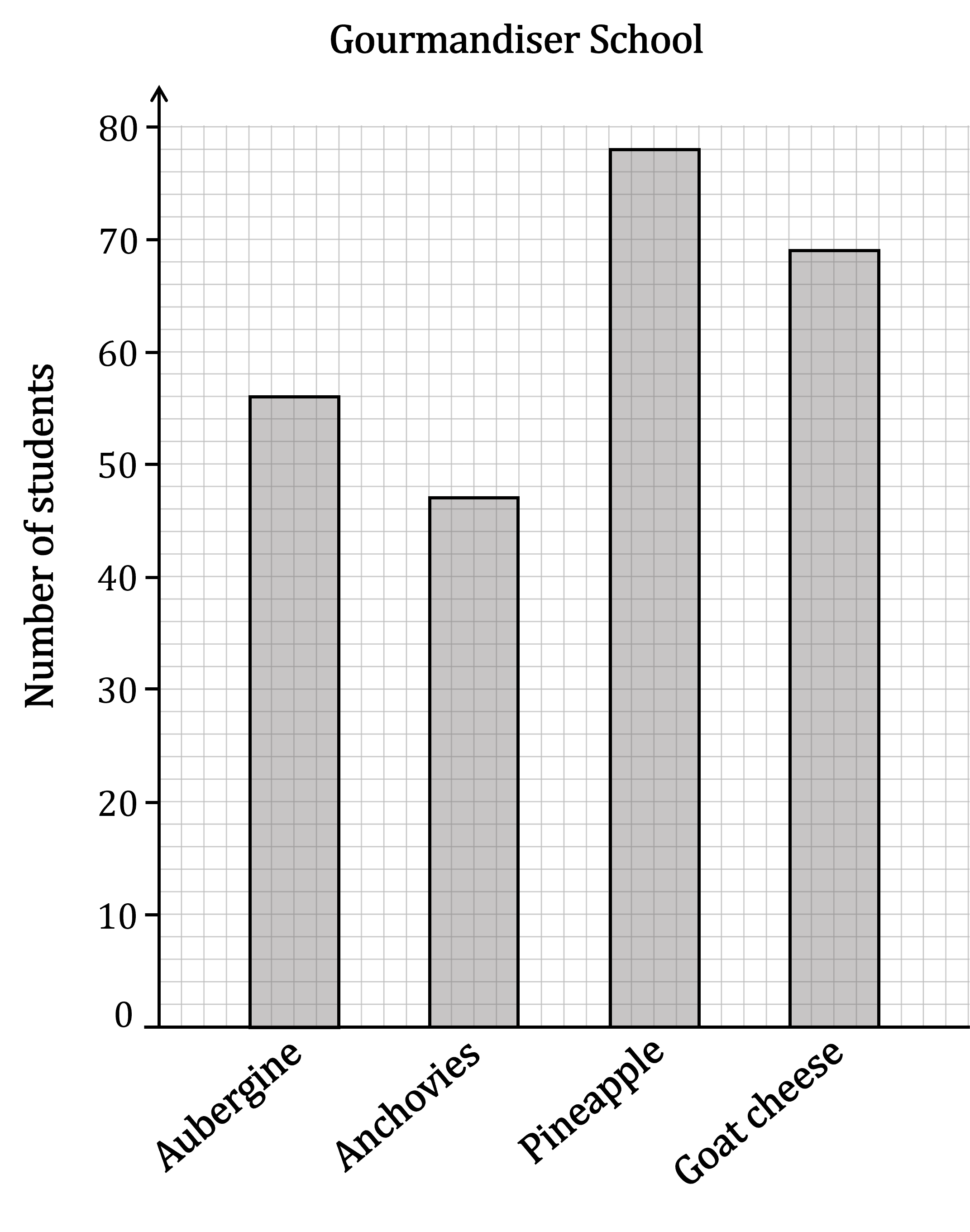
Mary is interested in the proportions of students at each school who prefer the different toppings.
(a) State with a reason which of the two data representations will make it easier for Mary to find the information she wants.
The pie chart will be easier for Mary to use, because the proportions (in percentage form) are indicated directly on the diagram.
(b) Determine which school has the higher proportion of students who prefer goat cheese. Show workings to support your answer.
29.1% of the students at the Pescador Academy prefer goat cheese
We need to calculate the percentage for the Gourmandiser School
From the bar chart, 69 students prefer goat cheese
And there is a total of 56+47+78+69 students in total
format('truetype')%3Bfont-weight%3Anormal%3Bfont-style%3Anormal%3B%7D%3C%2Fstyle%3E%3C%2Fdefs%3E%3Cline%20stroke%3D%22%23000000%22%20stroke-linecap%3D%22square%22%20stroke-width%3D%221%22%20x1%3D%222.5%22%20x2%3D%22128.5%22%20y1%3D%2223.5%22%20y2%3D%2223.5%22%2F%3E%3Ctext%20font-family%3D%22Times%20New%20Roman%22%20font-size%3D%2218%22%20text-anchor%3D%22middle%22%20x%3D%2266.5%22%20y%3D%2216%22%3E69%3C%2Ftext%3E%3Ctext%20font-family%3D%22Times%20New%20Roman%22%20font-size%3D%2218%22%20text-anchor%3D%22middle%22%20x%3D%2213.5%22%20y%3D%2241%22%3E56%3C%2Ftext%3E%3Ctext%20font-family%3D%22math105e3f444b77fd674ead956ad23%22%20font-size%3D%2216%22%20text-anchor%3D%22middle%22%20x%3D%2230.5%22%20y%3D%2241%22%3E%2B%3C%2Ftext%3E%3Ctext%20font-family%3D%22Times%20New%20Roman%22%20font-size%3D%2218%22%20text-anchor%3D%22middle%22%20x%3D%2248.5%22%20y%3D%2241%22%3E47%3C%2Ftext%3E%3Ctext%20font-family%3D%22math105e3f444b77fd674ead956ad23%22%20font-size%3D%2216%22%20text-anchor%3D%22middle%22%20x%3D%2265.5%22%20y%3D%2241%22%3E%2B%3C%2Ftext%3E%3Ctext%20font-family%3D%22Times%20New%20Roman%22%20font-size%3D%2218%22%20text-anchor%3D%22middle%22%20x%3D%2283.5%22%20y%3D%2241%22%3E78%3C%2Ftext%3E%3Ctext%20font-family%3D%22math105e3f444b77fd674ead956ad23%22%20font-size%3D%2216%22%20text-anchor%3D%22middle%22%20x%3D%22100.5%22%20y%3D%2241%22%3E%2B%3C%2Ftext%3E%3Ctext%20font-family%3D%22Times%20New%20Roman%22%20font-size%3D%2218%22%20text-anchor%3D%22middle%22%20x%3D%22118.5%22%20y%3D%2241%22%3E69%3C%2Ftext%3E%3Ctext%20font-family%3D%22math105e3f444b77fd674ead956ad23%22%20font-size%3D%2216%22%20text-anchor%3D%22middle%22%20x%3D%22139.5%22%20y%3D%2230%22%3E%3D%3C%2Ftext%3E%3Cline%20stroke%3D%22%23000000%22%20stroke-linecap%3D%22square%22%20stroke-width%3D%221%22%20x1%3D%22150.5%22%20x2%3D%22180.5%22%20y1%3D%2223.5%22%20y2%3D%2223.5%22%2F%3E%3Ctext%20font-family%3D%22Times%20New%20Roman%22%20font-size%3D%2218%22%20text-anchor%3D%22middle%22%20x%3D%22166.5%22%20y%3D%2216%22%3E69%3C%2Ftext%3E%3Ctext%20font-family%3D%22Times%20New%20Roman%22%20font-size%3D%2218%22%20text-anchor%3D%22middle%22%20x%3D%22165.5%22%20y%3D%2241%22%3E250%3C%2Ftext%3E%3Ctext%20font-family%3D%22math105e3f444b77fd674ead956ad23%22%20font-size%3D%2216%22%20text-anchor%3D%22middle%22%20x%3D%22191.5%22%20y%3D%2230%22%3E%3D%3C%2Ftext%3E%3Ctext%20font-family%3D%22Times%20New%20Roman%22%20font-size%3D%2218%22%20text-anchor%3D%22middle%22%20x%3D%22204.5%22%20y%3D%2230%22%3E0%3C%2Ftext%3E%3Ctext%20font-family%3D%22math105e3f444b77fd674ead956ad23%22%20font-size%3D%2216%22%20text-anchor%3D%22middle%22%20x%3D%22211.5%22%20y%3D%2230%22%3E.%3C%2Ftext%3E%3Ctext%20font-family%3D%22Times%20New%20Roman%22%20font-size%3D%2218%22%20text-anchor%3D%22middle%22%20x%3D%22227.5%22%20y%3D%2230%22%3E276%3C%2Ftext%3E%3Ctext%20font-family%3D%22math105e3f444b77fd674ead956ad23%22%20font-size%3D%2216%22%20text-anchor%3D%22middle%22%20x%3D%22249.5%22%20y%3D%2230%22%3E%3D%3C%2Ftext%3E%3Ctext%20font-family%3D%22Times%20New%20Roman%22%20font-size%3D%2218%22%20text-anchor%3D%22middle%22%20x%3D%22267.5%22%20y%3D%2230%22%3E27%3C%2Ftext%3E%3Ctext%20font-family%3D%22math105e3f444b77fd674ead956ad23%22%20font-size%3D%2216%22%20text-anchor%3D%22middle%22%20x%3D%22278.5%22%20y%3D%2230%22%3E.%3C%2Ftext%3E%3Ctext%20font-family%3D%22Times%20New%20Roman%22%20font-size%3D%2218%22%20text-anchor%3D%22middle%22%20x%3D%22285.5%22%20y%3D%2230%22%3E6%3C%2Ftext%3E%3Ctext%20font-family%3D%22Times%20New%20Roman%22%20font-size%3D%2218%22%20text-anchor%3D%22middle%22%20x%3D%22298.5%22%20y%3D%2230%22%3E%25%3C%2Ftext%3E%3C%2Fsvg%3E)
The proportion of students who prefer goat cheese at the Pescador Academy (29.1%) is higher than the proportion at the Gourmandiser School (27.6%).
Titus and Irma are also examining the two diagrams.
Titus says that it is obvious that there are more students at the Pescador Academy who prefer anchovies than there are at the Gourmandiser School.
Irma says there is no way to tell from the diagrams which school has a greater number of students who prefer anchovies.
(c) Explain with a reason which student is correct.
Nearly half the students at the Pescador Academy prefer anchovies, while at the Gourmandiser School it is the least popular choice
However we don’t know from the pie chart how many students are at the Pescador Academy
If the Pescador Academy is a small school, then 44.7% of its students may actually be less than the 47 students who prefer anchovies at the Gourmandiser School
So Irma is correct
Irma is correct. The pie chart doesn’t tell us how many students in total are at the Pescador Academy, so there is no way to know exactly how many students there prefer anchovies.
Misrepresentations in Statistical Diagrams
What sort of misrepresentations can appear in statistical diagrams?
-
If a data representation gives a misleading or incorrect impression about the data, this is known as a misrepresentation
-
Sometimes this may be the result of a mistake
-
But sometimes it may be done intentionally in order to be misleading
-
-
If scales in diagrams do not go up in equal steps, or if parts of them are missed out
-
this will distort the sizes and shapes of things plotted against them
-
-
If scales in diagrams do not start at zero
-
this can give a misleading sense of the true size of bars, etc., plotted against them
-
Note that scales don’t have to start at zero
-
But not starting at zero can change the impression given about the data
-
-
-
If axes on a graph are not labelled
-
then there is no way to know for sure what the data represents
-
-
If a graph or chart doesn’t have a key
-
then it may be impossible to interpret what it is meant to show
-
-
If a diagram uses bright colours
-
it can make some parts of a diagram stand out more than others
-
-
If lines on a graph are drawn too thick
-
it can make it difficult to read the graph precisely
-
-
If frequency densities for histograms are calculated incorrectly, or if the class widths are plotted incorrectly on the horizontal axis
-
the bars on the histogram will not represent the data accurately
-
What are possible problems with 3D representations?
-
3D representations can look nice and be quite ‘eye-catching’
-
but they can also distort the data or be misleading
-
-
For example, in a 3D pie chart
-
the angles of the different sections are distorted
-
parts at the front can seem bigger or more prominent
-
parts at the back can seem smaller or be hidden behind parts at the front
-
a section that is pulled out of the ‘pie’ can be hard to compare with the rest of the sections
-
Responses