
Exam code:1ST0
The Probability Scale & Basic Probabilities
What is the probability scale?
-
Probability describes the likelihood of something happening
-
In real-life you might use words such as impossible, unlikely and certain
-
In maths we use the probability scale to describe probability
-
-
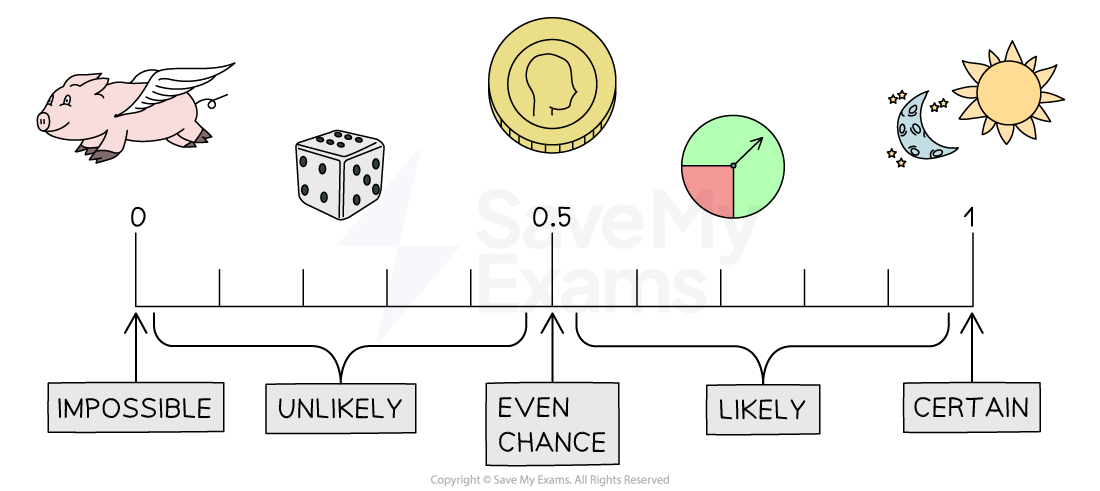
On the probability scale likelihood is measured by a number between 0 and 1
-
0 means impossible (i.e. it will never happen)
-
a pig will grow wings and fly
-
-
Between 0 and 0.5 means unlikely
-
getting a ‘6’ when you roll a fair 6-sided dice
-
getting a ‘6’ when you choose a number between one and a million at random can be described as very unlikely
-
-
0.5 means even chance (i.e. it happens 50% of the time)
-
getting ‘heads’ when you flip a fair coin
-
-
Between 0.5 and 1 means likely
-
a spinner that is three quarters green landing on green
-
not getting a ‘6’ when you choose a number between one and a million at random can be described as very likely
-
-
1 means certain (i.e. it will always happen)
-
the sun will rise tomorrow morning
-
-
-
Probabilities can be given as fractions, decimals or percentages
How do I calculate basic probabilities?
-
An outcome is a single possible result of a trial
-
For example:
-
a dice lands on 6
-
a dice lands on 5
-
-
-
If all possible outcomes are equally likely then the probability for each outcome is the same
-
The probability for each outcome is

-
If there are 50 marbles in a bag then the probability of selecting a specific one is

-
-
An event is an outcome or a collection of outcomes
-
For example:
-
a dice lands on a six (one outcome)
-
a dice lands on an even number (a collection of outcomes)
-
-
Events can be referred to by capital letters
-
e.g. event A might be ‘a dice lands on an odd number’
-
The probability of event A occurring can be written as P(A)
-
-
-
If all possible outcomes are equally likely then the probability of an event can be calculated by dividing the number of ‘successful’ outcomes by the total number of possible outcomes
-
format('truetype')%3Bfont-weight%3Anormal%3Bfont-style%3Anormal%3B%7D%3C%2Fstyle%3E%3C%2Fdefs%3E%3Ctext%20font-family%3D%22Times%20New%20Roman%22%20font-size%3D%2218%22%20text-anchor%3D%22middle%22%20x%3D%2240.5%22%20y%3D%2230%22%3EProbability%3C%2Ftext%3E%3Ctext%20font-family%3D%22Times%20New%20Roman%22%20font-size%3D%2218%22%20text-anchor%3D%22middle%22%20x%3D%2291.5%22%20y%3D%2230%22%3Eof%3C%2Ftext%3E%3Ctext%20font-family%3D%22Times%20New%20Roman%22%20font-size%3D%2218%22%20text-anchor%3D%22middle%22%20x%3D%22111.5%22%20y%3D%2230%22%3Ean%3C%2Ftext%3E%3Ctext%20font-family%3D%22Times%20New%20Roman%22%20font-size%3D%2218%22%20text-anchor%3D%22middle%22%20x%3D%22143.5%22%20y%3D%2230%22%3Eevent%3C%2Ftext%3E%3Ctext%20font-family%3D%22math17f39f8317fbdb1988ef4c628eb%22%20font-size%3D%2216%22%20text-anchor%3D%22middle%22%20x%3D%22171.5%22%20y%3D%2230%22%3E%3D%3C%2Ftext%3E%3Cline%20stroke%3D%22%23000000%22%20stroke-linecap%3D%22square%22%20stroke-width%3D%221%22%20x1%3D%22182.5%22%20x2%3D%22431.5%22%20y1%3D%2223.5%22%20y2%3D%2223.5%22%2F%3E%3Ctext%20font-family%3D%22Times%20New%20Roman%22%20font-size%3D%2218%22%20text-anchor%3D%22middle%22%20x%3D%22222.5%22%20y%3D%2216%22%3Enumber%3C%2Ftext%3E%3Ctext%20font-family%3D%22Times%20New%20Roman%22%20font-size%3D%2218%22%20text-anchor%3D%22middle%22%20x%3D%22261.5%22%20y%3D%2216%22%3Eof%3C%2Ftext%3E%3Ctext%20font-family%3D%22Times%20New%20Roman%22%20font-size%3D%2218%22%20text-anchor%3D%22middle%22%20x%3D%22310.5%22%20y%3D%2216%22%3Esuccessful%3C%2Ftext%3E%3Ctext%20font-family%3D%22Times%20New%20Roman%22%20font-size%3D%2218%22%20text-anchor%3D%22middle%22%20x%3D%22385.5%22%20y%3D%2216%22%3Eoutcomes%3C%2Ftext%3E%3Ctext%20font-family%3D%22Times%20New%20Roman%22%20font-size%3D%2218%22%20text-anchor%3D%22middle%22%20x%3D%22200.5%22%20y%3D%2241%22%3Etotal%3C%2Ftext%3E%3Ctext%20font-family%3D%22Times%20New%20Roman%22%20font-size%3D%2218%22%20text-anchor%3D%22middle%22%20x%3D%22247.5%22%20y%3D%2241%22%3Enumber%3C%2Ftext%3E%3Ctext%20font-family%3D%22Times%20New%20Roman%22%20font-size%3D%2218%22%20text-anchor%3D%22middle%22%20x%3D%22286.5%22%20y%3D%2241%22%3Eof%3C%2Ftext%3E%3Ctext%20font-family%3D%22Times%20New%20Roman%22%20font-size%3D%2218%22%20text-anchor%3D%22middle%22%20x%3D%22327.5%22%20y%3D%2241%22%3Epossible%3C%2Ftext%3E%3Ctext%20font-family%3D%22Times%20New%20Roman%22%20font-size%3D%2218%22%20text-anchor%3D%22middle%22%20x%3D%22395.5%22%20y%3D%2241%22%3Eoutcomes%3C%2Ftext%3E%3C%2Fsvg%3E)
-
A ‘successful‘ outcome is an outcome belonging to the event
-
e.g. for the event ‘a dice lands on an even number’
-
‘2’, ‘4’ and ‘6’ are all successful outcomes
-
-
If there are 50 marbles in a bag and 20 are blue, then the probability of selecting a blue marble is

-
The probability of selecting a particular blue marble is still
-
-
-
A probability worked out this way is sometimes known as a theoretical probability
-
The word ‘fair‘ is used to indicate equally likely outcomes
-
e.g. for tossing a fair coin, heads and tails are equally likely
-
or for rolling a fair dice, each number on the dice is equally likely
-
Examiner Tips and Tricks
-
If you are not told in the question how to leave your answer, then fractions are best for probabilities
Worked Example
Mark the following on a probability scale:
A: All of your numbers will come up on a lottery draw
B: A randomly chosen day of the year falls on a weekend
C: A randomly selected UK adult owns a mobile phone
‘A’ is extremely unlikely, so mark that event on the scale close to zero
‘B’ is unlikely (most days are weekdays), but not as unlikely as ‘A’
So mark that event closer to 0.5 than ‘A’
‘C’ is very likely (most UK adults own mobile phones). so mark that event on the scale close to one
Responses