
Maths Gcse Wjec-Eduqas Foundation
-
Scatter-Graphs-And-Correlation Wjec-Eduqas Foundation2 主题
-
Statistical-Diagrams- Wjec-Eduqas Foundation7 主题
-
Comparing-Statistical-Diagrams Wjec-Eduqas Foundation
-
Reading-And-Interpreting-Statistical-Diagrams Wjec-Eduqas Foundation
-
Time-Series-Graphs- Wjec-Eduqas Foundation
-
Pie-Charts- Wjec-Eduqas Foundation
-
Frequency-Polygons Wjec-Eduqas Foundation
-
Bar-Charts-And-Pictograms- Wjec-Eduqas Foundation
-
Tally-Charts-And-Frequency-Tables Wjec-Eduqas Foundation
-
Comparing-Statistical-Diagrams Wjec-Eduqas Foundation
-
Statistics-Toolkit Wjec-Eduqas Foundation8 主题
-
Questionnaires Wjec-Eduqas Foundation
-
Population-And-Sampling Wjec-Eduqas Foundation
-
Comparing-Data-Sets- Wjec-Eduqas Foundation
-
Range Wjec-Eduqas Foundation
-
Averages-From-Grouped-Data Wjec-Eduqas Foundation
-
Averages-From-Tables- Wjec-Eduqas Foundation
-
Calculations-With-The-Mean Wjec-Eduqas Foundation
-
Mean-Median-And-Mode Wjec-Eduqas Foundation
-
Questionnaires Wjec-Eduqas Foundation
-
Tree-Diagrams-And-Combined-Probability Wjec-Eduqas Foundation2 主题
-
Simple-Probability-Diagrams- Wjec-Eduqas Foundation4 主题
-
Probability-Toolkit Wjec-Eduqas Foundation3 主题
-
Transformations Wjec-Eduqas Foundation4 主题
-
Vectors Wjec-Eduqas Foundation3 主题
-
Pythagoras-And-Trigonometry Wjec-Eduqas Foundation5 主题
-
Congruence-Similarity-And-Geometrical-Proof Wjec-Eduqas Foundation5 主题
-
Volume-And-Surface-Area- Wjec-Eduqas Foundation3 主题
-
Circles-Arcs-And-Sectors Wjec-Eduqas Foundation3 主题
-
Area-And-Perimeter Wjec-Eduqas Foundation4 主题
-
Bearings-Scale-Drawing-Constructions-And-Loci- Wjec-Eduqas Foundation5 主题
-
2D-And-3D-Shapes Wjec-Eduqas Foundation4 主题
-
Angles-In-Polygons-And-Parallel-Lines Wjec-Eduqas Foundation5 主题
-
Geometry-Toolkit Wjec-Eduqas Foundation4 主题
-
Exchange-Rates-And-Best-Buys Wjec-Eduqas Foundation2 主题
-
Standard-And-Compound-Units- Wjec-Eduqas Foundation5 主题
-
Direct-And-Inverse-Proportion- Wjec-Eduqas Foundation1 主题
-
Ratio-Problem-Solving- Wjec-Eduqas Foundation2 主题
-
Ratio-Toolkit Wjec-Eduqas Foundation3 主题
-
Sequences Wjec-Eduqas Foundation4 主题
-
Solving-Inequalities- Wjec-Eduqas Foundation3 主题
-
Real-Life-Graphs Wjec-Eduqas Foundation4 主题
-
Graphs-Of-Functions Wjec-Eduqas Foundation3 主题
-
Linear-Graphs Wjec-Eduqas Foundation3 主题
-
Coordinate-Geometry Wjec-Eduqas Foundation3 主题
-
Functions Wjec-Eduqas Foundation1 主题
-
Forming-And-Solving-Equations Wjec-Eduqas Foundation2 主题
-
Simultaneous-Equations Wjec-Eduqas Foundation1 主题
-
Solving-Quadratic-Equations- Wjec-Eduqas Foundation1 主题
-
Linear-Equations Wjec-Eduqas Foundation3 主题
-
Algebraic-Reasoning Wjec-Eduqas Foundation1 主题
-
Rearranging-Formulae Wjec-Eduqas Foundation1 主题
-
Factorising Wjec-Eduqas Foundation3 主题
-
Expanding-Brackets Wjec-Eduqas Foundation2 主题
-
Algebraic-Roots-And-Indices Wjec-Eduqas Foundation1 主题
-
Algebra-Toolkit Wjec-Eduqas Foundation4 主题
-
Using-A-Calculator Wjec-Eduqas Foundation1 主题
-
Exact-Values Wjec-Eduqas Foundation1 主题
-
Rounding-Estimation-And-Error-Intervals Wjec-Eduqas Foundation4 主题
-
Fractions-Decimals-And-Percentages Wjec-Eduqas Foundation2 主题
-
Simple-And-Compound-Interest-Growth-And-Decay Wjec-Eduqas Foundation4 主题
-
Percentages Wjec-Eduqas Foundation5 主题
-
Fractions Wjec-Eduqas Foundation6 主题
-
Multiplying-And-Dividing-Fractions Wjec-Eduqas Foundation
-
Adding-And-Subtracting-Fractions- Wjec-Eduqas Foundation
-
Mixed-Numbers-And-Improper-Fractions Wjec-Eduqas Foundation
-
Equivalent-And-Simplified-Fractions Wjec-Eduqas Foundation
-
Fractions-Of-Amounts Wjec-Eduqas Foundation
-
Introduction-To-Fractions Wjec-Eduqas Foundation
-
Multiplying-And-Dividing-Fractions Wjec-Eduqas Foundation
-
Powers-Roots-And-Standard-Form Wjec-Eduqas Foundation4 主题
-
Types-Of-Number-Prime-Factors-Hcf-And-Lcm- Wjec-Eduqas Foundation6 主题
-
Number-Toolkit Wjec-Eduqas Foundation9 主题
-
Counting-Principles Wjec-Eduqas Foundation
-
Related-Calculations- Wjec-Eduqas Foundation
-
Multiplication-And-Division Wjec-Eduqas Foundation
-
Addition-And-Subtraction Wjec-Eduqas Foundation
-
Money-Calculations- Wjec-Eduqas Foundation
-
Negative-Numbers- Wjec-Eduqas Foundation
-
Place-Value Wjec-Eduqas Foundation
-
Order-Of-Operations-Bidmasbodmas Wjec-Eduqas Foundation
-
Mathematical-Operations Wjec-Eduqas Foundation
-
Counting-Principles Wjec-Eduqas Foundation
Problem-Solving-With-Volumes Wjec-Eduqas Foundation
Exam code:C300
Problem-solving with volumes
What is problem-solving?
-
Problem-solving, usually has two key features:
-
A question is given as a real-life scenario
-
eg. The volume of water in a swimming pool…
-
-
There is usually more than one topic of maths you will need in order to answer the question
-
eg. Volume and money
-
-
What are common problems that involve volume?
-
Volume is a commonly used topic of ‘real-world’ maths
-
For example, a carton of juice in the shape of a cuboid, a cylindrical tin and a triangular prism chocolate box all involve volume
-
-
Typically, the ‘real-world’ scenarios also have a cost
-
A lot of volume problems also involve calculations with money
-
How do I solve problems involving volume?
-
Often the 3D object in a question will not be a standard cuboid, cone, sphere, etc.
-
It will likely either be:
-
A prism (3D shape with the same cross-section running through it)
-
A portion or fraction of a standard shape (a hemisphere for example)
-
A compound object (an object made up of two or more standard 3D objects)
-
-
-
If the object is a prism, recall that the volume of a prism is the cross-sectional area × its length
-
The cross-sectional area may be a compound 2D shape
-
For example, an L-shape, or a combination of a rectangle and a triangle
-
-
-
If the object is a fraction of a standard shape, consider the “full” version of the object and find the appropriate fraction of it
-
A hemisphere is half a sphere
-
-
If the object is a compound object, find the volumes of the individual standard 3D objects and add them together
-
Problem solving questions could appear on either a non-calculator paper or a calculator paper
Examiner Tips and Tricks
-
Before you start calculating, make a quick note of your plan to tackle the question
-
For example, “Find the area of the triangle and the rectangle, add together, multiply by the length”
-
Worked Example
The diagram shows a prism.
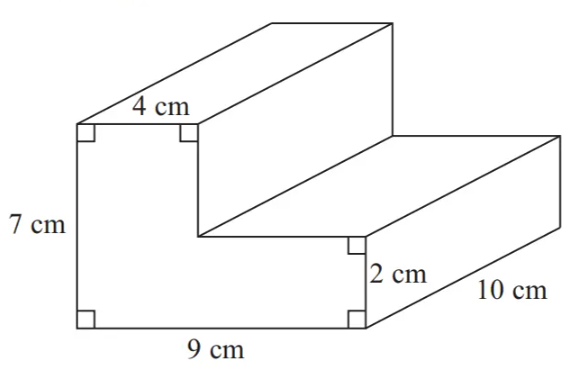
Work out the volume of the prism.
The volume is the area of the cross section × length (10 cm)
Find the area by splitting into a 7 × 4 and a (9 – 4) × 2 rectangle (or a 9 × 2 and a (7 – 2) × 4 rectangle)
7 × 4 + (9 – 4) × 2 = 38 cm2
Find the volume (by multiplying 38 by 10)
38 × 10
380 cm3
Responses