
Maths Gcse Wjec-Eduqas Foundation
-
Scatter-Graphs-And-Correlation Wjec-Eduqas Foundation2 主题
-
Statistical-Diagrams- Wjec-Eduqas Foundation7 主题
-
Comparing-Statistical-Diagrams Wjec-Eduqas Foundation
-
Reading-And-Interpreting-Statistical-Diagrams Wjec-Eduqas Foundation
-
Time-Series-Graphs- Wjec-Eduqas Foundation
-
Pie-Charts- Wjec-Eduqas Foundation
-
Frequency-Polygons Wjec-Eduqas Foundation
-
Bar-Charts-And-Pictograms- Wjec-Eduqas Foundation
-
Tally-Charts-And-Frequency-Tables Wjec-Eduqas Foundation
-
Comparing-Statistical-Diagrams Wjec-Eduqas Foundation
-
Statistics-Toolkit Wjec-Eduqas Foundation8 主题
-
Questionnaires Wjec-Eduqas Foundation
-
Population-And-Sampling Wjec-Eduqas Foundation
-
Comparing-Data-Sets- Wjec-Eduqas Foundation
-
Range Wjec-Eduqas Foundation
-
Averages-From-Grouped-Data Wjec-Eduqas Foundation
-
Averages-From-Tables- Wjec-Eduqas Foundation
-
Calculations-With-The-Mean Wjec-Eduqas Foundation
-
Mean-Median-And-Mode Wjec-Eduqas Foundation
-
Questionnaires Wjec-Eduqas Foundation
-
Tree-Diagrams-And-Combined-Probability Wjec-Eduqas Foundation2 主题
-
Simple-Probability-Diagrams- Wjec-Eduqas Foundation4 主题
-
Probability-Toolkit Wjec-Eduqas Foundation3 主题
-
Transformations Wjec-Eduqas Foundation4 主题
-
Vectors Wjec-Eduqas Foundation3 主题
-
Pythagoras-And-Trigonometry Wjec-Eduqas Foundation5 主题
-
Congruence-Similarity-And-Geometrical-Proof Wjec-Eduqas Foundation5 主题
-
Volume-And-Surface-Area- Wjec-Eduqas Foundation3 主题
-
Circles-Arcs-And-Sectors Wjec-Eduqas Foundation3 主题
-
Area-And-Perimeter Wjec-Eduqas Foundation4 主题
-
Bearings-Scale-Drawing-Constructions-And-Loci- Wjec-Eduqas Foundation5 主题
-
2D-And-3D-Shapes Wjec-Eduqas Foundation4 主题
-
Angles-In-Polygons-And-Parallel-Lines Wjec-Eduqas Foundation5 主题
-
Geometry-Toolkit Wjec-Eduqas Foundation4 主题
-
Exchange-Rates-And-Best-Buys Wjec-Eduqas Foundation2 主题
-
Standard-And-Compound-Units- Wjec-Eduqas Foundation5 主题
-
Direct-And-Inverse-Proportion- Wjec-Eduqas Foundation1 主题
-
Ratio-Problem-Solving- Wjec-Eduqas Foundation2 主题
-
Ratio-Toolkit Wjec-Eduqas Foundation3 主题
-
Sequences Wjec-Eduqas Foundation4 主题
-
Solving-Inequalities- Wjec-Eduqas Foundation3 主题
-
Real-Life-Graphs Wjec-Eduqas Foundation4 主题
-
Graphs-Of-Functions Wjec-Eduqas Foundation3 主题
-
Linear-Graphs Wjec-Eduqas Foundation3 主题
-
Coordinate-Geometry Wjec-Eduqas Foundation3 主题
-
Functions Wjec-Eduqas Foundation1 主题
-
Forming-And-Solving-Equations Wjec-Eduqas Foundation2 主题
-
Simultaneous-Equations Wjec-Eduqas Foundation1 主题
-
Solving-Quadratic-Equations- Wjec-Eduqas Foundation1 主题
-
Linear-Equations Wjec-Eduqas Foundation3 主题
-
Algebraic-Reasoning Wjec-Eduqas Foundation1 主题
-
Rearranging-Formulae Wjec-Eduqas Foundation1 主题
-
Factorising Wjec-Eduqas Foundation3 主题
-
Expanding-Brackets Wjec-Eduqas Foundation2 主题
-
Algebraic-Roots-And-Indices Wjec-Eduqas Foundation1 主题
-
Algebra-Toolkit Wjec-Eduqas Foundation4 主题
-
Using-A-Calculator Wjec-Eduqas Foundation1 主题
-
Exact-Values Wjec-Eduqas Foundation1 主题
-
Rounding-Estimation-And-Error-Intervals Wjec-Eduqas Foundation4 主题
-
Fractions-Decimals-And-Percentages Wjec-Eduqas Foundation2 主题
-
Simple-And-Compound-Interest-Growth-And-Decay Wjec-Eduqas Foundation4 主题
-
Percentages Wjec-Eduqas Foundation5 主题
-
Fractions Wjec-Eduqas Foundation6 主题
-
Multiplying-And-Dividing-Fractions Wjec-Eduqas Foundation
-
Adding-And-Subtracting-Fractions- Wjec-Eduqas Foundation
-
Mixed-Numbers-And-Improper-Fractions Wjec-Eduqas Foundation
-
Equivalent-And-Simplified-Fractions Wjec-Eduqas Foundation
-
Fractions-Of-Amounts Wjec-Eduqas Foundation
-
Introduction-To-Fractions Wjec-Eduqas Foundation
-
Multiplying-And-Dividing-Fractions Wjec-Eduqas Foundation
-
Powers-Roots-And-Standard-Form Wjec-Eduqas Foundation4 主题
-
Types-Of-Number-Prime-Factors-Hcf-And-Lcm- Wjec-Eduqas Foundation6 主题
-
Number-Toolkit Wjec-Eduqas Foundation9 主题
-
Counting-Principles Wjec-Eduqas Foundation
-
Related-Calculations- Wjec-Eduqas Foundation
-
Multiplication-And-Division Wjec-Eduqas Foundation
-
Addition-And-Subtraction Wjec-Eduqas Foundation
-
Money-Calculations- Wjec-Eduqas Foundation
-
Negative-Numbers- Wjec-Eduqas Foundation
-
Place-Value Wjec-Eduqas Foundation
-
Order-Of-Operations-Bidmasbodmas Wjec-Eduqas Foundation
-
Mathematical-Operations Wjec-Eduqas Foundation
-
Counting-Principles Wjec-Eduqas Foundation
Rates-Of-Change-Of-Graphs Wjec-Eduqas Foundation
Exam code:C300
Rates of change of graphs
What is a rate-of-change graph?
-
A rate-of-change graph usually shows how a variable changes with time
-
The following are examples of rates-of-change graphs:
-
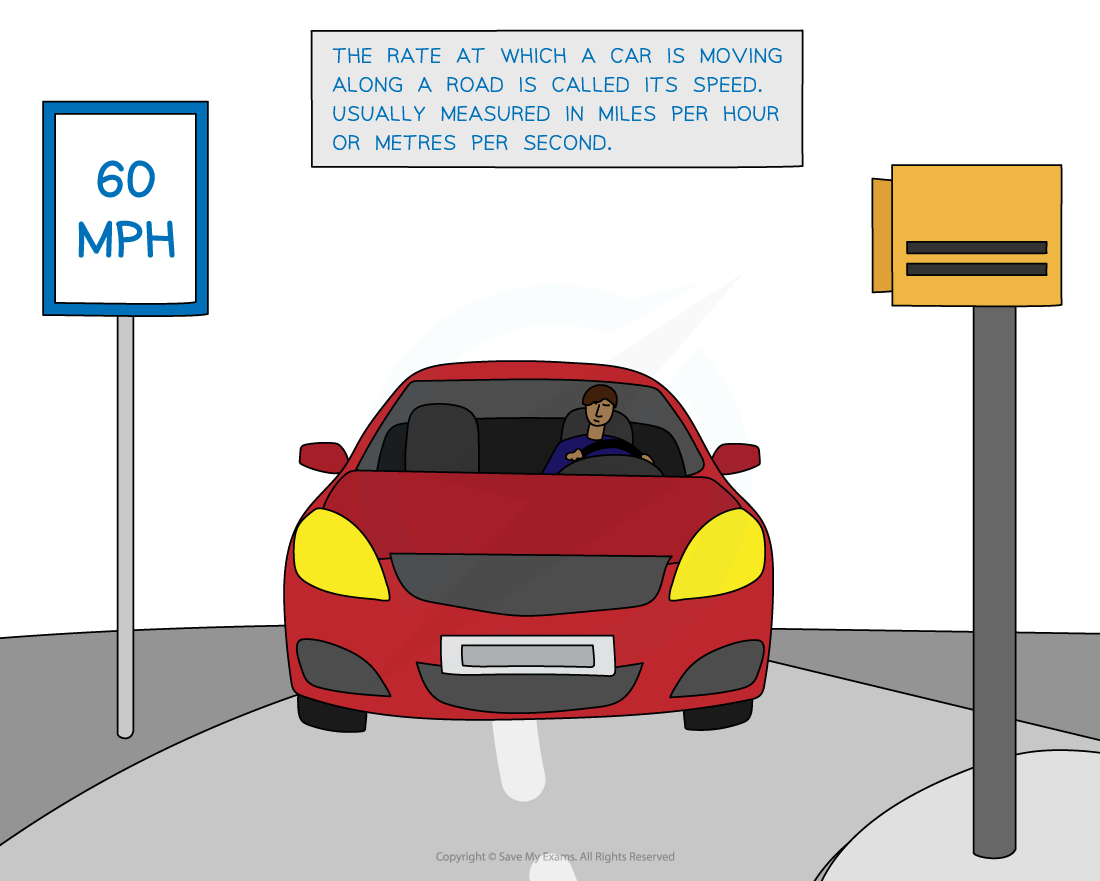
Speed against time
-
Speed is the rate of change of distance as time increases
-
-
Acceleration against time
-
Acceleration is the rate of change of velocity as time increases
-
-
The depth of water against time (e.g. in a container as it is filled with water)
-
Can rates-of-change graphs not be against time?
-
More generally, rate-of-change graphs can show any two different variables plotted against each other, not just time
-
E.g. the volume of air inside an inflating balloon plotted against the balloon’s radius
-
This shows the rate of change of volume as radius increases
-
-
E.g. the number of ice-creams sold plotted against the weather temperature
-
This shows the rate of change of number of ice-creams as temperature increases
-
-
How can I use gradients to find rates of change?
-
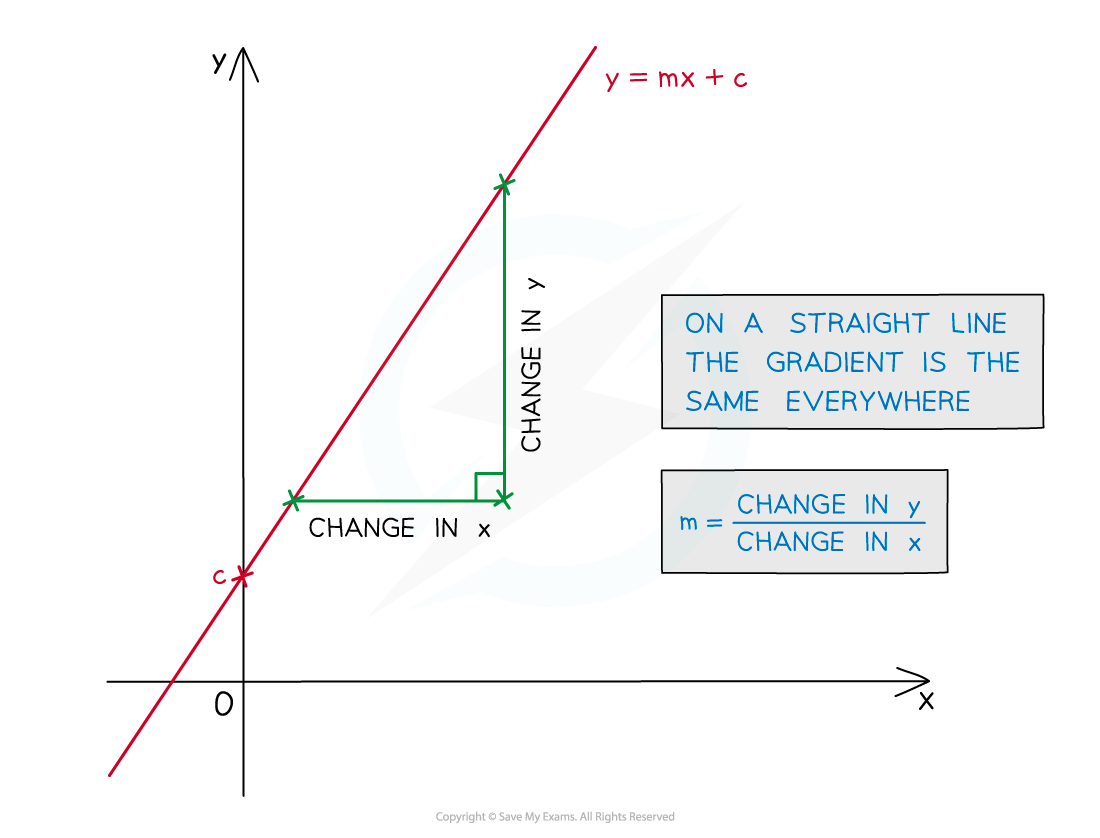
The gradient of the graph of y against x represents:
-
the amount of change in y for every 1 unit of increase in the x-direction
-
This is the amount of y per unit of x
-
-
This is called the rate of change of y against x
-
-
The units of gradients are the units of the y-axis, divided by the units of the x-axis
-
E.g. If the graph shows volume in cm3 on the y-axis and time in seconds on the x-axis, the rate of change is measured in cm3/s (or cm3s-1)
-
-
If the graph is a straight line the rate of change is constant
-
If the graph is horizontal, the rate of change is zero
-
y is not changing as x changes
-
-
How can I use tangents to find rates of change?
-
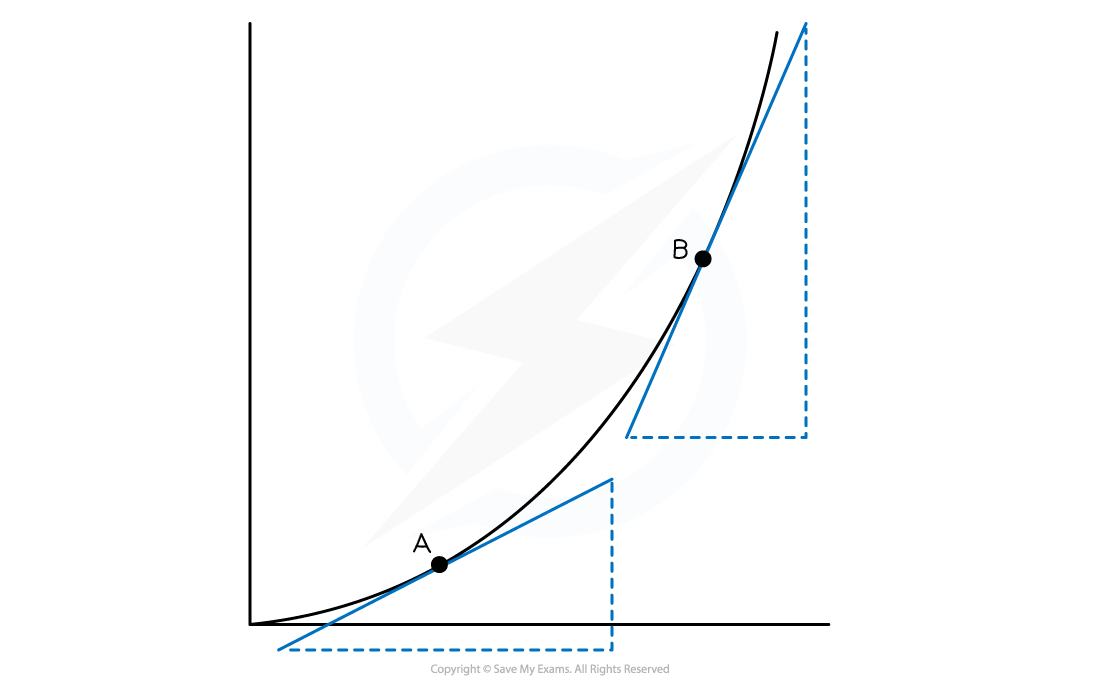
If the graph is a curve, you can draw a tangent at a point on the graph and find its gradient
-
This will be an estimate of the rate of change of y against x
-
-
The rate of change is greater when the graph is steeper
-
In the below image
-
tangents drawn at points A and B show the graph is steeper at B
-
therefore the rate of change at B is greater
-
-
-
On a distance-time graph, a tangent at a point on the curve can be used to estimate the velocity at that particular time
-
On a speed-time graph, a tangent at a point on the curve can be used to estimate the acceleration at that particular time
Examiner Tips and Tricks
-
The units of the gradient can help you understand what is happening in the context of an exam question
-
For example, if the y-axis is in dollars and the x-axis is in hours, the gradient represents the change in dollars per hour
-
Worked Example
(a) Each of the graphs below show the depth of water, d cm, in different containers that are being filled from a running tap of water.
Match each of the graphs 1, 2, 3, 4 with the containers A, B, C, D.
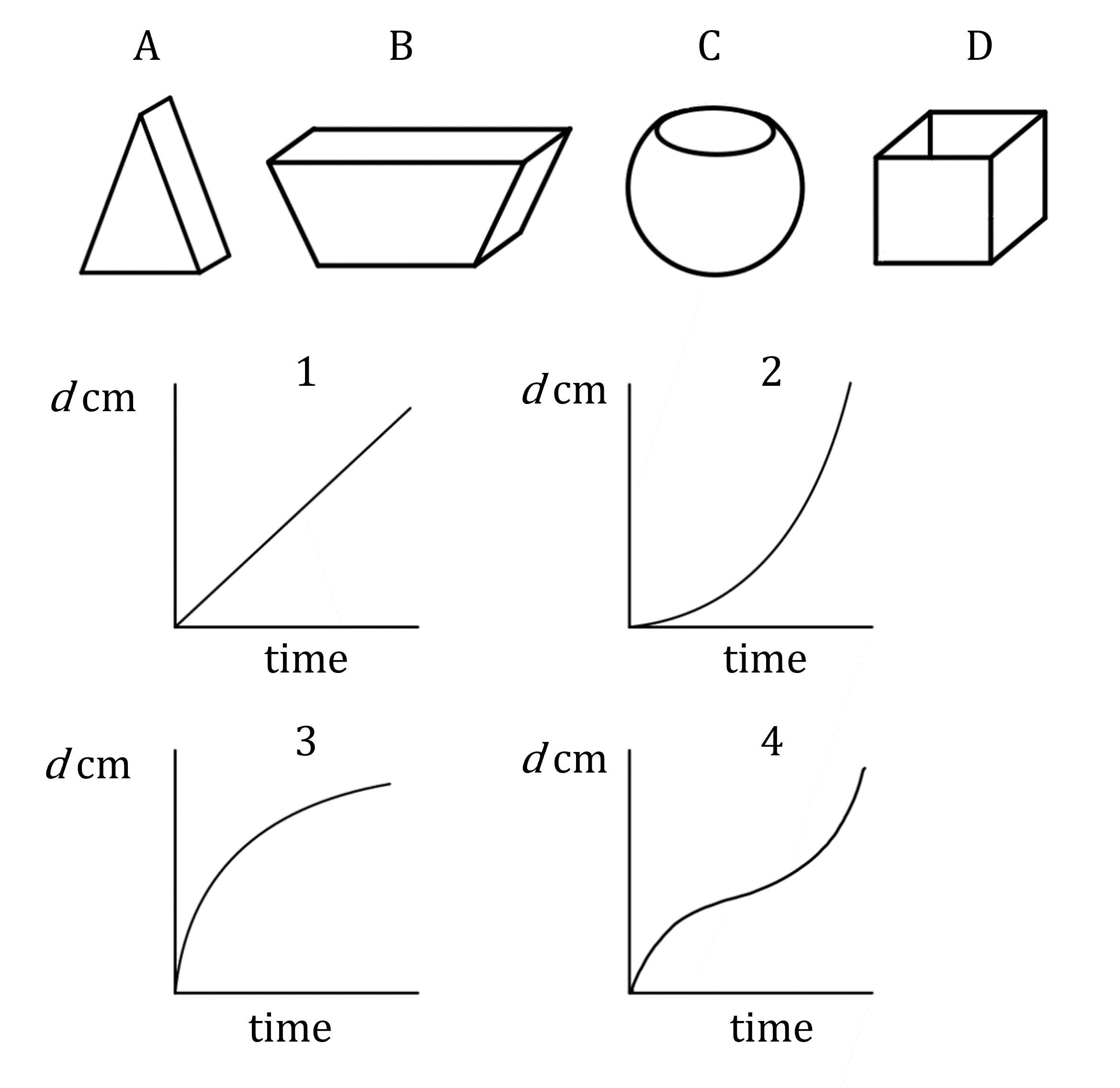
Considering graph 1: the gradient is constant
This means the rate of change is constant
So the depth increases at the same rate throughout
This matches container D which has vertical sides, so depth increases uniformly
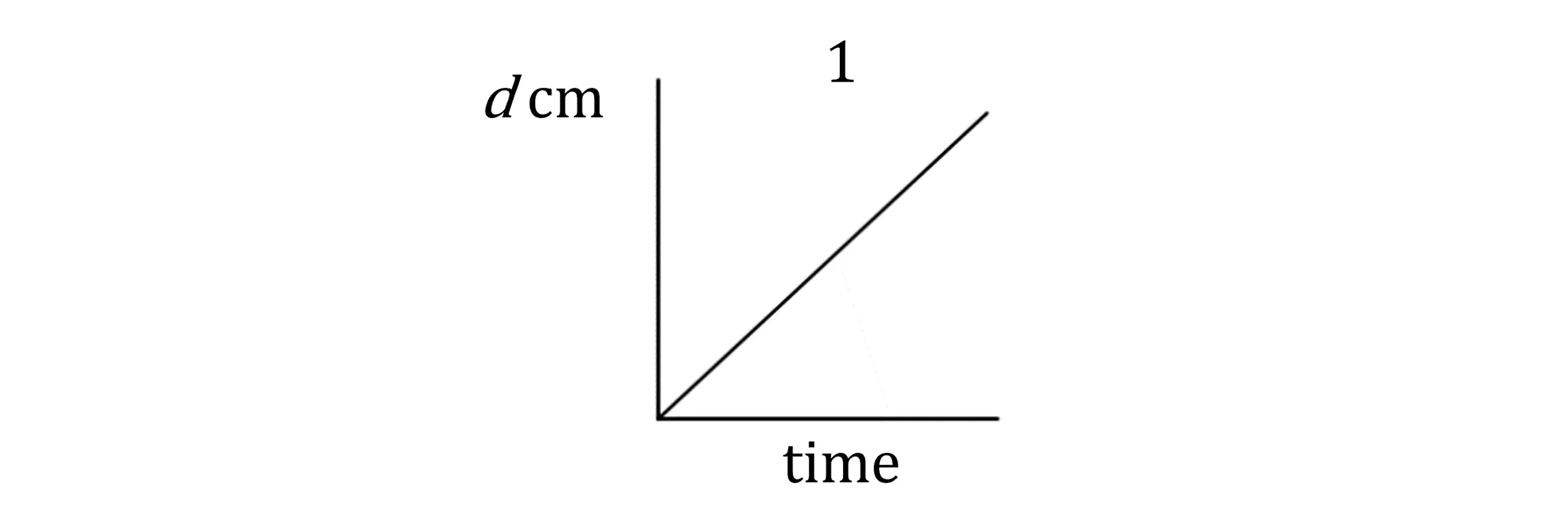
Graph 1 is container D
Considering graph 2: the gradient starts shallow and becomes steeper, meaning that the depth increases faster and faster at the end
This matches container A, which gets narrower towards the top, causing the depth to increase faster at the end
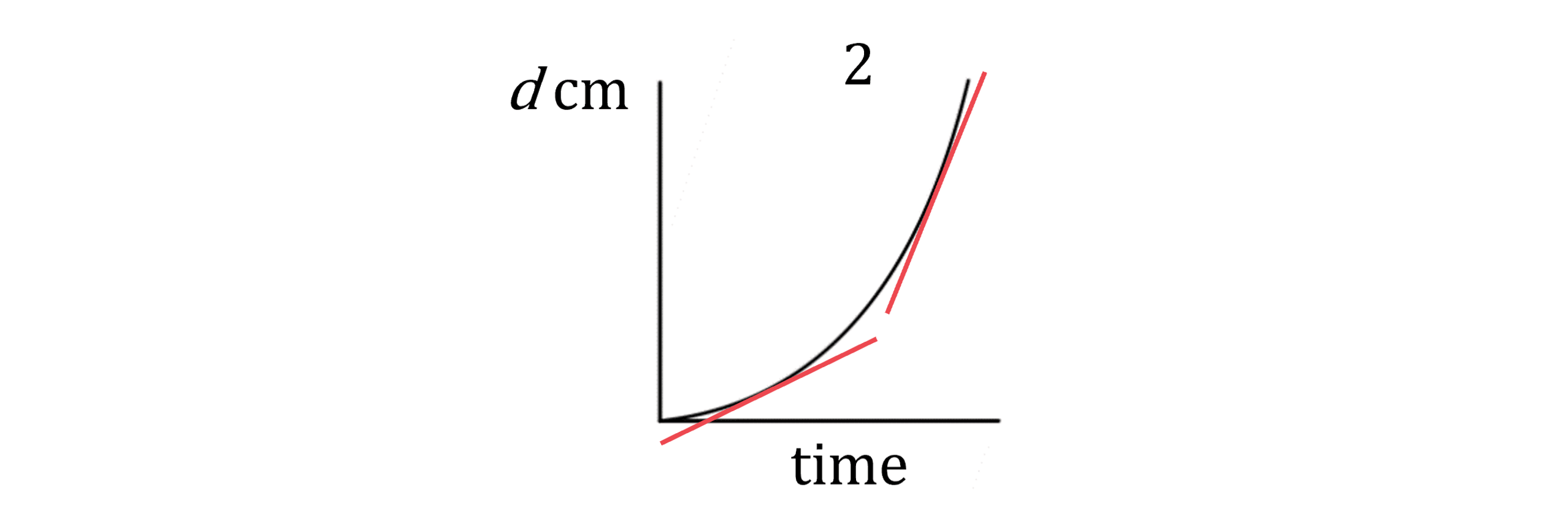
Graph 2 is container A
Considering graph 3: the gradient starts steep and becomes shallower, meaning that the depth increases at a slower and slower rate as time increases
This matches container B, which gets wider towards the top, causing the depth to increase more slowly at the end
Responses