
Maths Gcse Aqa Higher
-
Scatter-Graphs-And-Correlation Aqa Higher2 主题
-
Cumulative-Frequency-And-Box-Plots Aqa Higher4 主题
-
Histograms Aqa Higher3 主题
-
Statistical-Diagrams Aqa Higher5 主题
-
Averages-Ranges-And-Data Aqa Higher7 主题
-
Combined-And-Conditional-Probability Aqa Higher3 主题
-
Tree-Diagrams Aqa Higher1 主题
-
Simple-Probability-Diagrams Aqa Higher3 主题
-
Transformations Aqa Higher5 主题
-
Vectors Aqa Higher6 主题
-
3D-Pythagoras-And-Trigonometry Aqa Higher1 主题
-
Sine-Cosine-Rule-And-Area-Of-Triangles Aqa Higher4 主题
-
Pythagoras-And-Trigonometry Aqa Higher4 主题
-
Area-And-Volume-Of-Similar-Shapes Aqa Higher1 主题
-
Congruence-Similarity-And-Geometrical-Proof Aqa Higher5 主题
-
Volume-And-Surface-Area Aqa Higher3 主题
-
Circles-Arcs-And-Sectors Aqa Higher2 主题
-
Area-And-Perimeter Aqa Higher4 主题
-
Circle-Theorems Aqa Higher7 主题
-
Bearings-Scale-Drawing-Constructions-And-Loci Aqa Higher5 主题
-
Angles-In-Polygons-And-Parallel-Lines Aqa Higher3 主题
-
Symmetry-And-Shapes Aqa Higher6 主题
-
Exchange-Rates-And-Best-Buys Aqa Higher2 主题
-
Standard-And-Compound-Units Aqa Higher5 主题
-
Direct-And-Inverse-Proportion Aqa Higher2 主题
-
Problem-Solving-With-Ratios Aqa Higher2 主题
-
Ratios Aqa Higher3 主题
-
Sequences Aqa Higher4 主题
-
Transformations-Of-Graphs Aqa Higher2 主题
-
Graphing-Inequalities Aqa Higher2 主题
-
Solving-Inequalities Aqa Higher2 主题
-
Real-Life-Graphs Aqa Higher4 主题
-
Estimating-Gradients-And-Areas-Under-Graphs Aqa Higher2 主题
-
Equation-Of-A-Circle Aqa Higher2 主题
-
Functions Aqa Higher3 主题
-
Forming-And-Solving-Equations Aqa Higher3 主题
-
Graphs-Of-Functions Aqa Higher6 主题
-
Linear-Graphs Aqa Higher4 主题
-
Coordinate-Geometry Aqa Higher4 主题
-
Iteration Aqa Higher1 主题
-
Simultaneous-Equations Aqa Higher2 主题
-
Quadratic-Equations Aqa Higher4 主题
-
Linear-Equations Aqa Higher1 主题
-
Algebraic-Proof Aqa Higher1 主题
-
Rearranging-Formulas Aqa Higher2 主题
-
Algebraic-Fractions Aqa Higher4 主题
-
Completing-The-Square Aqa Higher1 主题
-
Factorising Aqa Higher6 主题
-
Expanding-Brackets Aqa Higher3 主题
-
Algebraic-Roots-And-Indices Aqa Higher1 主题
-
Using-A-Calculator Aqa Higher1 主题
-
Surds Aqa Higher2 主题
-
Rounding-Estimation-And-Bounds Aqa Higher2 主题
-
Fractions-Decimals-And-Percentages Aqa Higher3 主题
-
Introduction Aqa Higher7 主题
-
Simple-And-Compound-Interest-Growth-And-Decay Aqa Higher4 主题
-
Percentages Aqa Higher3 主题
-
Fractions Aqa Higher4 主题
-
Powers-Roots-And-Standard-Form Aqa Higher4 主题
-
Prime-Factors-Hcf-And-Lcm Aqa Higher4 主题
-
Number-Operations Aqa Higher10 主题
-
Product-Rule-For-Counting Aqa Higher
-
Systematic-Lists Aqa Higher
-
Related-Calculations Aqa Higher
-
Multiplication-And-Division Aqa Higher
-
Addition-And-Subtraction Aqa Higher
-
Money-Calculations Aqa Higher
-
Negative-Numbers Aqa Higher
-
Irrational-Numbers Aqa Higher
-
Order-Of-Operations-Bidmas-Bodmas Aqa Higher
-
Mathematical-Symbols Aqa Higher
-
Product-Rule-For-Counting Aqa Higher
Enlargements Aqa Higher
Exam code:8300
Enlargements
What is an enlargement?
-
An enlargement changes the size and position of a shape
-
The length of each side of the shape is multiplied by a scale factor
-
If the scale factor is greater than 1 then the enlarged image will be bigger than the original object
-
If the scale factor is between 0 and 1 (fractional) then the enlarged image will be smaller than the original object
-
-
The centre of enlargement determines the position of the enlarged image
-
If the scale factor is greater than 1 then the enlarged image will be further away from the centre of enlargement
-
If the scale factor is between 0 and 1 then the enlarged image will be closer to the centre of enlargement
-
How do I enlarge a shape?
-
STEP 1
Pick a vertex of the shape and count the horizontal and vertical distances from the centre of enlargement
-
STEP 2
Multiply both the horizontal and vertical distances by the given scale factor -
STEP 3
Start at the centre of enlargement and measure the new distances to find the enlarged vertex -
STEP 4
Repeat the steps for the other vertices-
You might be able to draw the enlarged shape from the first vertex by multiplying the original lengths by the scale factor
-
This can be done quickly if the shape is made up of vertical and horizontal lines
-
-
-
STEP 5
Connect the vertices on the enlarged image and label it
How do I describe an enlargement?
-
To describe an enlargement, you must:
-
State that the transformation is an enlargement
-
State the scale factor
-
This may be an integer or a fraction
-
-
Give the coordinates of the centre of enlargement
-
-
To find the scale factor:
-
Pick a side of the original shape
-
Identify the corresponding side on the enlarged image
-
For a fractional enlargement, the side on the enlarged image will be smaller than the corresponding side on the original image
-
-
Divide the length of the enlarged side by the length of the original side
-
-
To find the centre of enlargement:
-
Pick a vertex of the original shape
-
Identify the corresponding vertex on the enlarged image
-
Draw a line going through these two vertices
-
Repeat this for the other vertices of the original shape
-
These lines will intersect at the centre of enlargement
-
How do I reverse an enlargement?
-
If a shape has been enlarged, you can perform a single transformation to return the shape to its original size and position
-
An enlargement can be reversed by multiplying the enlarged shape by the reciprocal of the original scale factor
-
The centre of enlargement is the same
-
-
For a shape enlarged by a scale factor of 3 with centre of enlargement (-1, 6)
-
The reverse transformation is
-
an enlargement of scale factor

-
with centre of enlargement (-1, 6)
-
-
Examiner Tips and Tricks
-
To check that you have enlarged a shape correctly:
-
Draw lines going from the centre of enlargement to each of the vertices of the original shape
-
Extend these lines
-
The lines should go through the corresponding vertices of the enlarged image
-
Worked Example
(a) On the grid below enlarge shape C using scale factor 2 and centre of enlargement (2, 1).
Label your enlarged shape C’.
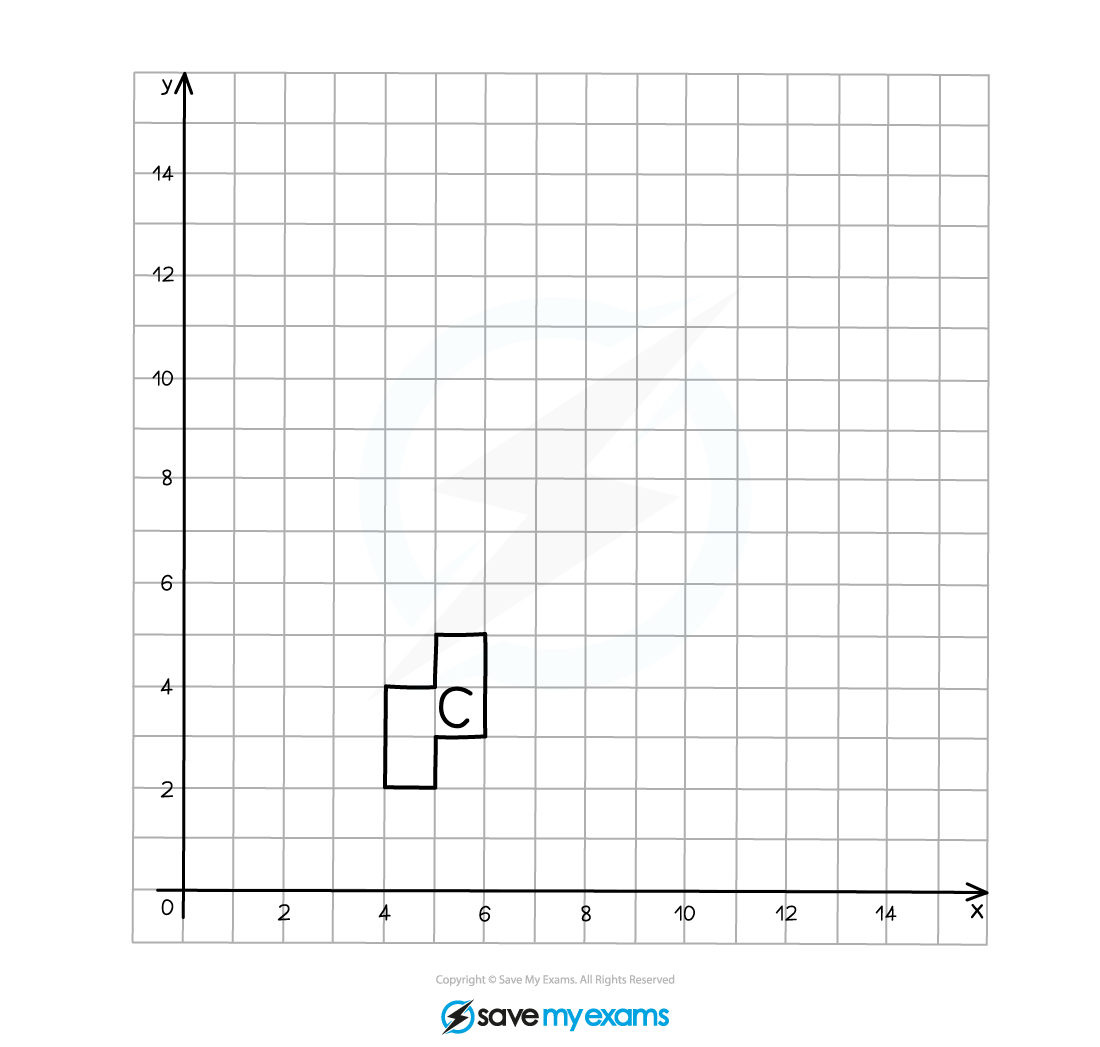
Start by marking on the centre of enlargement (CoE)
Count the number of squares in both a horizontal and vertical direction to go from the CoE to one of the vertices on the original object, this is 2 to the right and 3 up in this example
As the scale factor is 2, multiply these distances by 2, so they become 4 to the right and 6 up
Count these new distances from the CoE to the corresponding point on the enlarged image and mark it on
Draw a line through the CoE and the pair of corresponding points, they should line up in a straight line
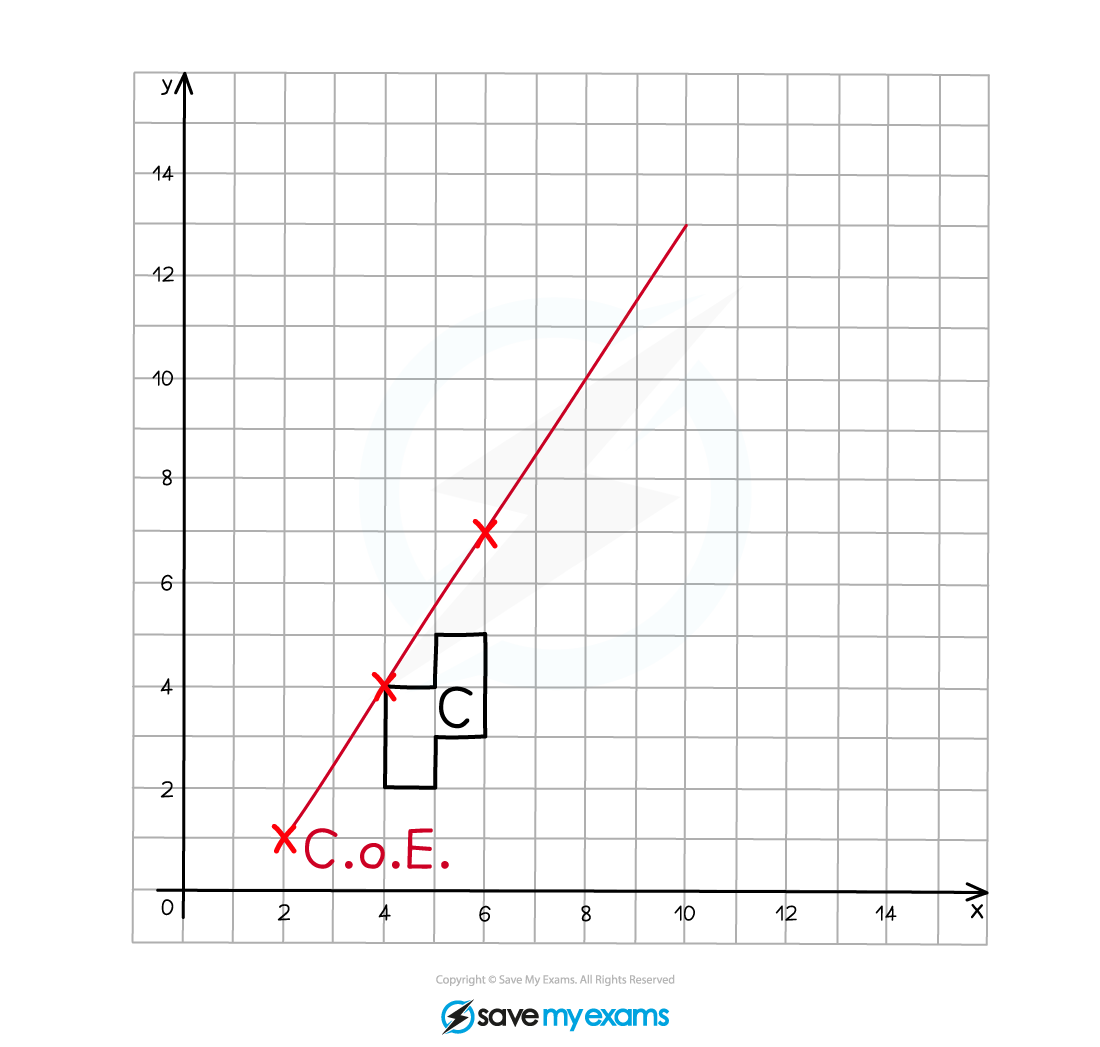
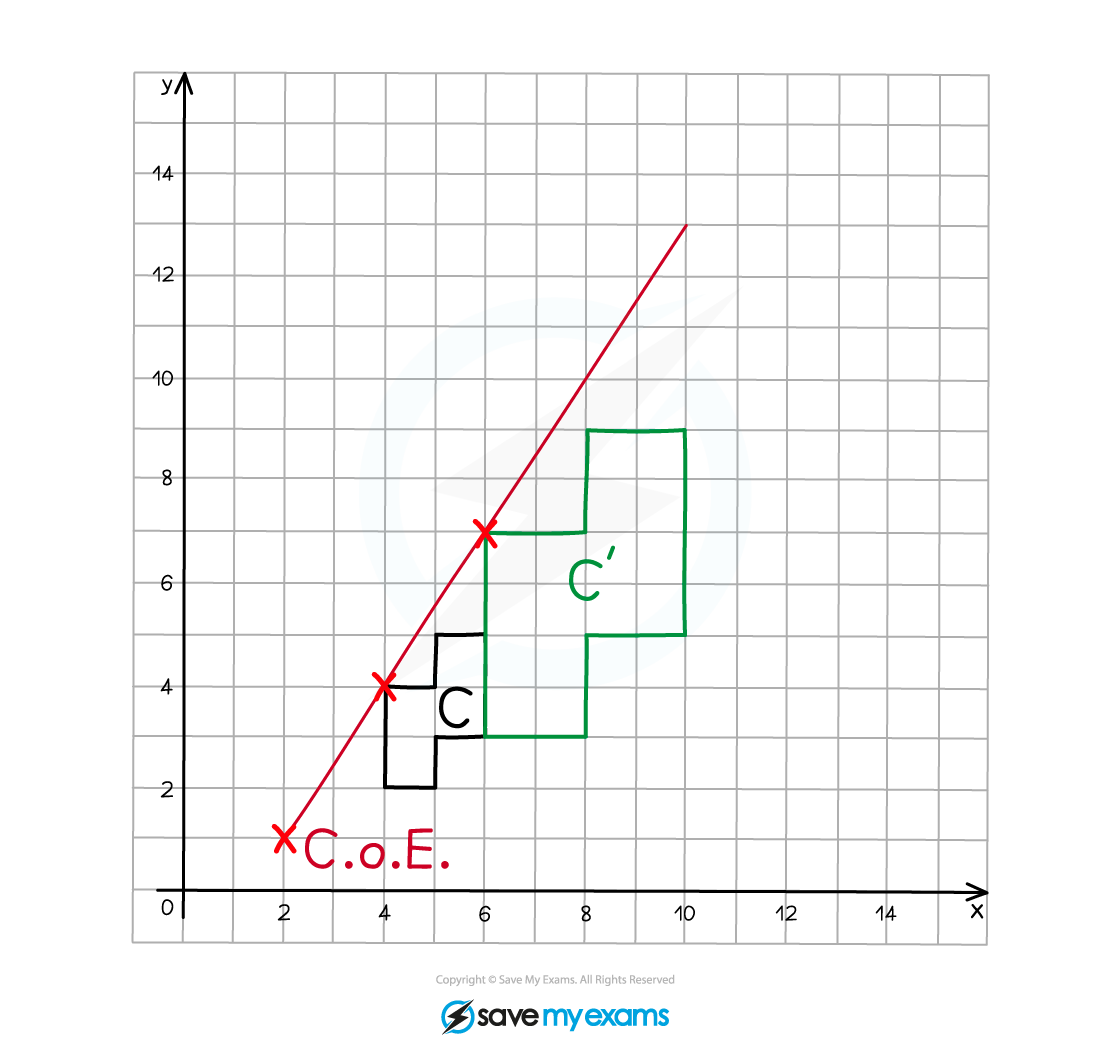
Repeat this process for each of the vertices on the original object (or at least 2)
Join adjacent vertices on the enlarged image as you go
Label the enlarged image C’
(b) Describe fully the single transformation that creates shape B from shape A.
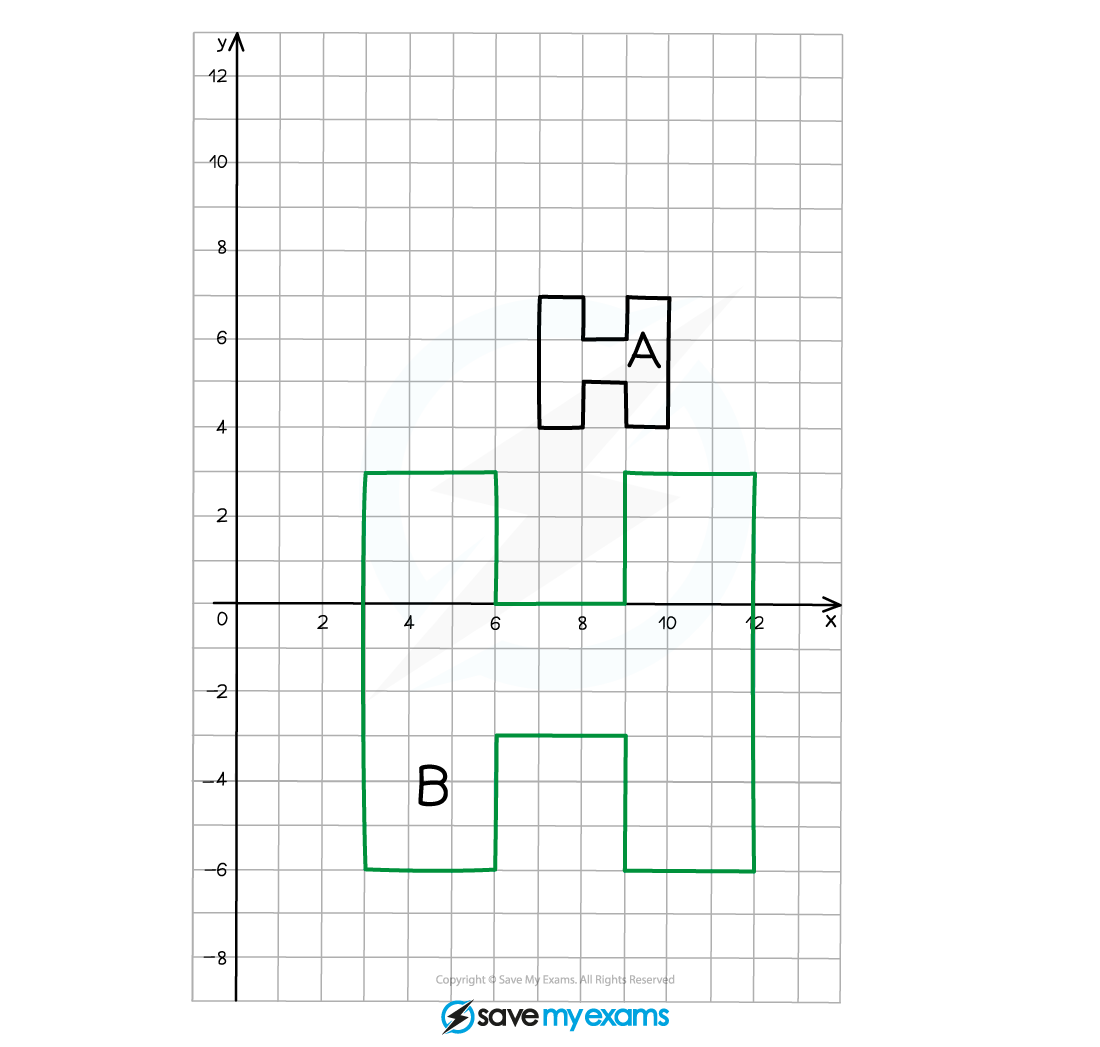
We can see that the image is larger than the original object, therefore it must be an enlargement
As the enlarged image is bigger than the original object, the scale factor must be greater than 1
Compare two corresponding edges on the object and the image to find the scale factor
The height of the original “H” is 3 squares
The height of the enlarged “H” is 9 squares
<img alt=”therefore Scale space Factor space equals 9 over 3 equals 3″ data-mathml='<math ><semantics><mrow><mo >∴</mo><mi >Scale</mi><mo > </mo><mi >Factor</mi><mo > </mo><mo >=</mo><mfrac ><mn>9</mn><mn>3</mn></mfrac><mo >=</mo><mn >3</mn></mrow><annotation encoding=”application/vnd.wiris.mtweb-params+json”>{“language”:”en”,”fontFamily”:”Times New Roman”,”fontSize”:”18″,”autoformat”:true}</annotation></semantics></math>’ data-type=”working” height=”47″ role=”math” src=”data:image/svg+xml;charset=utf8,%3Csvg%20xmlns%3D%22http%3A%2F%2Fwww.w3.org%2F2000%2Fsvg%22%20xmlns%3Awrs%3D%22http%3A%2F%2Fwww.wiris.com%2Fxml%2Fmathml-extension%22%20height%3D%2247%22%20width%3D%22171%22%20wrs%3Abaseline%3D%2230%22%3E%3C!–MathML%3A%20%3Cmath%20xmlns%3D%22http%3A%2F%2Fwww.w3.org%2F1998%2FMath%2FMathML%22%3E%3Cmo%20mathcolor%3D%22%23000000%22%3E%26%23×2234%3B%3C%2Fmo%3E%3Cmi%20mathcolor%3D%22%23000000%22%3EScale%3C%2Fmi%3E%3Cmo%20mathcolor%3D%22%23000000%22%3E%26%23xA0%3B%3C%2Fmo%3E%3Cmi%20mathcolor%3D%22%23000000%22%3EFactor%3C%2Fmi%3E%3Cmo%20mathcolor%3D%22%23000000%22%3E%26%23xA0%3B%3C%2Fmo%3E%3Cmo%20mathcolor%3D%22%23000000%22%3E%3D%3C%2Fmo%3E%3Cmfrac%20mathcolor%3D%22%23000000%22%3E%3Cmn%3E9%3C%2Fmn%3E%3Cmn%3E3%3C%2Fmn%3E%3C%2Fmfrac%3E%3Cmo%20mathcolor%3D%22%23000000%22%3E%3D%3C%2Fmo%3E%3Cmn%20mathcolor%3D%22%23000000%22%3E3%3C%2Fmn%3E%3C%2Fmath%3E–%3E%3Cdefs%3E%3Cstyle%20type%3D%22text%2Fcss%22%3E%40font-face%7Bfont-family%3A’math1f0b57a9ccae93e289fb2a26cc8’%3Bsrc%3Aurl(data%3Afont%2Ftruetype%3Bcharset%3Dutf-8%3Bbase64%2CAAEAAAAMAIAAAwBAT1MvMi7iBBMAAADMAAAATmNtYXDEvmKUAAABHAAAADxjdnQgDVUNBwAAAVgAAAA6Z2x5ZoPi2VsAAAGUAAABL2hlYWQQC2qxAAACxAAAADZoaGVhCGsXSAAAAvwAAAAkaG10eE2rRkcAAAMgAAAADGxvY2EAHTwYAAADLAAAABBtYXhwBT0FPgAAAzwAAAAgbmFtZaBxlY4AAANcAAABn3Bvc3QB9wD6AAAE%2FAAAACBwcmVwa1uragAABRwAAAAUAAADSwGQAAUAAAQABAAAAAAABAAEAAAAAAAAAQEAAAAAAAAAAAAAAAAAAAAAAAAAAAAAAAAAAAAAACAgICAAAAAg1UADev96AAAD6ACWAAAAAAACAAEAAQAAABQAAwABAAAAFAAEACgAAAAGAAQAAQACAD0iNP%2F%2FAAAAPSI0%2F%2F%2F%2FxN3OAAEAAAAAAAAAAAFUAywAgAEAAFYAKgJYAh4BDgEsAiwAWgGAAoAAoADUAIAAAAAAAAAAKwBVAIAAqwDVAQABKwAHAAAAAgBVAAADAAOrAAMABwAAMxEhESUhESFVAqv9qwIA%2FgADq%2FxVVQMAAAIAgADrAtUCFQADAAcAZRgBsAgQsAbUsAYQsAXUsAgQsAHUsAEQsADUsAYQsAc8sAUQsAQ8sAEQsAI8sAAQsAM8ALAIELAG1LAGELAH1LAHELAB1LABELAC1LAGELAFPLAHELAEPLABELAAPLACELADPDEwEyE1IR0BITWAAlX9qwJVAcBV1VVVAAMAbAArAusCQAADAAcACwBNGAGwDBCwBNSwBBCwBtSwBBCwAtSwAhCwANSwBRCwC9SwCxCwCdQAsAwQsAfUsAcQsAXUsAcQsALUsAIQsADUsAIQsAs8sAAQsAg8MDE3MzUjATM1IxMzNSNsgIABAICA%2F4CAK4ABFYD964AAAAEAAAABAADVeM5BXw889QADBAD%2F%2F%2F%2F%2F1joTc%2F%2F%2F%2F%2F%2FWOhNzAAD%2FIASAA6sAAAAKAAIAAQAAAAAAAQAAA%2Bj%2FagAAF3AAAP%2B2BIAAAQAAAAAAAAAAAAAAAAAAAAMDUgBVA1YAgANVAGwAAAAAAAAAKAAAALIAAAEvAAEAAAADAF4ABQAAAAAAAgCABAAAAAAABAAA3gAAAA
Responses