
Maths Gcse Aqa Higher
-
Scatter-Graphs-And-Correlation Aqa Higher2 主题
-
Cumulative-Frequency-And-Box-Plots Aqa Higher4 主题
-
Histograms Aqa Higher3 主题
-
Statistical-Diagrams Aqa Higher5 主题
-
Averages-Ranges-And-Data Aqa Higher7 主题
-
Combined-And-Conditional-Probability Aqa Higher3 主题
-
Tree-Diagrams Aqa Higher1 主题
-
Simple-Probability-Diagrams Aqa Higher3 主题
-
Transformations Aqa Higher5 主题
-
Vectors Aqa Higher6 主题
-
3D-Pythagoras-And-Trigonometry Aqa Higher1 主题
-
Sine-Cosine-Rule-And-Area-Of-Triangles Aqa Higher4 主题
-
Pythagoras-And-Trigonometry Aqa Higher4 主题
-
Area-And-Volume-Of-Similar-Shapes Aqa Higher1 主题
-
Congruence-Similarity-And-Geometrical-Proof Aqa Higher5 主题
-
Volume-And-Surface-Area Aqa Higher3 主题
-
Circles-Arcs-And-Sectors Aqa Higher2 主题
-
Area-And-Perimeter Aqa Higher4 主题
-
Circle-Theorems Aqa Higher7 主题
-
Bearings-Scale-Drawing-Constructions-And-Loci Aqa Higher5 主题
-
Angles-In-Polygons-And-Parallel-Lines Aqa Higher3 主题
-
Symmetry-And-Shapes Aqa Higher6 主题
-
Exchange-Rates-And-Best-Buys Aqa Higher2 主题
-
Standard-And-Compound-Units Aqa Higher5 主题
-
Direct-And-Inverse-Proportion Aqa Higher2 主题
-
Problem-Solving-With-Ratios Aqa Higher2 主题
-
Ratios Aqa Higher3 主题
-
Sequences Aqa Higher4 主题
-
Transformations-Of-Graphs Aqa Higher2 主题
-
Graphing-Inequalities Aqa Higher2 主题
-
Solving-Inequalities Aqa Higher2 主题
-
Real-Life-Graphs Aqa Higher4 主题
-
Estimating-Gradients-And-Areas-Under-Graphs Aqa Higher2 主题
-
Equation-Of-A-Circle Aqa Higher2 主题
-
Functions Aqa Higher3 主题
-
Forming-And-Solving-Equations Aqa Higher3 主题
-
Graphs-Of-Functions Aqa Higher6 主题
-
Linear-Graphs Aqa Higher4 主题
-
Coordinate-Geometry Aqa Higher4 主题
-
Iteration Aqa Higher1 主题
-
Simultaneous-Equations Aqa Higher2 主题
-
Quadratic-Equations Aqa Higher4 主题
-
Linear-Equations Aqa Higher1 主题
-
Algebraic-Proof Aqa Higher1 主题
-
Rearranging-Formulas Aqa Higher2 主题
-
Algebraic-Fractions Aqa Higher4 主题
-
Completing-The-Square Aqa Higher1 主题
-
Factorising Aqa Higher6 主题
-
Expanding-Brackets Aqa Higher3 主题
-
Algebraic-Roots-And-Indices Aqa Higher1 主题
-
Using-A-Calculator Aqa Higher1 主题
-
Surds Aqa Higher2 主题
-
Rounding-Estimation-And-Bounds Aqa Higher2 主题
-
Fractions-Decimals-And-Percentages Aqa Higher3 主题
-
Introduction Aqa Higher7 主题
-
Simple-And-Compound-Interest-Growth-And-Decay Aqa Higher4 主题
-
Percentages Aqa Higher3 主题
-
Fractions Aqa Higher4 主题
-
Powers-Roots-And-Standard-Form Aqa Higher4 主题
-
Prime-Factors-Hcf-And-Lcm Aqa Higher4 主题
-
Number-Operations Aqa Higher10 主题
-
Product-Rule-For-Counting Aqa Higher
-
Systematic-Lists Aqa Higher
-
Related-Calculations Aqa Higher
-
Multiplication-And-Division Aqa Higher
-
Addition-And-Subtraction Aqa Higher
-
Money-Calculations Aqa Higher
-
Negative-Numbers Aqa Higher
-
Irrational-Numbers Aqa Higher
-
Order-Of-Operations-Bidmas-Bodmas Aqa Higher
-
Mathematical-Symbols Aqa Higher
-
Product-Rule-For-Counting Aqa Higher
2D-Shapes Aqa Higher
Exam code:8300
Properties of 2D shapes
What are the names of common 2D shapes?
-
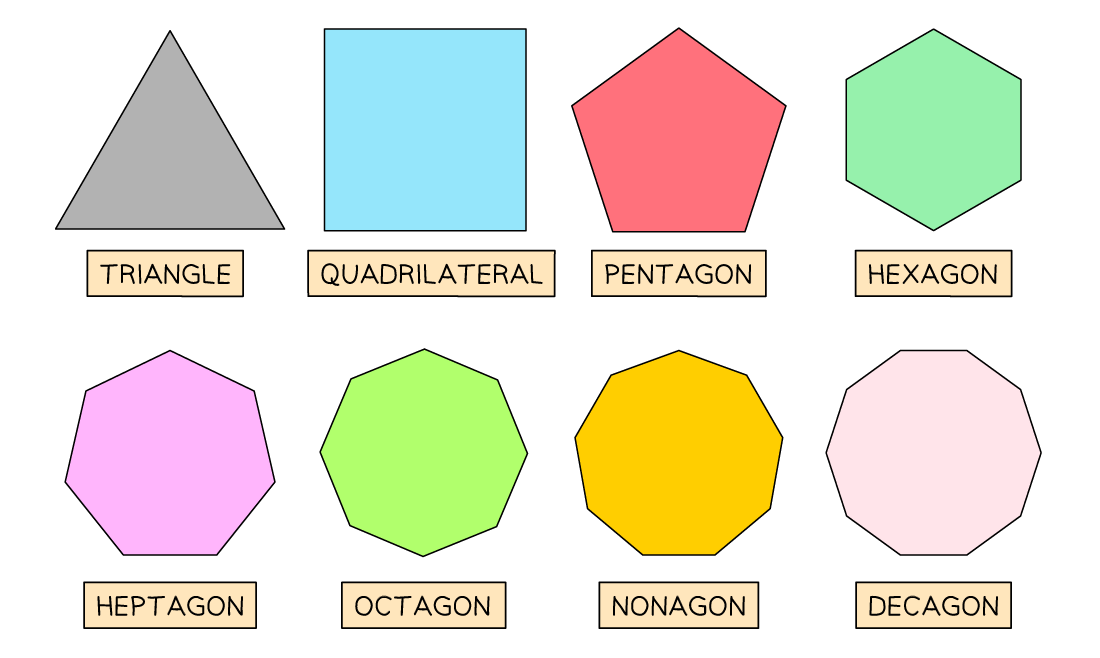
You should know the general names of all the 2D polygons
-
A triangle has 3 sides
-
A quadrilateral has 4 sides
-
A pentagon has 5 sides
-
A hexagon has 6 sides
-
A heptagon has 7 sides
-
An octagon has 8 sides
-
A nonagon has 9 sides
-
A decagon has 10 sides
-
A polygon is a flat (plane) shape with n straight sides
-
A regular polygon has all sides the same length and all angles the same size
-
-
What are the names of the different types of triangles?
-
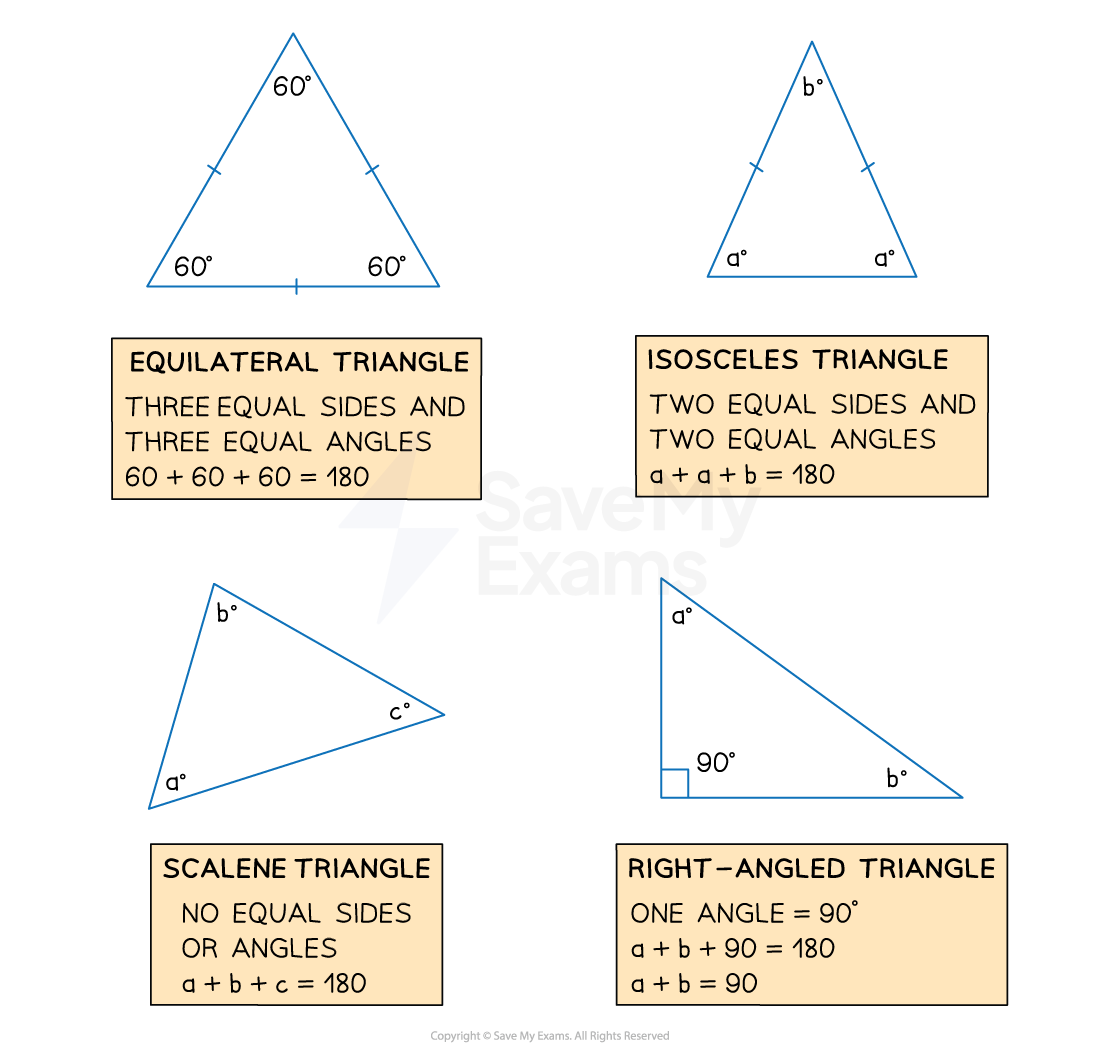
You should know the names and properties of the different types of triangles
-
An equilateral triangle has 3 equal sides and 3 equal angles
-
An isosceles triangle has 2 equal sides and 2 equal angles
-
A right-angled triangle has one 90° angle
-
A scalene triangle has 3 sides all of different lengths
-
What are the names of the different types of quadrilaterals?
-
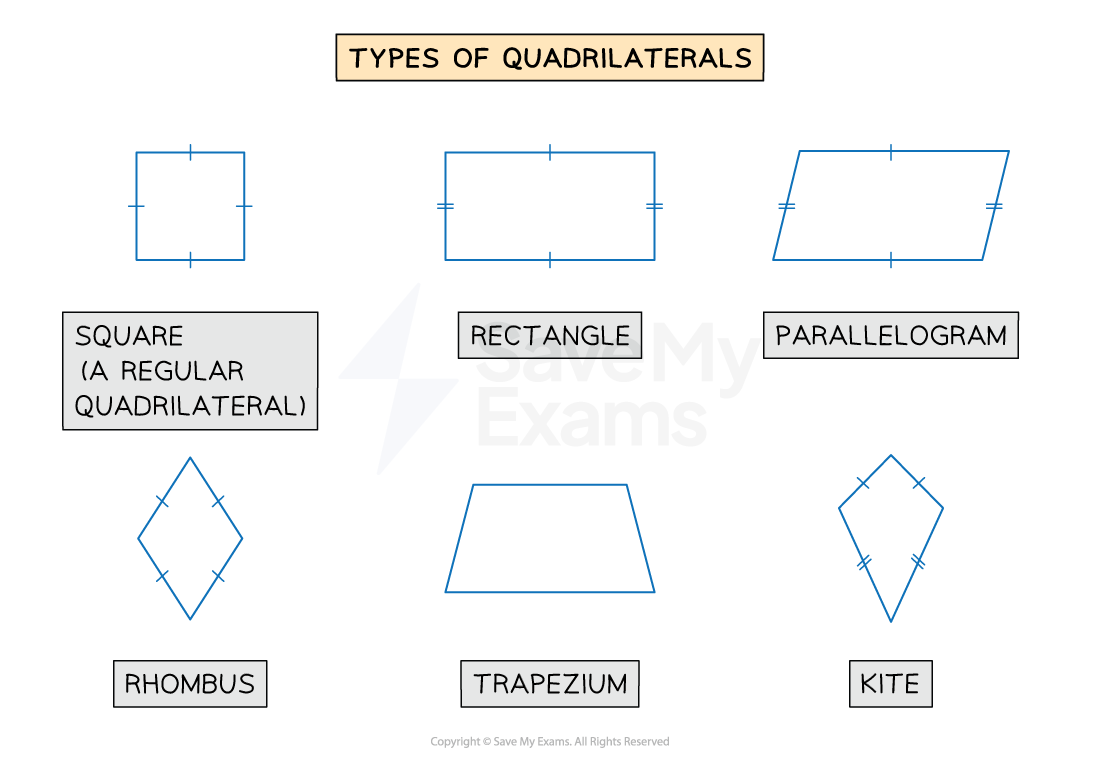
You should know the names and properties of the different types of quadrilaterals
-
These are squares, rectangles, parallelograms, rhombuses, trapeziums and kites
-
What are the properties of rectangles and squares?
-
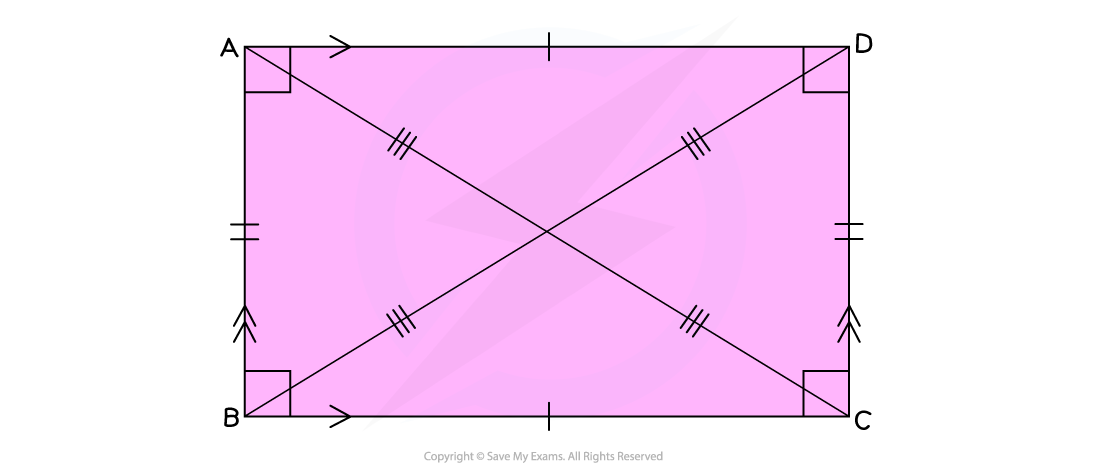
Rectangles and squares have four equal right angles (90°)
-
Rectangles have two pairs of equal length, parallel sides
-
Squares are just regular rectangles; all four of their sides are equal
-
-
The diagonals of a rectangle bisect each other at the centre of the rectangle
-
This means that they cut each other in half
-
The intersecting diagonals form two pairs of angles at the centre
-
In a square, all four of these angles will be equal to 90°
-
-
-
Pythagoras’ theorem can be used to find the length of the diagonal of a square or rectangle
-
The diagonal forms the hypotenuse of a right-angled triangle
-
What are the properties of parallelograms and rhombuses?
-
Parallelograms and rhombuses (rhombi) have two pairs of equal, opposite, angles
-
Parallelograms and rhombuses have two pairs of opposite, parallel sides
-
Rhombuses have four sides of the same length
-
This means a rhombus is a regular parallelogram
-
A square is also a regular rhombus
-
-
-
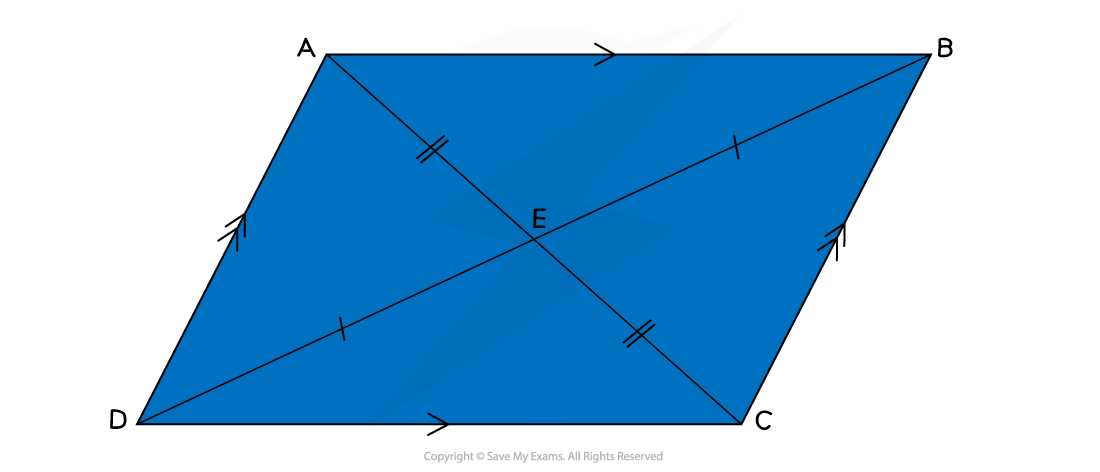
The diagonals of a parallelogram bisect each other, forming two pairs of opposite angles
-
The diagonals of a rhombus bisect each other at right angles (90°)
-
This means that they cut each other in half
-
The diagonals will not be of equal length
-
On the diagram below, the diagonal AC is shorter than the diagonal DB
-
-
What are the properties of trapeziums?
-
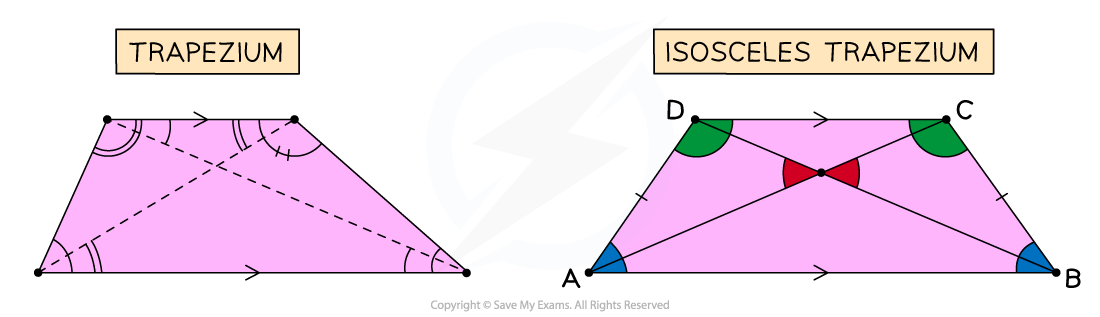
Trapeziums have one pair of opposite, parallel sides
-
These are not of equal length
-
-
Trapeziums may not have any equal angles
-
As with all quadrilaterals, the angles add up to 360°
-
-
If a trapezium has a line of symmetry, it is classed as isosceles
-
Isosceles trapeziums have two pairs of equal angles
-
The non-parallel sides in an isosceles trapezium will be equal length
-
An isosceles trapezium has two diagonals of equal length
-
What are the properties of kites?
-
Kites have one line of symmetry, known as their main diagonal
-
The angles opposite the main diagonal are equal
-
These are angles ABC and ADC on the diagram below
-
-
The diagonals of a kite bisect each other at right angles (90°)
-
This means that they cut each other in half
-
The diagonals will not be of equal length
-
-
Kites have no parallel sides
-
Kites have two pairs of equal length, adjacent sides
Responses