
Maths Gcse Aqa Foundation
-
Scatter-Graphs-And-Correlation Aqa Foundation2 主题
-
Statistical-Diagrams Aqa Foundation6 主题
-
Averages-Ranges-And-Data Aqa Foundation7 主题
-
Tree-Diagrams-And-Combined-Probability Aqa Foundation2 主题
-
Simple-Probability-Diagrams Aqa Foundation4 主题
-
Transformations Aqa Foundation4 主题
-
Vectors Aqa Foundation3 主题
-
Pythagoras-And-Trigonometry Aqa Foundation5 主题
-
Congruence-Similarity-And-Geometrical-Proof Aqa Foundation5 主题
-
Volume-And-Surface-Area Aqa Foundation3 主题
-
Circles-Arcs-And-Sectors Aqa Foundation3 主题
-
Area-And-Perimeter Aqa Foundation4 主题
-
Bearings-Scale-Drawing-Constructions-And-Loci Aqa Foundation5 主题
-
2D-And-3D-Shapes Aqa Foundation4 主题
-
Angles-In-Polygons-And-Parallel-Lines Aqa Foundation5 主题
-
Symmetry-And-Shapes Aqa Foundation4 主题
-
Exchange-Rates-And-Best-Buys Aqa Foundation2 主题
-
Standard-And-Compound-Units Aqa Foundation5 主题
-
Direct-And-Inverse-Proportion Aqa Foundation1 主题
-
Ratio-Problem-Solving Aqa Foundation2 主题
-
Sequences Aqa Foundation4 主题
-
Solving-Inequalities Aqa Foundation3 主题
-
Real-Life-Graphs Aqa Foundation4 主题
-
Graphs-Of-Functions Aqa Foundation3 主题
-
Linear-Graphs Aqa Foundation3 主题
-
Coordinate-Geometry Aqa Foundation3 主题
-
Functions Aqa Foundation1 主题
-
Forming-And-Solving-Equations Aqa Foundation2 主题
-
Simultaneous-Equations Aqa Foundation1 主题
-
Solving-Quadratic-Equations Aqa Foundation1 主题
-
Linear-Equations Aqa Foundation3 主题
-
Algebraic-Reasoning Aqa Foundation1 主题
-
Rearranging-Formulas Aqa Foundation1 主题
-
Introduction Aqa Foundation10 主题
-
Relative-And-Expected-Frequency Aqa Foundation
-
Sample-Space-Diagrams Aqa Foundation
-
Basic-Probability Aqa Foundation
-
Sharing-In-A-Ratio Aqa Foundation
-
Equivalent-And-Simplified-Ratios Aqa Foundation
-
Introduction-To-Ratios Aqa Foundation
-
Collecting-Like-Terms Aqa Foundation
-
Substitution Aqa Foundation
-
Algebraic-Vocabulary Aqa Foundation
-
Algebraic-Notation Aqa Foundation
-
Relative-And-Expected-Frequency Aqa Foundation
-
Factorising Aqa Foundation3 主题
-
Expanding-Brackets Aqa Foundation2 主题
-
Algebraic-Roots-And-Indices Aqa Foundation1 主题
-
Using-A-Calculator Aqa Foundation1 主题
-
Exact-Values Aqa Foundation1 主题
-
Rounding-Estimation-And-Error-Intervals Aqa Foundation4 主题
-
Fractions-Decimals-And-Percentages Aqa Foundation2 主题
-
Simple-And-Compound-Interest-Growth-And-Decay Aqa Foundation4 主题
-
Percentages Aqa Foundation5 主题
-
Fractions Aqa Foundation6 主题
-
Powers-Roots-And-Standard-Form Aqa Foundation4 主题
-
Types-Of-Number-Prime-Factors-Hcf-And-Lcm Aqa Foundation6 主题
-
Number-Operations Aqa Foundation9 主题
-
Counting-Principles Aqa Foundation
-
Related-Calculations Aqa Foundation
-
Multiplication-And-Division Aqa Foundation
-
Addition-And-Subtraction Aqa Foundation
-
Money-Calculations Aqa Foundation
-
Negative-Numbers Aqa Foundation
-
Place-Value Aqa Foundation
-
Order-Of-Operations-Bidmasbodmas Aqa Foundation
-
Mathematical-Operations Aqa Foundation
-
Counting-Principles Aqa Foundation
Geometrical-Proof Aqa Foundation
Exam code:8300
Geometrical proof
What is a geometrical proof?
-
Geometric proof involves using known rules about geometry to prove a new statement about geometry
-
A proof question might start with “Prove…” or “Show that …”
-
The rules that you might need to use to complete a proof include;
-
Properties of 2D shapes
-
Especially triangles and quadrilaterals
-
-
Basic angle properties
-
Angles in polygons
-
Angles in parallel lines
-
Congruence and similarity
-
Pythagoras theorem
-
-
You will need to be familiar with the vocabulary of the topics above, in order to fully answer many geometrical proof questions
How do I write a geometrical proof?
-
Usually you will need to write down two or three steps to prove the statement
-
At each step, you should write down a fact and a reason
-
For example, “AB = CD, opposite sides of a rectangle are equal length”
-
-
The proof is complete when you have written down all the steps clearly
-
Use the diagram!
-
Add key information such as angles or line lengths to the diagram as you work through the steps
-
but you must write them down in your written answer too
-
-
What geometric notation should I use?
-
Points or vertices of a shape are labelled with capital letters
-
A, B, C and D are the vertices of the quadrilateral
-
O is the centre of the circle
-
-
Two letters are used to represent the line between the points
-
AB is the line between points A and B
-
-
Three letters are used to represent the angle formed by the three points
-
Angle ABC is the angle between lines AB and BC
-
The letter in the middle is the point where the angle is at
-
-
Multiple letters are used to represent the whole shape
-
ABCD is a quadrilateral
-
The letters are written down so that they go clockwise around the shape
-
-
If you use a variable to represent a length or an angle then write it down
-
Angle ABC =

-

How can I prove that the exterior angle of a triangle is equal to the sum of the interior angles at the other two vertices?
-
Let a, b and c be the three interior angles in a triangle
-
Let d be the exterior angle next to the interior angle c
-
Split d into two angles by drawing a parallel line to the other side of the triangle
-
There will be an angle alternate to angle a
-
There will be an angle corresponding to angle b
-
-
Therefore the exterior angle is the sum of the two opposite interior angles

What are common geometric reasons I can use?
-
There are common phrases that are sufficient as explanations and should be learnt
-
These will be what mark schemes look for
-
-
For triangles and quadrilaterals
-
Angles in a triangle add up to 180°
-
Base angles of an isosceles triangle are equal
-
Angles in an equilateral triangle are equal
-
Angles in a quadrilateral add up to 360°
-
An exterior angle of a triangle is equal to the sum of the interior opposite angles
-
-
For straight lines
-
Vertically opposite angles are equal
-
Angles on a straight line add up to 180°
-
Angles at a point add up to 360°
-
-
For parallel lines
-
Alternate angles are equal
-
Corresponding angles are equal
-
Allied (or co-interior) angles add up to 180°
-
-
For polygons
-
Exterior angles of a polygon add up to 360°
-
The interior and exterior angle of any polygon add up to 180°
-
Examiner Tips and Tricks
-
DO show all the key steps
-
If in doubt, include it
-
-
DON’T write in full sentences
-
For each step, just write down the fact, followed by the key mathematical reason that justifies it
-
Worked Example
In the diagram below, AC and DG are parallel lines. B lies on AC, E and F lie on DG and triangle BEF is isosceles.

Prove that angle EBF is format('truetype')%3Bfont-weight%3Anormal%3Bfont-style%3Anormal%3B%7Dtext%7Bfill%3A%23000000%3B%3C%2Fstyle%3E%3C%2Fdefs%3E%3Ctext%20font-family%3D%22Times%20New%20Roman%22%20font-size%3D%2218%22%20text-anchor%3D%22middle%22%20x%3D%2213.5%22%20y%3D%2216%22%3E180%3C%2Ftext%3E%3Ctext%20font-family%3D%22math1da40657c9fece7e48d30af42d3%22%20font-size%3D%2216%22%20text-anchor%3D%22middle%22%20x%3D%2235.5%22%20y%3D%2216%22%3E%26%23x2212%3B%3C%2Ftext%3E%3Ctext%20font-family%3D%22Times%20New%20Roman%22%20font-size%3D%2218%22%20text-anchor%3D%22middle%22%20x%3D%2248.5%22%20y%3D%2216%22%3E2%3C%2Ftext%3E%3Ctext%20font-family%3D%22Times%20New%20Roman%22%20font-size%3D%2218%22%20font-style%3D%22italic%22%20text-anchor%3D%22middle%22%20x%3D%2257.5%22%20y%3D%2216%22%3Ex%3C%2Ftext%3E%3C%2Fsvg%3E) . Give reasons for each stage of your working.
. Give reasons for each stage of your working.
Mark on the diagram that triangle BEF is isosceles
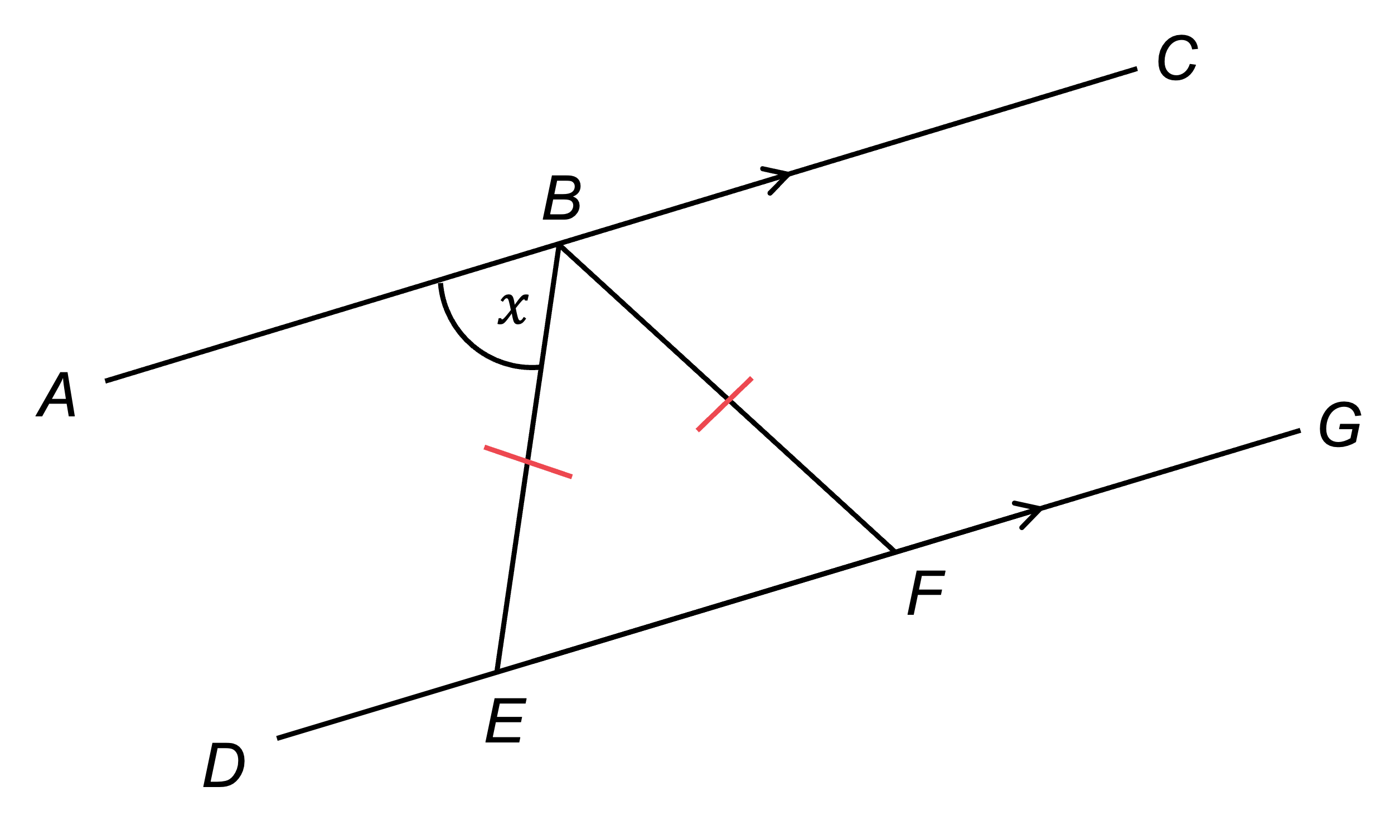
AC and DG are parallel lines, so using alternate angles we know that angle BEF = 
Mark this on the diagram
Responses