
Exam code:9FM0
Problem solving with energy
How do I include air resistance in the work-energy principle?
-
The work done by a constant air resistance / drag force,
 Newtons, when moving
  metres is
  Joules
 -
Air resistance hinders (slows down) the particle, so is negative in the work-energy principle
-
total final energy = total initial energy – work done by air resistance
-
-
This can work for particles moving horizontally or vertically
-
sometimes the air resistance experienced upwards has a different value to that experienced downwards
-
-
Air resistances, in reality, are often proportional to the speed (or square of the speed) of the particle
-
but this makes it a non-constant force
-
and the work done formula only works for constant forces
-
-
How do I use the work-energy principle on curved surfaces?
-
The work-energy principle can be used in new situations that aren’t always inclined planes!
-
e.g. skateboarding down a curving slope
-
the skater may put in their own work done (e.g. using their legs) which “helps” to go faster (+ work done)
-
but there may be a constant resistive force acting against them throughout (- work done)
-
assume that the resistances are always parallel to the curved slope at any given time (and reactions are always perpendicular)
-
-
How do I apply the work-energy principle to connected particles?
-
You can still use the work-energy principle with connected particles by considering it all as one object
-
total final energy = total initial energy ± work done
-
-
The total energies will be the sum of the GPEs and KEs of all particles
-
There will be a combination of “work done” terms with + or – depending on whether it’s helping or hindering its respective particle
-
e.g. for a driving car pulling a trailer, the terms look like:
-
+ WD(by driving force on car) – WD(by tension in towbar on car) – WD(by resistances on car) + WD(by tension from towbar on trailer) – WD(resistances on trailer)
-
Notice that the work done by the tensions will cancel each other out
-
-
How do I apply the work-energy principle to collisions?
-
Some questions use the work-energy principle and the theory of collisions
-
There may be a particle projected into a perpendicular wall
-
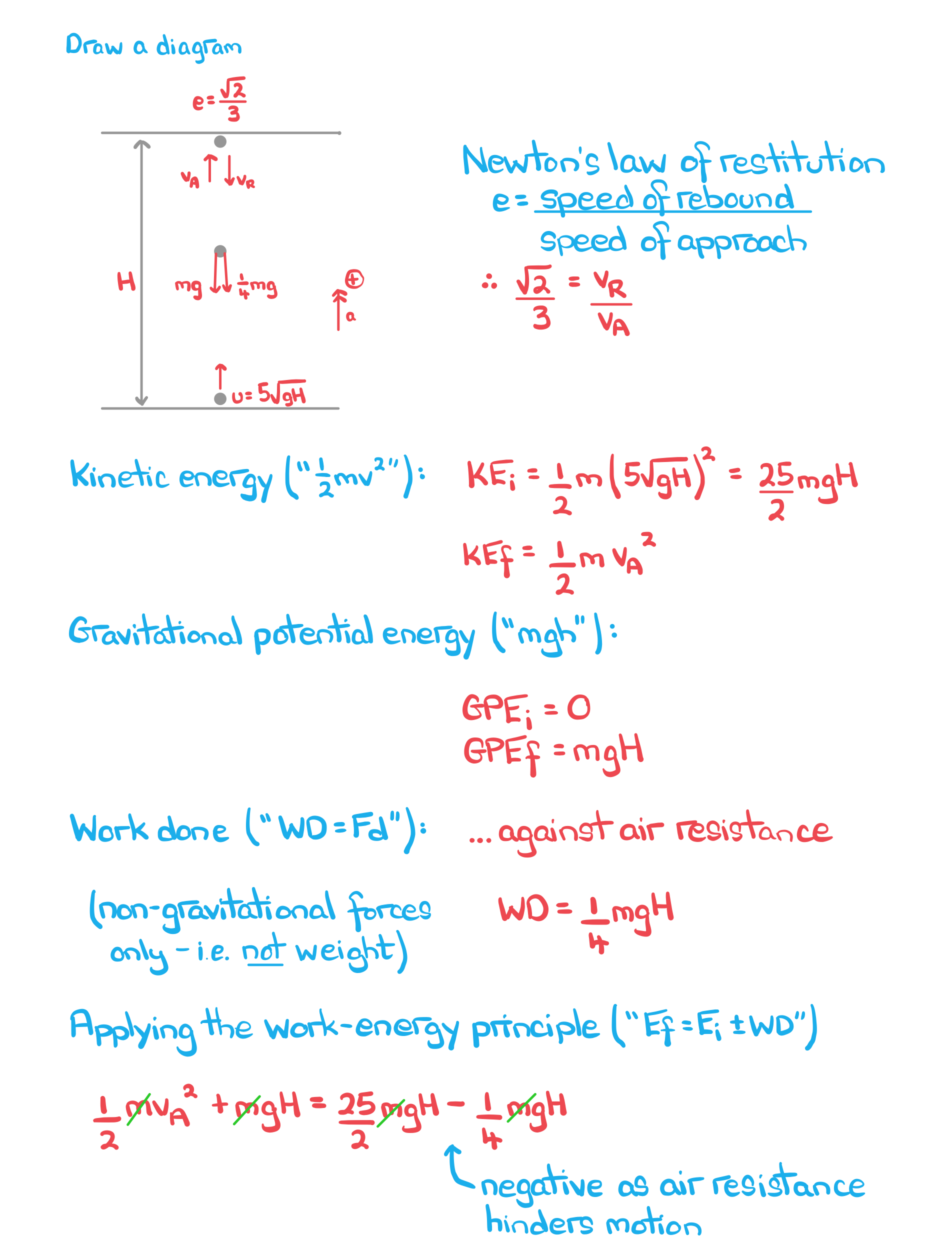
Use the Work-Energy Principle to find the speed with which it impacts the wall
-
You can find the speed by making the kinetic energy the subject
-
-
This gives the speed of impact
-
To find the speed of rebound, calculate “e” × the speed of impact
-
“e” is the coefficient of restitution
-
-
-
Other questions may have two spheres colliding on a horizontal table, then one falling off
-
Use conservation of momentum and Newton’s law of restitution to find velocities after the collision
-
When the sphere rolls off the table, it becomes a projectile (projected horizontally with it’s new velocity)
-
If you know the height of the table, you can use the Work-Energy Principle to find the speed of impact with the ground
-
-
Examiner Tips and Tricks
-
It is common for harder energy questions to be fully algebraic
-
look out for masses,
 , cancelling in the working
-
Worked Example
A particle of mass  kg is projected vertically upwards from ground level at a speed of
 %22%2F%3E%3Cpolyline%20fill%3D%22none%22%20points%3D%226%2C0%202%2C-7%201%2C-6%22%20stroke%3D%22%23000%22%20stroke-linecap%3D%22square%22%20stroke-width%3D%221%22%20transform%3D%22translate(9.5%2C23.5)%22%2F%3E%3Cline%20stroke%3D%22%23000%22%20stroke-linecap%3D%22square%22%20stroke-width%3D%221%22%20x1%3D%2223.5%22%20x2%3D%2249.5%22%20y1%3D%224.5%22%20y2%3D%224.5%22%2F%3E%3Ctext%20font-family%3D%22Times%20New%20Roman%22%20font-size%3D%2218%22%20font-style%3D%22italic%22%20text-anchor%3D%22middle%22%20x%3D%2229.5%22%20y%3D%2220%22%3Eg%3C%2Ftext%3E%3Ctext%20font-family%3D%22Times%20New%20Roman%22%20font-size%3D%2218%22%20font-style%3D%22italic%22%20text-anchor%3D%22middle%22%20x%3D%2240.5%22%20y%3D%2220%22%3EH%3C%2Ftext%3E%3C%2Fsvg%3E) ms-1, where
ms-1, where  is the vertical height in metres between the ground and the ceiling. The particle is subjected to a constant air resistance force of
  N, opposing its motion. The coefficient of restitution between the particle and the ceiling is
 %22%2F%3E%3Cpolyline%20fill%3D%22none%22%20points%3D%226%2C0%202%2C-7%201%2C-6%22%20stroke%3D%22%23000%22%20stroke-linecap%3D%22square%22%20stroke-width%3D%221%22%20transform%3D%22translate(4.5%2C23.5)%22%2F%3E%3Cline%20stroke%3D%22%23000%22%20stroke-linecap%3D%22square%22%20stroke-width%3D%221%22%20x1%3D%2218.5%22%20x2%3D%2230.5%22%20y1%3D%224.5%22%20y2%3D%224.5%22%2F%3E%3Ctext%20font-family%3D%22Times%20New%20Roman%22%20font-size%3D%2218%22%20text-anchor%3D%22middle%22%20x%3D%2224.5%22%20y%3D%2220%22%3E2%3C%2Ftext%3E%3Ctext%20font-family%3D%22Times%20New%20Roman%22%20font-size%3D%2218%22%20text-anchor%3D%22middle%22%20x%3D%2217.5%22%20y%3D%2245%22%3E3%3C%2Ftext%3E%3C%2Fsvg%3E) .
.
Find, in terms of  and , the exact speed of the ball immediately after rebounding with the ceiling.
Responses