
Exam code:9FM0
Newton’s law of restitution
What is Newton’s law of restitution?
-
Newton’s law of restitution (also known as Newton’s experimental law) concerns the ratio of the relative speed of separation and the relative speed of approach when two objects collide
-
Essentially this just means the speed of separation divided by the speed of approach
-
-
This ratio can be written as a coefficient; the “coefficient of restitution”
-
It is denoted by e
-
e is dimensionless as it is a ratio
-
The value of e in a particular situation will depend on the materials that the two particles are made from
-
-
e can take the values in the range 0 ≤ e ≤ 1
-
e =1: These are called perfectly elastic collisions and in these collisions there is no loss in kinetic energy
-
e =0: These are called perfectly inelastic collisions and in these collisions the objects coalesce (merge to form one object)
-
How do I calculate the coefficient of restitution between two objects?
-
format('truetype')%3Bfont-weight%3Anormal%3Bfont-style%3Anormal%3B%7D%3C%2Fstyle%3E%3C%2Fdefs%3E%3Ctext%20font-family%3D%22Times%20New%20Roman%22%20font-size%3D%2216%22%20font-style%3D%22italic%22%20text-anchor%3D%22middle%22%20x%3D%223.5%22%20y%3D%2226%22%3Ee%3C%2Ftext%3E%3Ctext%20font-family%3D%22math17f39f8317fbdb1988ef4c628eb%22%20font-size%3D%2214%22%20text-anchor%3D%22middle%22%20x%3D%2220.5%22%20y%3D%2226%22%3E%3D%3C%2Ftext%3E%3Cline%20stroke%3D%22%23000%22%20stroke-linecap%3D%22square%22%20stroke-width%3D%221%22%20x1%3D%2234.5%22%20x2%3D%22253.5%22%20y1%3D%2220.5%22%20y2%3D%2220.5%22%2F%3E%3Ctext%20font-family%3D%22Times%20New%20Roman%22%20font-size%3D%2216%22%20text-anchor%3D%22middle%22%20x%3D%2255.5%22%20y%3D%2215%22%3ESpeed%3C%2Ftext%3E%3Ctext%20font-family%3D%22Times%20New%20Roman%22%20font-size%3D%2216%22%20text-anchor%3D%22middle%22%20x%3D%2285.5%22%20y%3D%2215%22%3Eof%3C%2Ftext%3E%3Ctext%20font-family%3D%22Times%20New%20Roman%22%20font-size%3D%2216%22%20text-anchor%3D%22middle%22%20x%3D%22129.5%22%20y%3D%2215%22%3Eseparation%3C%2Ftext%3E%3Ctext%20font-family%3D%22Times%20New%20Roman%22%20font-size%3D%2216%22%20text-anchor%3D%22middle%22%20x%3D%22172.5%22%20y%3D%2215%22%3Eof%3C%2Ftext%3E%3Ctext%20font-family%3D%22Times%20New%20Roman%22%20font-size%3D%2216%22%20text-anchor%3D%22middle%22%20x%3D%22193.5%22%20y%3D%2215%22%3Ethe%3C%2Ftext%3E%3Ctext%20font-family%3D%22Times%20New%20Roman%22%20font-size%3D%2216%22%20text-anchor%3D%22middle%22%20x%3D%22229.5%22%20y%3D%2215%22%3Eobjects%3C%2Ftext%3E%3Ctext%20font-family%3D%22Times%20New%20Roman%22%20font-size%3D%2216%22%20text-anchor%3D%22middle%22%20x%3D%2259.5%22%20y%3D%2237%22%3ESpeed%3C%2Ftext%3E%3Ctext%20font-family%3D%22Times%20New%20Roman%22%20font-size%3D%2216%22%20text-anchor%3D%22middle%22%20x%3D%2289.5%22%20y%3D%2237%22%3Eof%3C%2Ftext%3E%3Ctext%20font-family%3D%22Times%20New%20Roman%22%20font-size%3D%2216%22%20text-anchor%3D%22middle%22%20x%3D%22129.5%22%20y%3D%2237%22%3Eapproach%3C%2Ftext%3E%3Ctext%20font-family%3D%22Times%20New%20Roman%22%20font-size%3D%2216%22%20text-anchor%3D%22middle%22%20x%3D%22169.5%22%20y%3D%2237%22%3Eof%3C%2Ftext%3E%3Ctext%20font-family%3D%22Times%20New%20Roman%22%20font-size%3D%2216%22%20text-anchor%3D%22middle%22%20x%3D%22190.5%22%20y%3D%2237%22%3Ethe%3C%2Ftext%3E%3Ctext%20font-family%3D%22Times%20New%20Roman%22%20font-size%3D%2216%22%20text-anchor%3D%22middle%22%20x%3D%22226.5%22%20y%3D%2237%22%3Eobjects%3C%2Ftext%3E%3C%2Fsvg%3E)
-
The speed of approach depends on whether the objects are travelling towards each other or in the same direction. For example, if the speeds of the two objects before the collision are 5 m s-1 and 2 m s-1 then the speed of approach is:
-
3 m s-1 if they are moving in the same direction (each second the objects approach each other by a further 3 metres)
-
7 m s-1 if they are moving in opposite directions (each second the objects approach each other by a further 7 metres)
-
-
The speed of separation depends on whether the objects are travelling away from each other or in the same direction. For example, if the speeds of the two objects after the collision are 5 m s-1 and 2 m s-1 then the speed of separation is:
-
3 m s-1 if they are moving in the same direction (each second the objects separate by a further 3 metres)
-
7 m s-1 if they are moving in opposite directions (each second the objects separate by a further 7 metres)
-
-
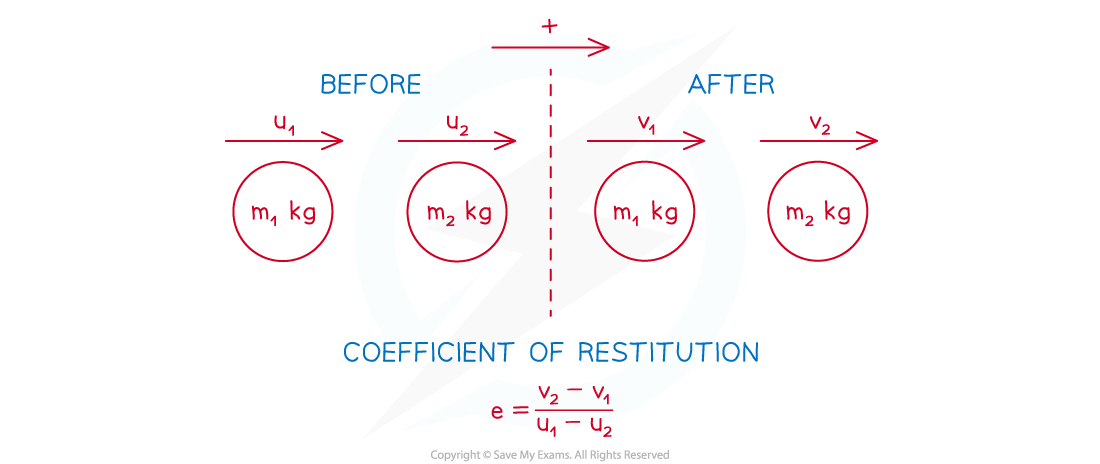
If the velocities of the two objects before the collision are u1 m s-1 and u2 m s-1 and the velocities after the collision are v1m s-1 and v2 m s-1 then:
-
format('truetype')%3Bfont-weight%3Anormal%3Bfont-style%3Anormal%3B%7D%3C%2Fstyle%3E%3C%2Fdefs%3E%3Ctext%20font-family%3D%22Times%20New%20Roman%22%20font-size%3D%2216%22%20font-style%3D%22italic%22%20text-anchor%3D%22middle%22%20x%3D%223.5%22%20y%3D%2233%22%3Ee%3C%2Ftext%3E%3Ctext%20font-family%3D%22math143f4d31b04031e49f5eb18baba%22%20font-size%3D%2214%22%20text-anchor%3D%22middle%22%20x%3D%2220.5%22%20y%3D%2233%22%3E%3D%3C%2Ftext%3E%3Cline%20stroke%3D%22%23000%22%20stroke-linecap%3D%22square%22%20stroke-width%3D%221%22%20x1%3D%2234.5%22%20x2%3D%2284.5%22%20y1%3D%2227.5%22%20y2%3D%2227.5%22%2F%3E%3Ctext%20font-family%3D%22Times%20New%20Roman%22%20font-size%3D%2216%22%20font-style%3D%22italic%22%20text-anchor%3D%22middle%22%20x%3D%2242.5%22%20y%3D%2215%22%3Ev%3C%2Ftext%3E%3Ctext%20font-family%3D%22Times%20New%20Roman%22%20font-size%3D%2212%22%20text-anchor%3D%22middle%22%20x%3D%2250.5%22%20y%3D%2222%22%3E2%3C%2Ftext%3E%3Ctext%20font-family%3D%22math143f4d31b04031e49f5eb18baba%22%20font-size%3D%2214%22%20text-anchor%3D%22middle%22%20x%3D%2260.5%22%20y%3D%2215%22%3E%26%23x2212%3B%3C%2Ftext%3E%3Ctext%20font-family%3D%22Times%20New%20Roman%22%20font-size%3D%2216%22%20font-style%3D%22italic%22%20text-anchor%3D%22middle%22%20x%3D%2271.5%22%20y%3D%2215%22%3Ev%3C%2Ftext%3E%3Ctext%20font-family%3D%22Times%20New%20Roman%22%20font-size%3D%2212%22%20text-anchor%3D%22middle%22%20x%3D%2279.5%22%20y%3D%2222%22%3E1%3C%2Ftext%3E%3Ctext%20font-family%3D%22Times%20New%20Roman%22%20font-size%3D%2216%22%20font-style%3D%22italic%22%20text-anchor%3D%22middle%22%20x%3D%2240.5%22%20y%3D%2244%22%3Eu%3C%2Ftext%3E%3Ctext%20font-family%3D%22Times%20New%20Roman%22%20font-size%3D%2212%22%20text-anchor%3D%22middle%22%20x%3D%2248.5%22%20y%3D%2251%22%3E1%3C%2Ftext%3E%3Ctext%20font-family%3D%22math143f4d31b04031e49f5eb18baba%22%20font-size%3D%2214%22%20text-anchor%3D%22middle%22%20x%3D%2261.5%22%20y%3D%2244%22%3E%26%23x2212%3B%3C%2Ftext%3E%3Ctext%20font-family%3D%22Times%20New%20Roman%22%20font-size%3D%2216%22%20font-style%3D%22italic%22%20text-anchor%3D%22middle%22%20x%3D%2272.5%22%20y%3D%2244%22%3Eu%3C%2Ftext%3E%3Ctext%20font-family%3D%22Times%20New%20Roman%22%20font-size%3D%2212%22%20text-anchor%3D%22middle%22%20x%3D%2280.5%22%20y%3D%2251%22%3E2%3C%2Ftext%3E%3C%2Fsvg%3E)
-
Note that velocities can be negative so be careful with signs
-
How do I solve collision problems involving the coefficient of restitution?
-
STEP 1: Draw a before/after diagram and label the positive direction
-
There may be multiple diagrams if there are multiple collisions
-
-
STEP 2: Form an equation using the coefficient of restitution
-
The unknown(s) could be the coefficient of restitution or any of the speeds or directions
-
-
STEP 3: Form an equation using the principle of conservation of momentum
-
In the case of a collision with a wall you may be given the impulse or some other information instead
-
-
STEP 4: Solve and give your answer in context
-
You may have to solve simultaneous equations
-
You may have to solve an inequality
-
You may have to form an inequality using 0 ≤ e ≤ 1 or using the fact that velocity is positive (or negative) if the object is going forwards (or backwards)
-
Examiner Tips and Tricks
-
Exam questions refer to spheres as having equal radii, this just means the objects are the same size so that dimensions don’t affect the collision. Exam questions often leave velocities in terms of e. If you know the direction of the object then you know whether the velocity is positive or negative. This can be used to form an inequality for the range of possible values of e for that scenario.
Worked Example
Two balls  and
and  are of equal radius and have masses 2 kg and 5 kg respectively. and <img alt=”B” data-mathml='<math ><semantics><mi>B</mi><annotation encoding=”application/vnd.wiris.mtweb-params+json”>{“language”:”en”,”fontFamily”:”Times New Roman”,”fontSize”:”18″}</annotation></semantics></math>’ height=”22″ role=”math” src=”data:image/svg+xml;charset=utf8,%3Csvg%20xmlns%3D%22http%3A%2F%2Fwww.w3.org%2F2000%2Fsvg%22%20xmlns%3Awrs%3D%22http%3A%2F%2Fwww.wiris.com%2Fxml%2Fmathml-extension%22%20height%3D%2222
Responses