Back to 课程

Environmental Management AS CIE

0% Complete
0/0 Steps
  1. 1-1-continents-and-oceans as
    1 主题
  2. 1-2-country-classification-by-income-level as
    1 主题
  3. 1-3-sustainability as
    1 主题
  4. 1-4-the-water-cycle as
    1 主题
  5. 1-5-the-structure-and-composition-of-the-atmosphere as
    2 主题
  6. 1-6-ecosystems as
    5 主题
  7. 2-1-the-scientific-method as
    2 主题
  8. 2-2-environmental-research-in-the-context-of-climate-change as
    2 主题
  9. 2-3-collection-of-environmental-data as
    1 主题
  10. 2-4-data-collection-techniques-and-data-analysis as
    2 主题
  11. 2-5-the-use-of-technology-in-data-collection-and-analysis as
    1 主题
  12. 3-1-human-population-dynamics-and-structure as
    2 主题
  13. 3-2-impacts-of-human-population-change as
    1 主题
  14. 3-3-managing-human-population-change as
    1 主题
  15. 4-1-ecosystems as
    4 主题
  16. 4-2-managing-the-conservation-of-biodiversity as
    4 主题
  17. 4-3-impacts-of-human-activity-on-ecosystems as
    2 主题
  18. 5-1-food-security as
    2 主题
  19. 5-2-energy-resources as
    3 主题
  20. 5-3-waste-management as
    2 主题
  21. 6-1-global-water-distribution as
    3 主题
  22. 7-1-acid-deposition as
    1 主题
  23. 7-2-photochemical-smog as
    1 主题
  24. 7-3-managing-air-pollution as
    1 主题
  25. 7-4-ozone-depletion as
    2 主题
  26. 8-1-climate-change as
    2 主题
  27. 8-2-the-impacts-of-climate-change as
    1 主题
  28. 8-3-managing-climate-change as
    1 主题
课 Progress
0% Complete

Exam code:8291

Terrestrial Biomes

  • Biomes are large-scale ecological communities or ecosystem types that are characterised by their dominant vegetation, climate and other abiotic factors that shape their biotic communities

  • Biomes cover large geographic areas (different ecosystems can be found within a single biome):

    • These larger zones have similar climatic and ecosystem characteristics

  • Terrestrial biomes (i.e. non-aquatic biomes) are classified into four major classes:

    • Forest

    • Grassland

    • Desert

    • Tundra

  • These major classes can be divided into further categories, for example:

    • Forest biomes are dominated by trees and are categorised into tropical rainforests, temperate deciduous forests and boreal forests

    • Grassland biomes are characterised by grasses and herbaceous plants and are categorised into savanna and temperate grasslands

    • Desert biomes are characterised by low rainfall and are dominated by cacti and other drought-resistant plants – they can be further divided into subcategories such as hot deserts, cold deserts, coastal deserts and semi-arid deserts

    • Tundra biomes are found in high latitudes and are characterised by low temperatures and permafrost – they can be further divided into subcategories such as arctic tundra and alpine tundra

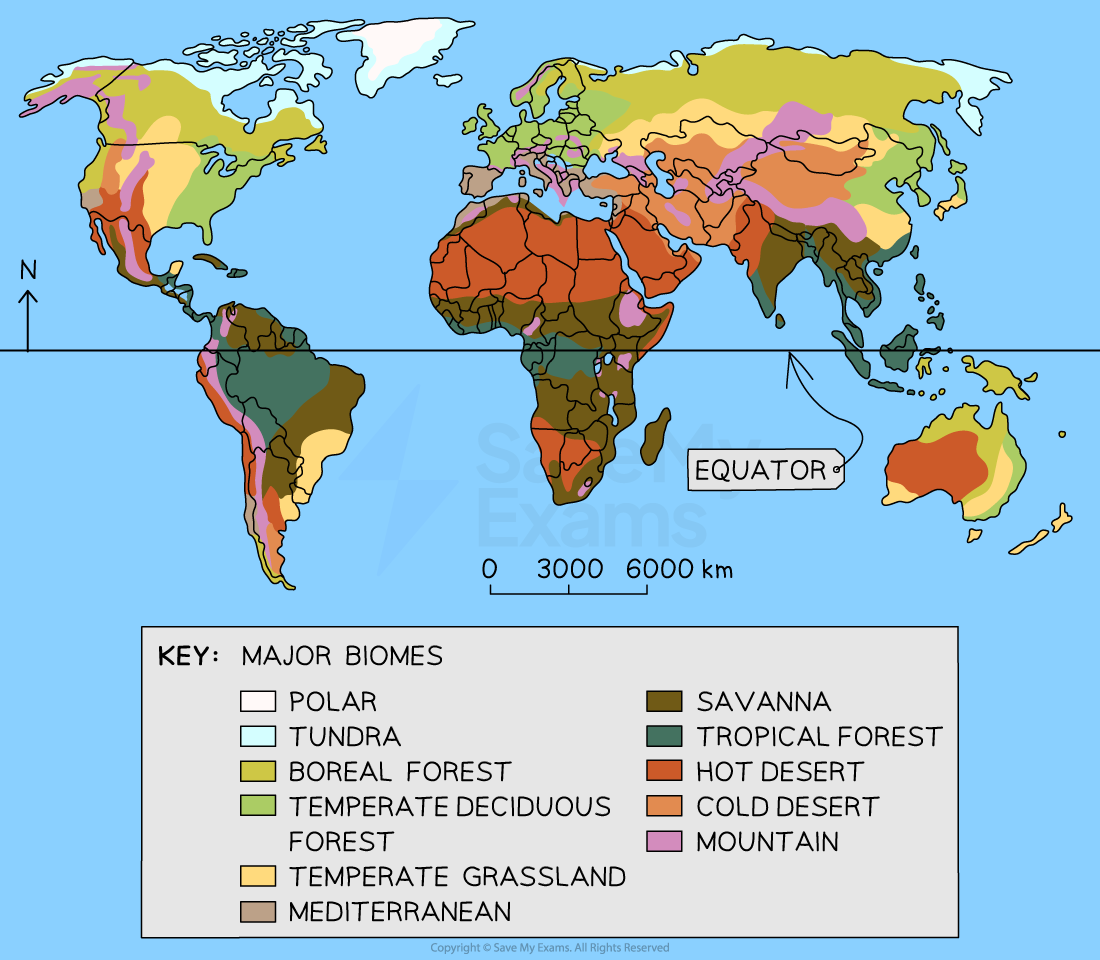
Map showing the distribution of different types of terrestrial biomes on Earth
Terrestrial biomes of the world

Forest

Forest Biomes

Characteristics

 Tropical rainforest

Temperate forest

Boreal forest

Location

  • Low latitudes

  • Within Tropics: 23.5° north and south of equator

  • E.g. Amazon in South America, New Guinea, Southeast Asia, Zaire Basin

  • Between 40°–60° north and south of equator

  • E.g. Western Europe, northeast USA, Eastern Asia

  • Between 50°–60° north and south of equator

  • E.g. Canada, Russia, Scandinavia

Annual precipitation

  • Over 2000 mm

  • 750–1500 mm (all year round)

300–900 mm (all year round)

Temperature range

  • 26 to 28°C

  • Over 0° C in winter

  • 20 to 25°C in summer

  • -30°C in winter

  • Up to 20°C in summer

Seasons

  • No seasons: hot and wet all year round

  • Four seasons of equal length

  • Two main seasons: winter and summer

Growing season

  • All year round

  • 6–8 months

2–3 months

Soils

  • Relatively infertile due to leaching and rapid uptake of nutrients by plants

  • Relatively fertile and nutrient rich due to decomposition of organic matter over autumn and winter

  • Not very fertile: often acidic, with permafrost

  • Shallow soil with a thick litter layer due to slow decomposition

Biodiversity

  • Approx. 50% of world’s plant and animal species live within the rainforest biome

  • Example flora: mahogany, teak trees, lianas, orchids

  • Example fauna: Toucans, jaguars, frogs, snakes

  • Wide range of animals and plants with higher biodiversity than boreal forests

  • Example flora: deciduous trees e.g. beech, oak, birch

  • Example fauna: deer, rabbits, squirrels, bears

  • Less biodiverse than temperate forests

  • Example flora: coniferous trees

  • Example fauna: squirrels, bears, reindeer, wolves

Grassland

Grassland Biomes

Characteristics

 Savanna

Temperate grasslands

Location

  • 5°–30° north and south of equator

  • North and south of tropical and monsoon forest biomes

  • E.g. central Africa: Tanzania, Kenya

  • 40°–60° north and south of equator

  • E.g.” veldts” of South Africa, “pampas” of Argentina, “steppes” of Russia, “plains” of USA

Annual precipitation

  • 800–900 mm

  • 250–750 mm

Temperature range

  • 15–35°C

  • -40 to 40°C

Seasons

  • Wet and dry season

  • Four seasons

Growing season

  • During wet season (4–5 months)

  • During summer (dependent on temperature)

Soils

  • Free draining with thin layer of humus

  • Not very fertile: most nutrients near surface

  • Fertile soil

Biodiversity

  • Wide range of plant and animal species

  • Greatest diversity of hoofed animals

  • Grasses, baobab and acacia trees

  • Zebras, elephants, giraffes

  • Large numbers of plant and animal species

  • Grasses, sunflowers

  • Bison, antelopes, rabbits

Desert

Desert Biomes

Characteristics

Hot desert

Location

  • 15°–30° north and south of equator

  • North Africa e.g. Sahara, Southern Africa e.g. Kalahari and Namib, Australia, Middle East

Annual precipitation

  • Below 250 mm

Temperature range

  • Daytime temperatures can reach 50°C but average around 25°C

  • Night time temperatures below 0°C

Seasons

  • Summer and winter

Growing season

  • All year round

Soils

  • Infertile, dry

Biodiversity

  • Low biodiversity

  • Cacti, yucca

  • Spiders, scorpions, camels, meerkats

Tundra

Tundra Biomes

Characteristics

Tundra

Location

  • North of the Arctic Circle and Antarctica

Annual precipitation

  • Less than 250 mm

Temperature range

  • Below 0°C for 6–10 months 

Seasons

  • Winter and summer

Growing season

  • 6–10 weeks

Soils

  • Thin infertile soil

  • Permafrost

Biodiversity

  • Low biodiversity

  • Small grasses, mosses, lichen

  • Snowy owls, snow bunting, tundra swan

  • Arctic foxes, hares and wolves

  • Polar bears, musk ox and caribou

Responses

您的邮箱地址不会被公开。 必填项已用 * 标注