
Exam code:8291
Populations & Samples
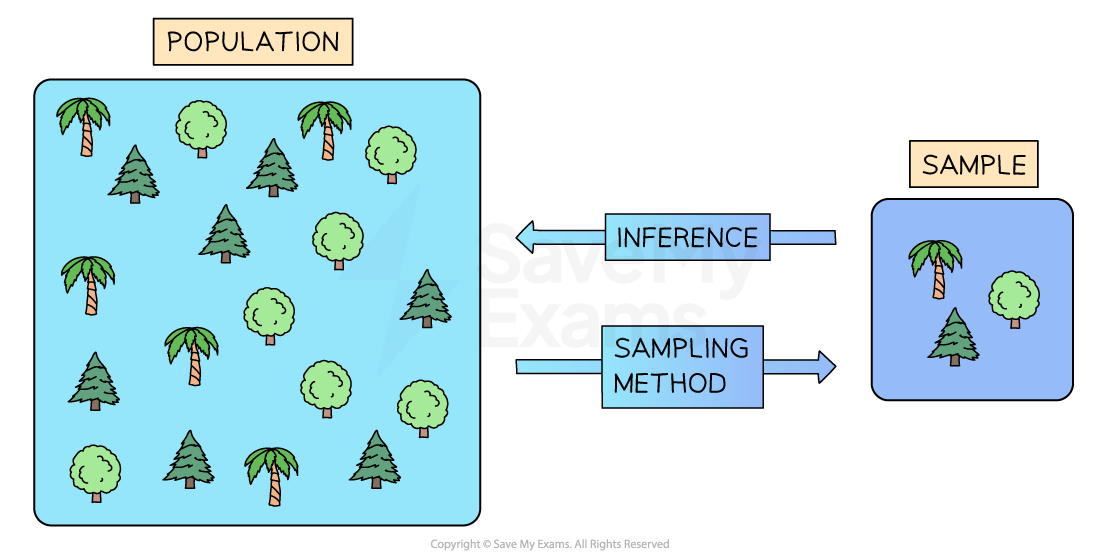
What is a population?
-
A population refers to the whole set of things that you are interested in
-
e.g. if a teacher wanted to know how long pupils in year 11 at their school spent revising each week then the population would be all the year 11 pupils at the school
-
-
Population does not necessarily refer to a number of people or animals
-
e.g. if an IT expert wanted to investigate the speed of mobile phones then the population would be all the different makes and models of mobile phones in the world
-
What is a sample?
-
A sample refers to a selected part (i.e. a subset) of the population that data is collected from
-
e.g. for the teacher investigating year 11 revision times, a sample would be a certain number of pupils from year 11
-
-
A random sample is where every item in the population has an equal chance of being selected
-
e.g. every pupil in year 11 would have the same chance of being selected for the teacher’s sample
-
-
A biased sample is where the sample is not random
-
e.g. the teacher asks pupils from just one class
-
What are the advantages and disadvantages of using a population?
-
You may see or hear the word census – this is when data is collected from every member of the whole population
-
The advantages of using a population include:
-
Accurate results – as every member/item of the population is used
-
All options/opinions/responses will be included in the results
-
-
The disadvantages of using a population include:
-
Time consuming to collect the data
-
Expensive due to the large numbers involved
-
Large amounts of data to organise and analyse
-
What are the advantages and disadvantages of using a sample?
-
The advantages of using a sample include:
-
Quicker to collect the data
-
Cheaper as not so much work involved
-
Less data to organise and analyse
-
-
The disadvantages of using a sample include:
-
A small sample size can lead to unreliable results
-
Sampling methods can usually be improved by taking a larger sample size
-
-
A sample can introduce bias
-
Particularly if the sample is not random
-
-
A sample might not be representative of the population
-
Only a selection of options/opinions/responses might be accounted for
-
The members/items used in the sample may all have similar responses
-
e.g. even with a random sample, it may be possible that the teacher happens to select pupils for their sample who all happen to do very little revision
-
-
-
It is important to recognise that different samples (from the same population) may produce different results
Random & Systematic Sampling Strategies

-
There are two different types of sampling:
-
Random
-
Systematic
-
-
In random sampling, the positions of the sampling points are completely random or due to chance
-
For example, sampling points can be selected using a random number generator to create a set of random coordinates
-
This method is beneficial because it means there will be no bias by the person that is carrying out the sampling that may affect the results (i.e. there will be no researcher bias)
-
Random sampling can be used when the population size or the individual sample size is relatively small, and all individuals have an equal chance of being sampled
-
-
In systematic sampling, the positions of the sampling points are chosen by the person carrying out the sampling and a regular pattern is used to select sample points
-
There is a possibility that the person choosing could show bias towards or against certain areas
-
Individuals may deliberately place the quadrats in areas with the least species as these will be easier and quicker to count
-
This is unrepresentative of the whole area
-
-
When a sampling area is reasonably uniform or has no clear pattern to the way the species are distributed, random sampling is the best choice
Responses