
Exam code:8700
Paper 1, Section B: Question 5 has two options: narrative writing or descriptive writing. This is an overview of the descriptive writing question.
|
Question 5: descriptive writing summary |
|
|---|---|
|
|
|
Top tips |
|
|
How to answer Paper 1 Question 5: descriptive writing
Let’s look at Question 5 from the June 2019 exam:

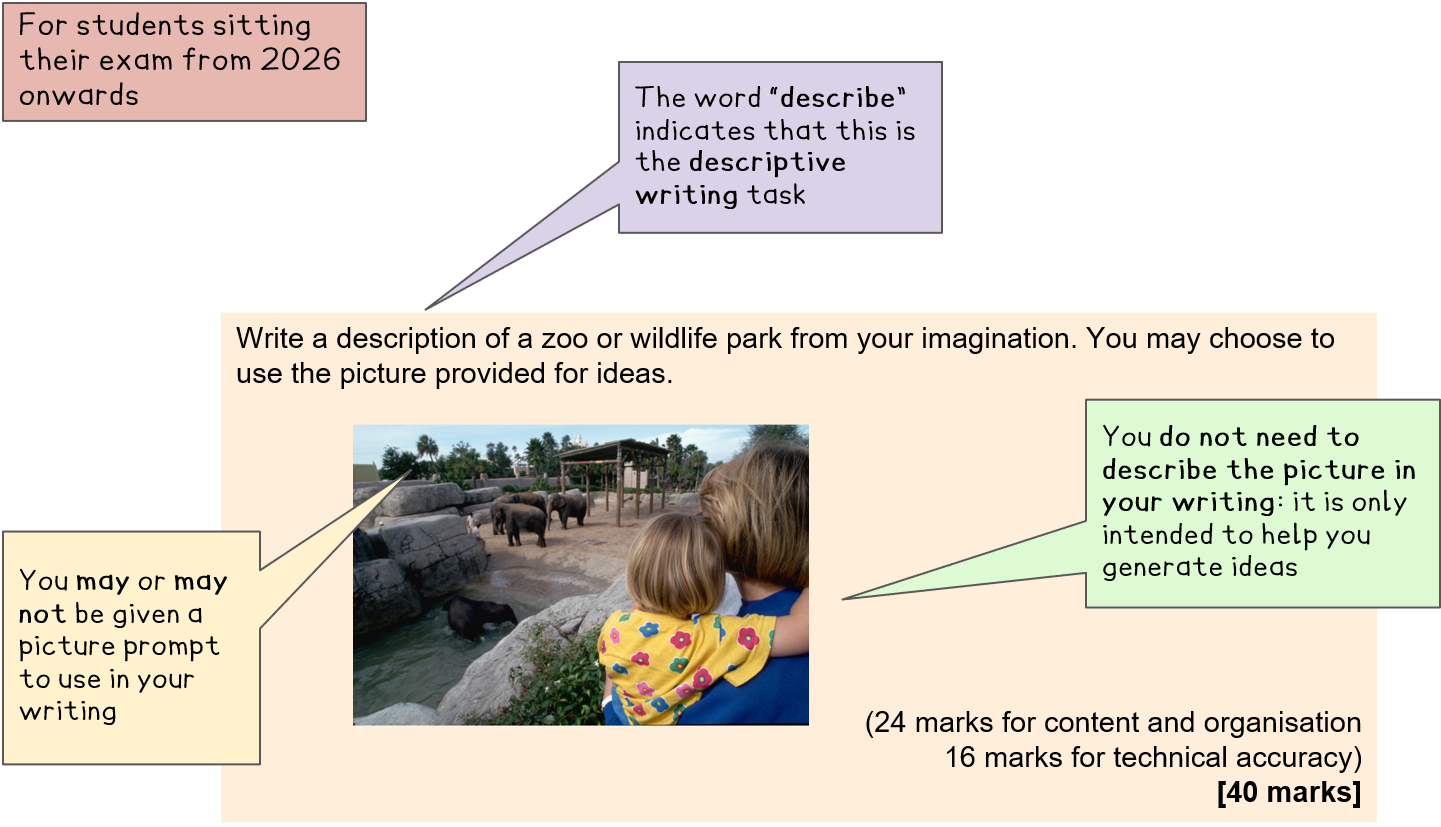
The wording for the exam question from 2026 onwards has slightly changed. The question now asks you to write a description “from your imagination”. Even if you are provided a picture prompt, you do not need to use it. This is to encourage students to be more free and creative with their writing, and not feel like they have to describe only what is in the image.
Let’s look at an example of the new wording for this question:
Step-by-step guide to Question 5
In order to achieve 40 marks for this question, you should:
-
Read the two task options carefully:
-
Highlight whether you are writing a story or a descriptive piece
-
-
If you are describing from the picture prompt, then annotate the image
-
Do not just limit yourself to the obvious details
-
-
Spend 10 minutes planning your writing:
-
Use a mind-map or a simple table to do this
-
Circle on the image what you are going to zoom in on
-
-
Write down some reminders of figurative language or literary techniques to include to add interest and detail to your writing:
-
It might be helpful to jot down, for example, “sound and silence”, “movement and stillness” and “light and dark” to prompt you
-
-
Write your description, sticking to your plan
-
Try to leave 5 minutes at the end to re-read your writing carefully, correcting any obvious mistakes you have made
Examiner Tips and Tricks
It is worth remembering that you will be given a choice of two tasks in the exam: one will be a story writing task, and the other will be a descriptive writing task.
One will also give you a picture as a prompt for your piece of writing, but this could be to write a story or a description, so it is important that you read both options carefully.
How to get full marks on Paper 1 Question 5
-
Avoid confusing ideas in a paragraph:
-
Each paragraph should focus on one idea
-
Ensure all words are chosen to contribute to the effect you want to create
-
-
Do not confuse the tenses in a paragraph:
-
If you use a flashback, ensure it is in the past tense
-
If you use present-tense verbs for effect, ensure they are all consistently in present tense
-
-
Do not just describe everything you can see without any structure:
-
Do not start your description with “In the image I can see…”
-
-
Do not use dialogue in a description
-
The highest marks are awarded for students who use complex and sophisticated vocabulary
How to plan your descriptive writing
It is important to remember that writers plan their texts deliberately to make the reader respond in certain ways, and think and feel certain things.
You should spend some time thinking about the question: not only the content, but also the order of your ideas.
In your answer you must:
-
Plan the structure of your piece of writing:
-
Order the information into roughly five to six paragraphs
-
-
Plan your setting:
-
This should create an effective mood
-
-
Consider the relevant information you need to give in order to create an engaging description:
-
Do you need to reveal everything at once, or can you withhold some information?
-
-
Use language techniques relevant to the style of writing:
-
You can plan what language features you will use
-
But these must reflect the overall mood or tone of your writing
-
Below are some points on how you might approach the following task:

It is divided into form and detail.
Descriptive writing form
You do not need a plot for a piece of descriptive writing; this is primarily where description differs from creative writing. However, it is important not to stray into uncontrolled narrative.
One way to start planning is to use the picture prompt. If you are given an image:
-
Use it as a springboard into your imagination:
-
But don’t limit yourself to just what you see
-
-
Draw upon the senses to describe elements of the image
-
Pick out any people from the image
If you are not given an image:
-
You are free from restrictions
-
Consider what appropriate image you could draw upon for inspiration:
-
A memory of a real place works well
-
-
Try to keep your mental image something that could be imagined by all
Examiner Tips and Tricks
Your paragraphs should link to one another logically, but should vary in terms of length and type.
Variety is key; you are bringing a scene to life for your reader, so they should be able to picture it, hear it, even smell it!
Descriptive writing structure
As with any extended piece of writing, planning is vital. You should spend 10 minutes annotating the image, or mind-mapping your ideas before you start writing.
Below is a suggestion of form for a piece of descriptive writing:
|
Descriptive writing form |
|
|---|---|
|
Panoramic |
|
|
Zoom |
|
|
Single line |
|
|
Shift |
|
|
Shift |
|
|
Panoramic |
|
Remember, you can include action or movement in your description, but this should not involve any story progression or interaction. Any action should only cover a short period of “real time”, such as the wind blowing a basket over.
Examiner Tips and Tricks
A great way to think of writing description is to think of yourself as a filmmaker: imagine yourself behind the lens of a camera
Take a “snap-shot” of a moment to create your setting. Then zoom in and out, or move your camera lens to focus on something else. All of this creates a sense of movement without including any plot.
Descriptive writing detail
When considering the detail you should include in your description, it is useful to consider the types of things that bring a scene to life. These things are normally rooted in contrast. For example:
|
Sound and silence |
|
|---|---|
|
Movement and stillness |
|
Responses