
Economics-A-level-Aqa
-
1-economic-methodology-and-the-economic-problem4 主题
-
2-individual-economic-decision-making4 主题
-
3-price-determination-in-competitive-markets10 主题
-
types-of-economic-integration
-
protectionist-policies-quotas-and-export-subsidies
-
protectionist-policies-tariffs
-
protectionist-policies-an-introduction
-
the-benefits-and-costs-of-trade
-
international-trade
-
globalisation
-
types-of-supply-side-policies
-
an-introduction-to-supply-side-policies
-
fiscal-policy-budget-balances-and-national-debt
-
types-of-economic-integration
-
4-production-costs-and-revenue11 主题
-
Production & Productivity
-
fiscal-policy-types-of-public-expenditure-and-taxation
-
fiscal-policy-an-introduction
-
regulating-the-financial-system
-
monetary-policy-transmission-mechanisms
-
central-banks-and-monetary-policy
-
commercial-and-investment-banks
-
financial-assets
-
financial-markets
-
conflicts-between-the-macroeconomic-objectives
-
price-level-global-influences
-
Production & Productivity
-
5-perfect-and-imperfectly-competitive-markets-and-monopolies12 主题
-
price-level-deflation
-
price-level-inflation
-
employment-and-unemployment
-
the-economic-cycle
-
the-impact-of-economic-growth
-
economic-growth
-
the-multiplier-and-basic-accelerator-process
-
macroeconomic-equilibrium
-
long-run-aggregate-supply-lras
-
short-run-aggregate-supply-sras
-
aggregate-demand-ad
-
injections-and-withdrawals-into-the-circular-flow
-
price-level-deflation
-
6-the-labour-market7 主题
-
7-income-and-wealth-distribution4 主题
-
8-the-market-mechanism-market-failure-and-government-intervention16 主题
-
government-intervention-price-controls
-
government-intervention-indirect-taxation-and-subsidies
-
government-intervention-an-introduction
-
market-failure-market-imperfections
-
market-failure-merit-and-demerit-goods
-
market-failure-tragedy-of-the-commons
-
market-failure-positive-externalities
-
market-failure-negative-externalities
-
market-failure-public-private-and-quasi-public-goods
-
an-introduction-to-market-failure
-
the-market-price-mechanism
-
government-policies-to-reduce-poverty-and-inequity
-
the-problem-of-poverty
-
the-lorenz-curve-and-gini-coefficient
-
income-and-wealth-distribution
-
discrimination-in-the-labour-market
-
government-intervention-price-controls
-
9-measuring-macroeconomic-performance5 主题
-
10-how-the-macroeconomy-works6 主题
-
11-economic-performance8 主题
-
12-financial-markets-and-monetary-policy6 主题
-
13-fiscal-and-supply-side-policies5 主题
-
14-the-international-economy16 主题
-
using-index-numbers
-
analysing-changes-to-market-equilibrium
-
the-determination-of-market-equilibrium
-
supply-curves-real-world-analysis
-
supply-curves
-
demand-curves-real-world-analysis
-
demand-curves
-
using-behavioural-economics
-
behavioural-economics
-
imperfect-information
-
consumer-behaviour
-
production-possibility-diagrams
-
scarcity-choice-and-the-allocation-of-resources
-
economic-resources
-
economic-activity
-
economic-methodology
-
using-index-numbers
protectionist-policies-quotas-and-export-subsidies
How a Quota Works
-
A quota is a physical limit on imports e.g. in June 2022 the UK extended its quota on steel imports for a further two years in order to protect employment in the domestic steel industry
-
This limit is usually set below the free market level of imports
-
As cheaper imports are limited, a quota raises the market price
-
As cheaper imports are limited, a quota may create shortages
-
-
Some domestic firms benefit as they are able to supply more due to the lower level of imports
-
This may increase the level of employment for domestic firms
-
How an Export Subsidy Works
-
An export subsidy lowers the cost of production for domestic firms
-
They can increase output and lower prices
-
With lower prices, their goods and services are more competitive internationally
-
If firms are able to meet all of the domestic demand then the excess supply may be exported
-
The increased output may result in increased domestic employment
-
-
The export subsidy can be given to the firm by the government using any of the following methods:
-
Direct subsidy payments
-
Tax relief which can be substantial
-
The provision of cheap credit or interest-free government loans
-
-
Following the 2nd World War, the European Union subsidised food production and this has continued ever since
-
Once food security had been established within Europe, countries were able to start exporting the excess supply that subsidies generate
-
Diagram: Impact of Subsidies on Truffles
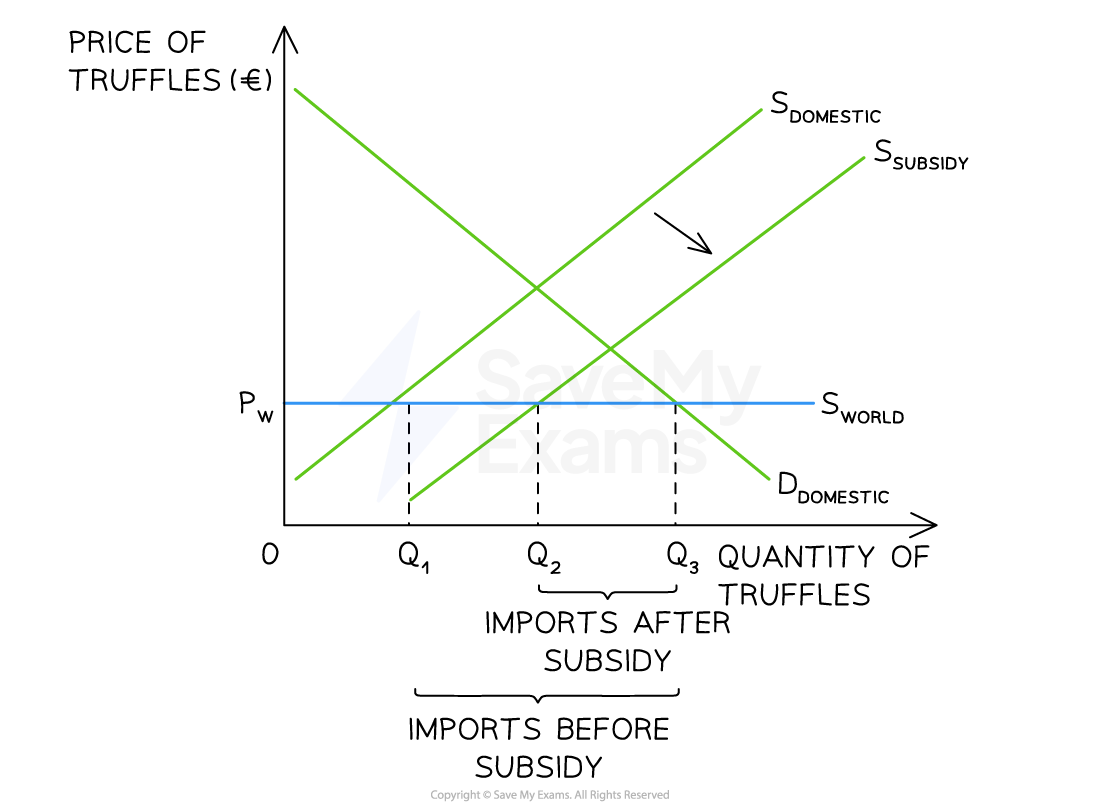
Diagram analysis
-
The domestic market for truffles in the EU was initially in equilibrium at PwQ3
-
Domestic firms supplied up to Q1, while Q2 – Q1 was imported into the EU
-
-
The implementation of the subsidy lowered firms costs of production, shifting the domestic supply curve from Sd to Sd + subsidy
-
Domestic firms increase output and market share from Q1 → Q2
-
Imports reduce from Q1Q3 → Q2Q3
-
Examiner Tips and Tricks
You do not need to be able to draw the export subsidy diagram above. However, you do need to understand how export subsidies work. Since you have studied subsidies in Micro, it is easy to apply your Micro knowledge to an export subsidy situation. For more visual learners, it helps to have the diagram above as you can then explain what you see.
Responses