
Competition in Oligopoly Markets
-
Firms in an oligopolistic market are highly competitive and can use price or non-price strategies to increase market share
-
There is a high degree of interdependence between competitors in an oligopoly market
-
Competitors closely watch each others actions
-
They are very responsive to new innovations
-
They use game theory to determine the best course of action
-
-
Non-price competition tends to be the most common way in which they compete
-
The focus of competition is on product differentiation to develop brand loyalty
-
E.g. Firms achieve this high levels of spending on advertising, branding, packaging, loyalty cards, etc
-
-
-
Price competition is less common, as firms want to avoid a price war
-
As goods and services are very close substitutes in an oligopolistic market, a price change initiated by one firm will cause other firms to react to price change
-
Individual firms will take into account the likely reactions of their competitors
-
This mutual interdependence leads to price stability or rigidity within the market
-
-
The kinked demand curve demonstrates the concept of price rigidity
-
The Kinked Demand Curve Model
-
The kinked demand curve provides one explanation of why prices are stable in oligopolistic competition
-
Rival firms react to price changes initiated by a competitor
Diagram: Kinked Demand Curve
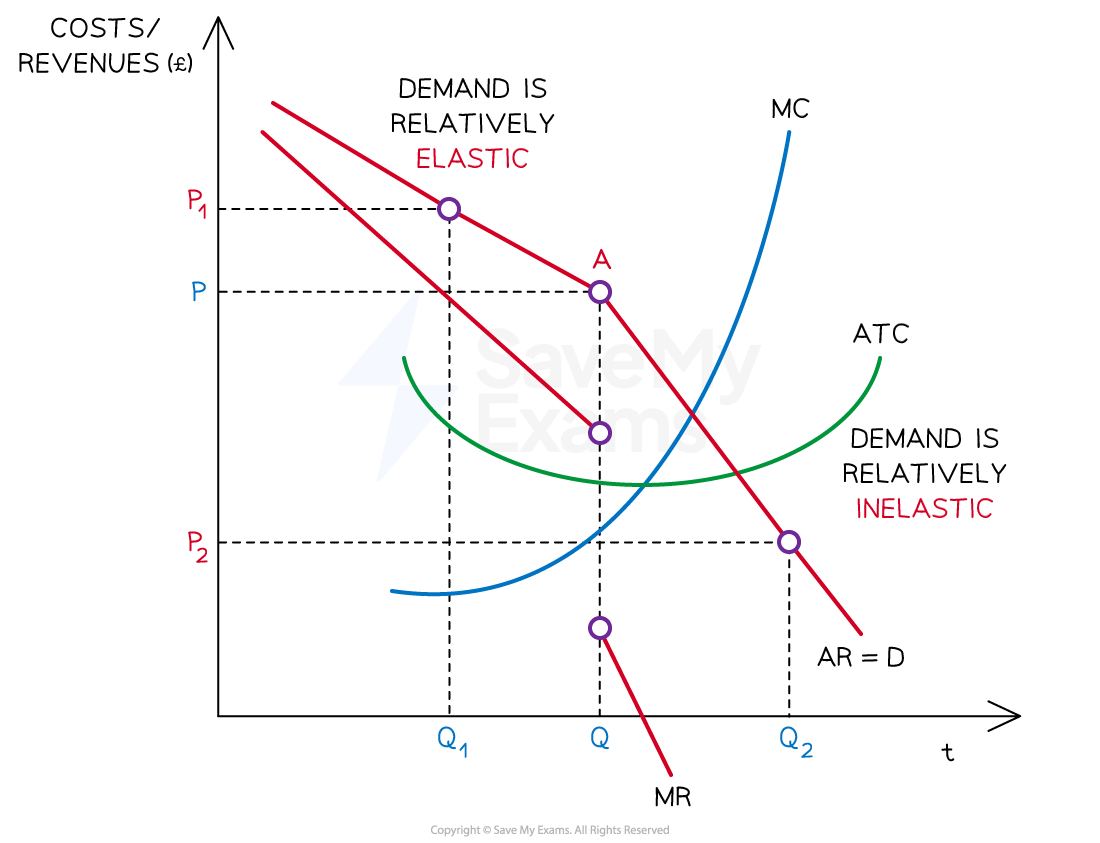
Diagram analysis
-
A firm produces a quantity of Q and sells at price P
Elastic section (above point A)
-
If a firm increases its price from P to P1, it is unlikely that rival firms will follow the price increase
-
The firm will lose consumers to rival firms if they charge a higher price
-
-
This means that a small increase in price leads to a greater than proportionate decrease in quantity demanded, resulting in an overall fall in market share and total revenue
-
This section of the demand curve is elastic
-
Inelastic section (below point A)
-
If a firm decreases its price from P to P2, it is likely that rival firms will respond by also decreasing price
-
All firms in the market will offer the new lower price
-
Market share remains the same. However, total revenue and profit decline for all
-
-
This means that a decrease in price leads to a less than proportionate increase in quantity demanded, resulting in an overall fall in total revenue
-
This section of the demand curve is inelastic
-
-
The change in elasticities, brings about a kink in the demand curve at a price level of P
-
This creates price rigidity, as firms tend not to change price due to the anticipated behaviour of competitors (mutual interdependence)
-
-
To avoid a price war, firms focus on non-price competition strategies to increase sales
-
This is why there is a high level of expenditure on research and advertising in oligopolistic industries
-
Reasons for Non-Price Competition
-
Firms in oligopolistic markets commonly engage in non-price competition
-
In other market structures, price competition is usually competitive
-
Several reasons push firms towards a focus of non-price competition
Reasons why Oligopolistic Firms Engage in Non-price Competition
|
Reason |
Explanation |
|---|---|
|
Operation of cartels |
|
|
Price leadership |
|
|
Price agreements |
|
|
Price wars |
|
|
Barriers to entry |
|
The Advantages & Disadvantages of Oligopoly
Evaluating an Oligopoly Market Structure
|
Advantages |
Disadvantages |
|---|---|
|
|
Responses