
Exam code:1CP2
Programming Validation
What is validation?
-
Validation is code which is used to check that an input from a user is acceptable and that it matches the requirements of the program
-
There are 5 main categories of validation which can be carried out on fields and data types (opens in a new tab), these are:
-
Length check
-
Range check
-
Presence check
-
Pattern check
-
-
There can be occasions where more than one type of validation will be used on a field
-
An example of this could be a password field which could have a length, presence and type check on it
-
An effective way of programming validation can be using while loops that terminate once the user has met the criteria
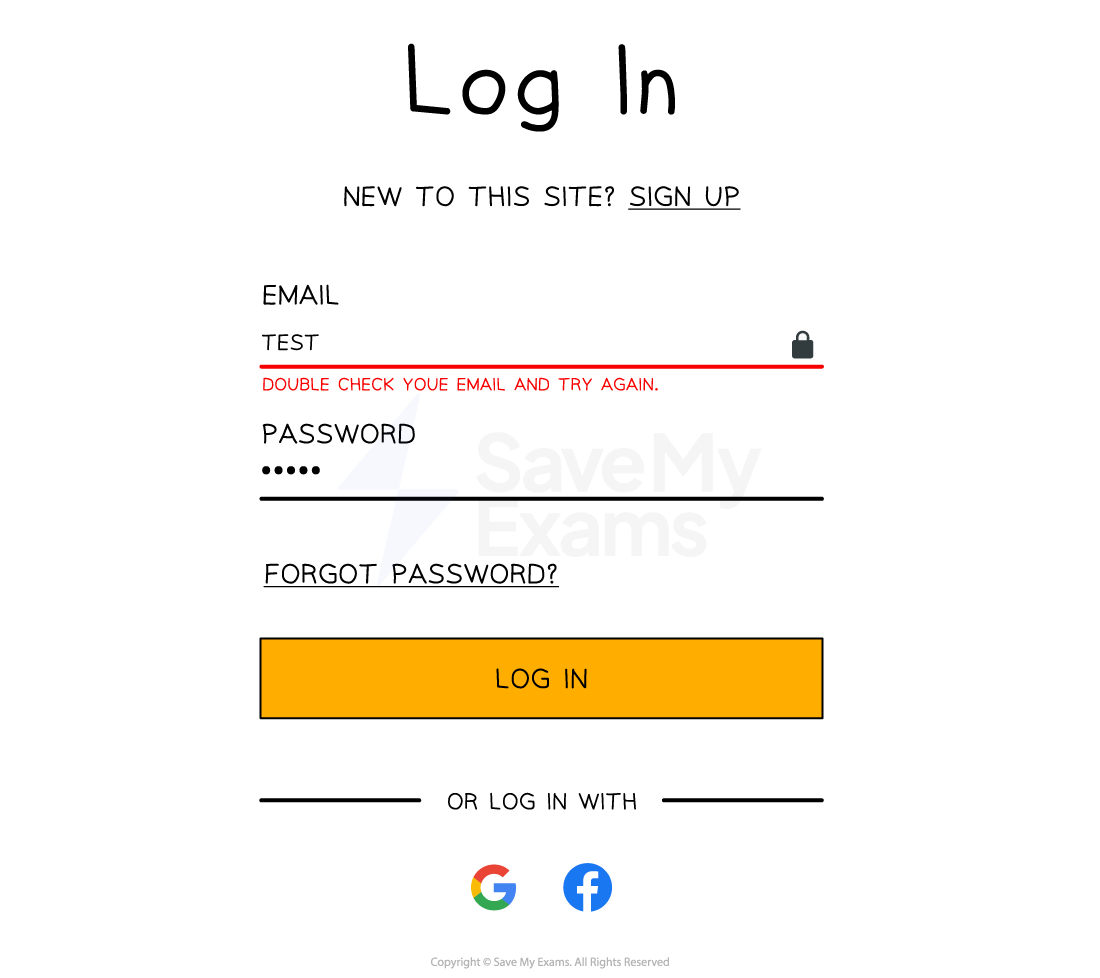
Length check
-
Checks the length of a string
-
An example is ensuring that a password is 8 or more characters in length
-
Code example
|
|
Range check
-
Ensures the data entered as a number falls within a particular range
-
An example is checking a user’s age has been entered and falls between the digits of 0-100
-
Code example
|
|
Presence check
-
Looks to see if any data has been entered in a field
-
An example is checking that a user has entered a name when registering for a website
-
Code example
|
|
Pattern check
-
Ensures that the data has been entered in the correct pattern / format
-
An example would be ensuring that an email includes the @ symbol and a full stop (.)
-
Code example
|
|
-
This could be extended further and made a little more complex by ensuring that the data entered into a program follows the set format
-
In the example below, the user must enter a postcode in the format of LL00 0LL where L is a letter and 0 is a number
-
This example uses a length check and string slicing covered in the previous revision note
-
Code example
|
|
Worked Example
A car dealership uses a computer system to record details of the cars that it has for sale. Each car has a make, model, age and number of miles driven.
The car dealership only sells cars that have fewer than 15,000 miles and are 10 years old or less.
Write an algorithm that will:
-
Ask the user to enter the number of miles and the age of a car
-
Validate the input to check that only sensible values that are in the given range are entered
-
Output True if valid data has been entered or False if invalid data has been entered [4]
How to answer this question
-
When answering any algorithm question, ask yourself:
-
What inputs and outputs do I need?
-
Do I need to do any calculations or comparisons?
-
Do I need to use selection or iteration?
-
Do I need to use a function or procedure?
-
-
Re-read the algorithm question working through the criteria given
|
Programming Skill |
Algorithm |
|---|---|
|
Inputs |
|
|
Outputs |
|
|
Calculations / Comparisons |
|
|
Selection or Iteration |
|
|
Function or Procedure |
|
Answer: i)1 mark per bullet, max 4
-
Miles and age input separately
-
Checks for valid mileage
-
Checks for valid age
-
Checks both are greater than / greater than equal to zero
-
…correctly outputs both True and False
Example Answer:
miles = int(input("enter miles driven"))age = int(input("enter age of car"))valid = Trueif miles > 15000 or miles < 0 : valid = Falseelif age > 10 or age < 0 : valid = Falseprint(valid)
Responses