
Computer Science GCES AQA
-
Representing Algorithms Aqa4 主题
-
Efficiency Of Algorithms Aqa1 主题
-
Searching Algorithms Aqa3 主题
-
Sorting Algorithms Aqa3 主题
-
Data Types Aqa1 主题
-
Programming Concepts Aqa5 主题
-
Arithmetic Relational And Boolean Operations Aqa1 主题
-
Data Structures Aqa3 主题
-
String Manipulation Aqa1 主题
-
Random Number Generation Aqa1 主题
-
Structured Programming Aqa2 主题
-
Robust And Secure Programming Aqa4 主题
-
Number Bases Aqa2 主题
-
Converting Between Number Bases Aqa3 主题
-
Units Of Information Aqa9 主题
-
Hardware And Software Aqa4 主题
-
Boolean Logic Aqa3 主题
-
Programming Languages And Translators Aqa2 主题
-
Cpu Architecture Performance And Embedded Systems Aqa4 主题
-
Memory Aqa2 主题
-
Secondary Storage Aqa3 主题
-
Fundamentals Of Computer Networks Aqa8 主题
-
Fundamentals Of Cyber Security Aqa1 主题
-
Methods Of Preventing Cyber Security Threats Aqa1 主题
-
Relational Databases Aqa2 主题
-
Ethical Legal And Environmental Impacts Aqa2 主题
Merge Sort Aqa
Exam code:8525
What is a sorting algorithm?
-
Sorting algorithms are precise step-by-step instructions that a computer can follow to efficiently sort data in massive datasets
-
Two common sorting algorithms are:
-
Bubble sort
-
Merge sort
-
Merge Sort
What is a merge sort?
-
A merge sort is a sorting algorithm that uses the ‘divide and conquer‘ strategy of dividing a dataset into smaller sub-datasets and merging them back together in the correct order
How do you perform a merge sort?
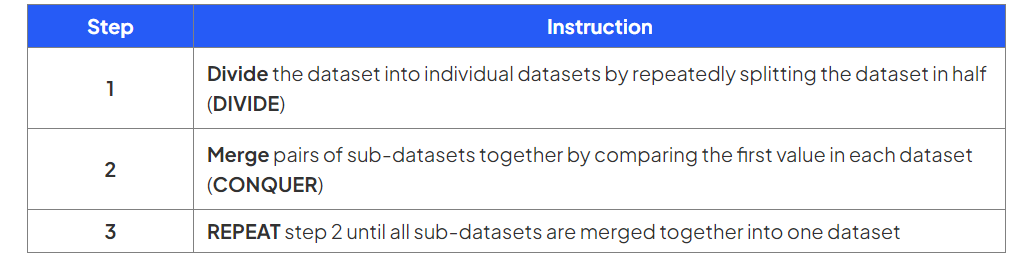
Example
-
Perform a merge sort on the following dataset
![Table showing the merge sort algorithm. The dataset [7, 4, 1, 2, 6, 3, 8, 5] is repeatedly divided, then merged back together by comparing values, resulting in a sorted array.](https://cdn.savemyexams.com/cdn-cgi/image/f=auto,width=3840/https://cdn.savemyexams.com/uploads/2024/08/51116_answer-mergesort.png)
Examiner Tips and Tricks
In the exam, the divide stage could already be done for you and you would only need to demonstrate the conquer stage!
A Merge Sort in Python
# List of numbers to perform merge sort on
numbers = [7, 4, 1, 2, 6, 3, 8, 5]
# Merge function to merge two sorted lists
def merge(left, right):
merged = []
left_index, right_index = 0, 0
# Merge the two sorted lists
while left_index < len(left) and right_index < len(right):
if left[left_index] < right[right_index]:
merged.append(left[left_index])
left_index += 1
else:
merged.append(right[right_index])
right_index += 1
# Append remaining elements from left or right sublist if there are any remaining elements in the left sublist
while left_index < len(left):
merged.append(left[left_index])
left_index += 1
# If there are any remaining elements in the right sublist
while right_index < len(right):
merged.append(right[right_index])
right_index += 1
return merged
# Merge sort implementation without using a separate function
def merge_sort(arr):
# Checks to see if the list has 1 or 0 elements, it's already sorted
if len(arr) <= 1:
return arr
# Split the list into two halves
mid = len(arr) // 2
left_half = merge_sort(arr[:mid]) # Split and recursively sort left half
right_half = merge_sort(arr[mid:]) # Split and recursively sort right half
# Merge the sorted halves
return merge(left_half, right_half)
# Perform merge sort
sorted_numbers = merge_sort(numbers)
print("Sorted numbers:", sorted_numbers)
Responses