
Computer Science AS OCR
-
1-1-structure-and-function-of-the-processor as5 主题
-
1-2-types-of-processor as3 主题
-
1-3-input-output-and-storage as2 主题
-
2-1-systems-software as8 主题
-
2-3-software-development as5 主题
-
2-4-types-of-programming-language as4 主题
-
3-1-compression-encryption-and-hashing as3 主题
-
3-2-databases as3 主题
-
3-3-networks as8 主题
-
3-4-web-technologies as13 主题
-
html as
-
css as
-
css-styling as
-
javascript as
-
variables-and-constants-in-javascript as
-
outputs-in-javascript as
-
selection-in-javascript- as
-
for-loops-in-javascript- as
-
while-loops-in-javascript- as
-
strings-in-javascript- as
-
operators-in-javascript- as
-
nested-statements-in-javascript as
-
functions-and-procedures-in-javascript as
-
html as
-
4-1-data-types as8 主题
-
4-2-data-structures as4 主题
-
4-3-boolean-algebra as1 主题
-
5-1-computing-related-legislation as4 主题
-
5-2-moral-and-ethical-issues as9 主题
-
6-1-thinking-abstractly as3 主题
-
6-2-thinking-ahead as1 主题
-
6-3-thinking-procedurally as3 主题
-
6-4-thinking-logically as2 主题
-
6-5-thinking-concurrently as2 主题
-
7-1-programming-techniques as9 主题
-
8-1-standard-algorithms-and-big-o-notation as8 主题
linear-search as
Exam code:H046
Searching Algorithms
What is a searching algorithm?
-
A searching algorithm is a method to find a specific value or element within a data structure.
-
The two most common are:
-
Binary search
-
Linear search
-
Linear search
What is a linear search?
-
The linear search is a standard algorithm used to find elements in an unordered list. The list is searched sequentially and systematically from the start to the end one element at a time, comparing each element to the value being searched for
-
If the value is found the algorithm outputs where it was found in the list
-
If the value is not found it outputs a message stating it is not in the list
-
-
An example of using a linear search would be looking for a specific student name in a list or searching for a supermarket item in a shopping list
Performing the linear search
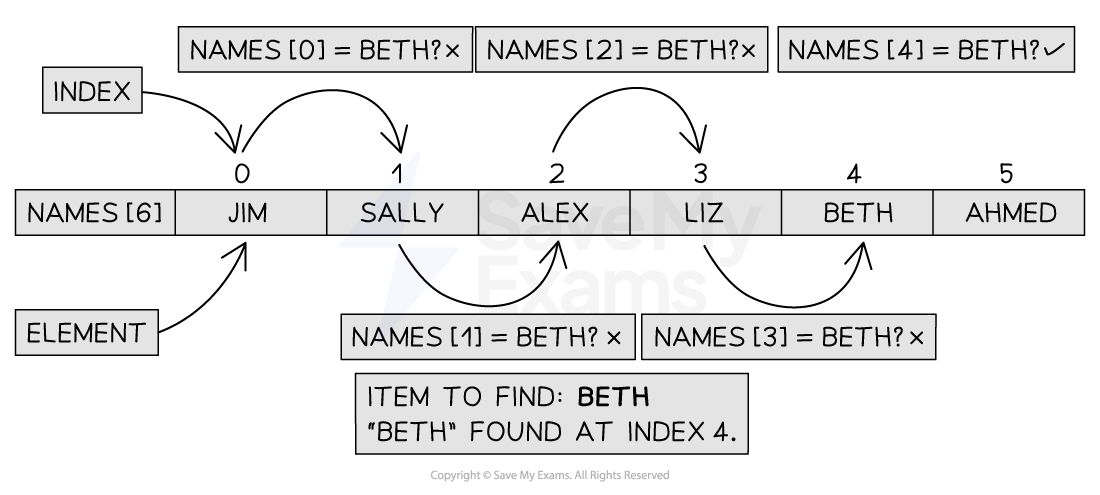
Figure 1: Performing the Linear Search
Time complexity of a linear search
-
To determine the algorithm’s execution time as measured by the number of instructions or steps carried out, Big-O notation must be used
-
The loop is executed n times, once for each item. There are two instructions within the loop, the if statement and an assignment, hence the Big-O for the loop is O(2n)
-
There are three initial statements which are O(1)
-
The overall Big-O notation is therefore 2n + 3, which when coefficients are factored out, becomes O(n) as linear time dominates constant time. The constant term and coefficients contribute significantly less as the input size n grows larger
-
It is important to remember here that O(n) is the worst case scenario. The best case scenario O(1) would find the item the first time, while the average case would be O(n/2) which when we remove coefficients still becomes O(n)
Space complexity of a linear search
-
Linear search has a space complexity of O(1) because it does not require any additional memory that grows with the size of the input
-
It only uses a constant amount of extra space, such as a loop counter or a variable to store the target value
Tracing a linear search
-
Given the following list [5, 4, 7, 1, 3, 8, 9, 2], a trace table for the linear search is shown below
Trace Table of the Linear Search
|
item |
index |
i |
list[i] |
found |
|---|---|---|---|---|
|
8 |
-1 |
0 |
5 |
False |
|
|
|
1 |
4 |
|
|
|
|
2 |
5 |
|
|
|
|
3 |
1 |
|
|
|
|
4 |
3 |
|
|
8 |
5 |
5 |
8 |
True |
Implementing a Linear Search
Pseudocode
function linearSearch(list, item) index = -1 i = 0 found = False while i < len(list) and found = False if list[i] = item then index = i found = True endif i = i + 1 endwhile return index
endfunction-
In the above algorithm, a list of n ordered items is passed to the function and three variables are initialised
-
index = -1is a default value to indicate “not found”,i = 0is a counter to ensure the loop starts at the beginning of the list andfound = Falsesets a flag to track when/if the value you are searching for is found -
The loop continues as long as the counter hasn’t reached the end of the list and if
list[i] = itemthe current index is stored as the location of the item -
The flag found is set to True to signal the search can be stopped
-
i = i + 1increments the counter to move to the next element in the list if the value is not found -
After the loop completes the function returns the final value of index
Python
def linear_search(list, item): index = -1 for i in range(len(list)): if list[i] == item: index = i break # Stop the loop once the item is found return index
Java
public class LinearSearch { public static int linearSearch(int[] list, int item) { int index = -1; for (int i = 0; i < list.length; i++) { if (list[i] == item) { index = i; break; // Stop the loop once the item is found } } return index; }
Responses