
Exam code:9618
What is a translator?
-
A translator is a program that translates program source code into machine code so that it can executed directly by a processor
-
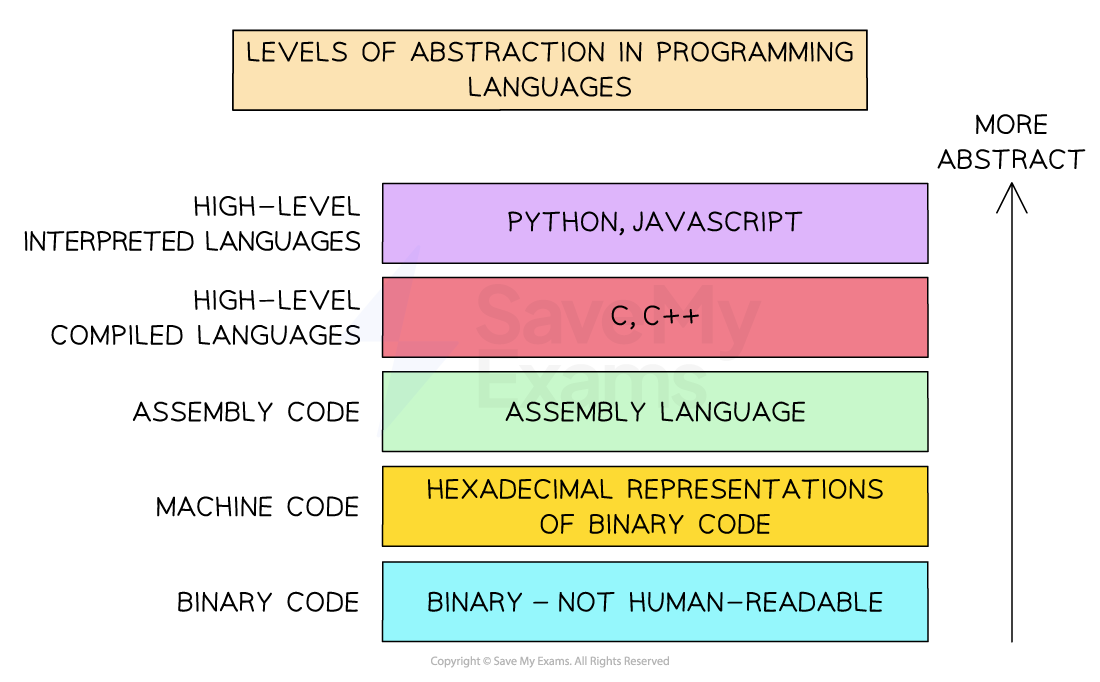
Low-level languages such as assembly code are translated using an assembler
-
High-level languages such as Python are translated using a compiler or interpreter
Assembler, compiler, interpreter
What is an assembler?
-
An assembler translates mnemonics written in assembly language (low-level) in to machine code
-
Each lime of assembly language is assembled into a single machine code instruction
-
Assemblers have been used less and less since high-level languages were introduced
|
Advantages |
Disadvantages |
|---|---|
|
Speed of execution |
Difficult to write due to limited and hard to understand commands |
|
Optimises the code |
Changes mean it must be reassembled |
|
Original source code will not be seen |
Designed solely for one specific processor |
What is a compiler?
-
A compiler translates high-level languages into machine code all in one go
-
Compilers translate inputs into machine code directly
-
Compilers are generally used when a program is finished and has been checked for syntax errors
-
Compiled code can be distributed (creates an executable) and run without the need for translation software
-
If compiled code contains any errors, after fixing, it will need re-compiling
|
Advantages |
Disadvantages |
|---|---|
|
Speed of execution |
Can be memory intensive |
|
Optimises the code |
Difficult to debug |
|
Original source code will not be seen |
Changes mean it must be recompiled |
|
|
It is designed solely for one specific processor |
What is an interpreter?
-
An interpreter translates high-level languages into machine code one line at a time
-
Each line is executed after translation and if any errors are found, the process stops
-
Interpreters do not generate machine code directly, appropriate machine code subroutines are called
-
Interpreters are generally used when a program is being written in the development stage
-
Interpreted code is more difficult to distribute as translation software is needed for it to run
|
Advantages |
Disadvantages |
|---|---|
|
Stops when it finds a specific syntax error in the code |
Slower execution |
|
Easier to debug |
Every time the program is run it has to be translated |
|
Require less RAM to process the code |
Executed as is, no optimisation |
Compiler vs interpreter
|
Aspect |
Compiler |
Interpreter |
|---|---|---|
|
Software needed by user |
End users only need the executable file, not the compiler – so there’s no extra cost or setup |
End users need an interpreter or compiler to translate and run the source code – may involve setup or cost |
|
Access to source code |
Users do not receive the source code, so they can’t modify or extend the program |
Users receive the full source code, making it easier to modify or extend the program themselves |
|
Control and monetisation |
Developers keep control of the code and can charge for upgrades or customisations |
Developers lose control over their code, making it harder to monetise upgrades or prevent copying |
|
Speed of execution |
Compiled programs run faster, as translation is done in advance and optimised machine code is used |
Interpreted programs run slower, since each line is translated every time it runs |
|
Error handling |
Compiled programs don’t run until all syntax and semantic errors are fixed |
Errors are caught one line at a time, making it easier for the developer to test and fix during development |
|
Portability |
Compiled code can be run on different machines, regardless of where it was compiled |
Interpreted programs must be interpreted on the same type of machine – less portable |
|
Debugging experience |
More difficult to test sections – developers need to write special routines to check partial results |
Developers can view partial results as they go, making it easier to test, debug, and refine ideas |
|
Crash risk |
Untested compiled programs may crash the system if run with errors |
Interpreted programs are safer during testing – errors are caught before the system can crash |
|
User independence |
Users are reliant on the developer for updates or modifications – they can’t edit the code themselves |
Users have full access to code and libraries, giving them freedom to customise or fix the program |
Mixed mode translation
What is mixed mode translation?
-
Mixed mode translation combines features of both a compiler and an interpreter
-
Instead of fully compiling or interpreting the code, the program is partially compiled into an intermediate form, which is then interpreted at runtime
-
It works by:
-
The source code is compiled into intermediate code, not full machine code
-
This intermediate code (e.g. bytecode) is interpreted by a virtual machine (e.g. the Java Virtual Machine – JVM)
-
Optionally, some parts may later be just-in-time (JIT) compiled into machine code for better performance
-
-
Java uses mixed mode translation:
-
Java source code is compiled to bytecode (.class file)
-
Bytecode is interpreted (or JIT compiled) by the JVM on any platform
-
|
Feature |
Compiler |
Interpreter |
Mixed mode translation |
|---|---|---|---|
|
Translation |
Entire program at once |
One line at a time |
Compiles to intermediate code |
|
Speed of execution |
Fastest (fully compiled) |
Slowest |
Medium (JIT makes it faster over time) |
|
Portability |
Not portable |
Not portable |
Highly portable (across platforms) |
|
Errors shown |
After full compilation |
One at a time |
During compile or runtime |
|
Requires runtime system |
No |
Yes |
Yes (e.g. JVM) |
|
Example languages |
C, C++ |
Python, JavaScript |
Java, C# (with .NET CLR) |
Worked Example
Jennifer uses an Integrated Development Environment (IDE) to write her computer program.
The IDE allows Jennifer to use both an interpreter and a compiler while creating her computer program.
Describe the ways in which Jennifer can use both a compiler and an interpreter while developing the program.[4]
Answer
Interpreter:
-
Use an interpreter while writing the program [1 mark]
-
… to test/debug the partially completed program [1 mark]
-
… because errors can be corrected and processing continue from where the execution stopped // errors can be corrected in real time // errors are identified one at a time [1 mark]
Compiler:
-
Use the compiler after the program is complete [1 mark]
-
… to create an executable file [1 mark]
-
Use the compiler to repeatedly test the same (completed) section [1 mark]
-
… without having to re-interpret every time // compiler not needed at runtime [1 mark]
Responses