
Computer-Science-A-level-Ocr
-
3-3-networks8 主题
-
3-2-databases7 主题
-
3-1-compression-encryption-and-hashing4 主题
-
2-5-object-oriented-languages7 主题
-
2-4-types-of-programming-language4 主题
-
2-3-software-development5 主题
-
2-2-applications-generation6 主题
-
2-1-systems-software8 主题
-
1-3-input-output-and-storage2 主题
-
1-2-types-of-processor3 主题
-
1-1-structure-and-function-of-the-processor1 主题
-
structuring-your-responses3 主题
-
the-exam-papers2 主题
-
8-2-algorithms-for-the-main-data-structures4 主题
-
8-1-algorithms10 主题
-
7-2-computational-methods11 主题
-
7-1-programming-techniques14 主题
-
capturing-selecting-managing-and-exchanging-data
-
entity-relationship-diagrams
-
data-normalisation
-
relational-databases
-
hashing
-
symmetric-vs-asymmetric-encryption
-
run-length-encoding-and-dictionary-coding
-
lossy-and-lossless-compression
-
polymorphism-oop
-
encapsulation-oop
-
inheritance-oop
-
attributes-oop
-
methods-oop
-
objects-oop
-
capturing-selecting-managing-and-exchanging-data
-
6-5-thinking-concurrently2 主题
-
6-4-thinking-logically2 主题
-
6-3-thinking-procedurally3 主题
-
6-2-thinking-ahead1 主题
-
6-1-thinking-abstractly3 主题
-
5-2-moral-and-ethical-issues9 主题
-
5-1-computing-related-legislation4 主题
-
4-3-boolean-algebra5 主题
-
4-2-data-structures10 主题
-
4-1-data-types9 主题
-
3-4-web-technologies16 主题
-
environmental-effects
-
automated-decision-making
-
computers-in-the-workforce
-
layout-colour-paradigms-and-character-sets
-
piracy-and-offensive-communications
-
analysing-personal-information
-
monitoring-behaviour
-
censorship-and-the-internet
-
artificial-intelligence
-
the-regulation-of-investigatory-powers-act-2000
-
the-copyright-design-and-patents-act-1988
-
the-computer-misuse-act-1990
-
the-data-protection-act-1998
-
adder-circuits
-
flip-flop-circuits
-
simplifying-boolean-algebra
-
environmental-effects
graphs-traversing-adding-and-removing-data-
Graphs: Traversing, Adding & Removing Data
How do you traverse a graph?
-
There are two approaches to traversing a graph:
-
A breadth-first search
-
A depth-first search
-
Breadth-first search
-
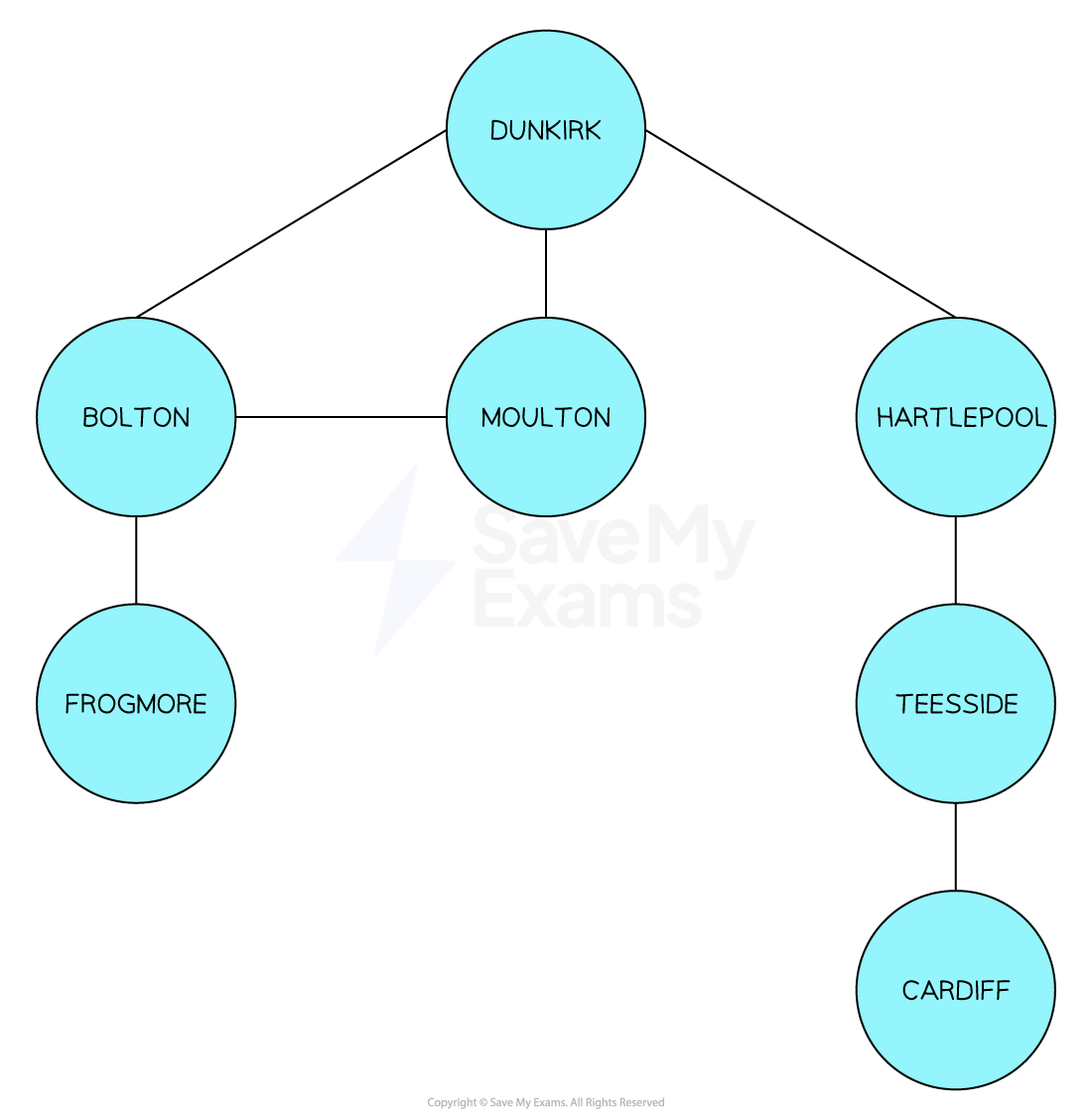
A breadth-first search is a graph traversal algorithm which systematically visits all neighbours of a given vertex before moving on to their neighbours. It then repeats this layer by layer.
-
This method makes use of a queue data structure to enqueue each node as long as it is not already in a list of visited nodes.
-
Take the example above, the root node, Dunkirk, would be set as the current node and then added to the visited list
|
Dunkirk |
|---|
-
Moving from left to right, we must check if the connected node isn’t already in the visited list, if it is not, it is enqueued to the queue.
The first version of the queue would have appeared as
|
Front Pointer |
Back Pointer |
Position |
Data |
|---|---|---|---|
|
|
|
5 |
|
|
|
|
4 |
|
|
|
|
3 |
|
|
→ |
→ |
2 |
Hartlepool |
|
→ |
→ |
1 |
Moulton |
|
→ |
→ |
0 |
Bolton |
|
→ |
→ |
-1 |
Empty |
-
That linked vertex is then added to the visited list. Finally, it is removed from the queue as this process repeats. This means that all nodes, from left to right are enqueued to the queue in turn, before being added to the visited list, and then dequeued from the queue
-
Output all of the visited vertices
Our final visited list would appear as
|
Dunkirk, Bolton, Moulton, Hartlepool, Frogmore, Teesside, Cardiff |
|---|
The final version of the queue would have appeared as
|
Front Pointer |
Back Pointer |
Position |
Data |
|---|---|---|---|
|
→ |
→ |
5 |
Cardiff |
|
→ |
→ |
4 |
Teesside |
|
→ |
→ |
3 |
Frogmore |
|
→ |
→ |
2 |
Hartlepool |
|
→ |
→ |
1 |
Moulton |
|
→ |
→ |
0 |
Bolton |
|
→ |
→ |
-1 |
Empty |
Depth-first search
-
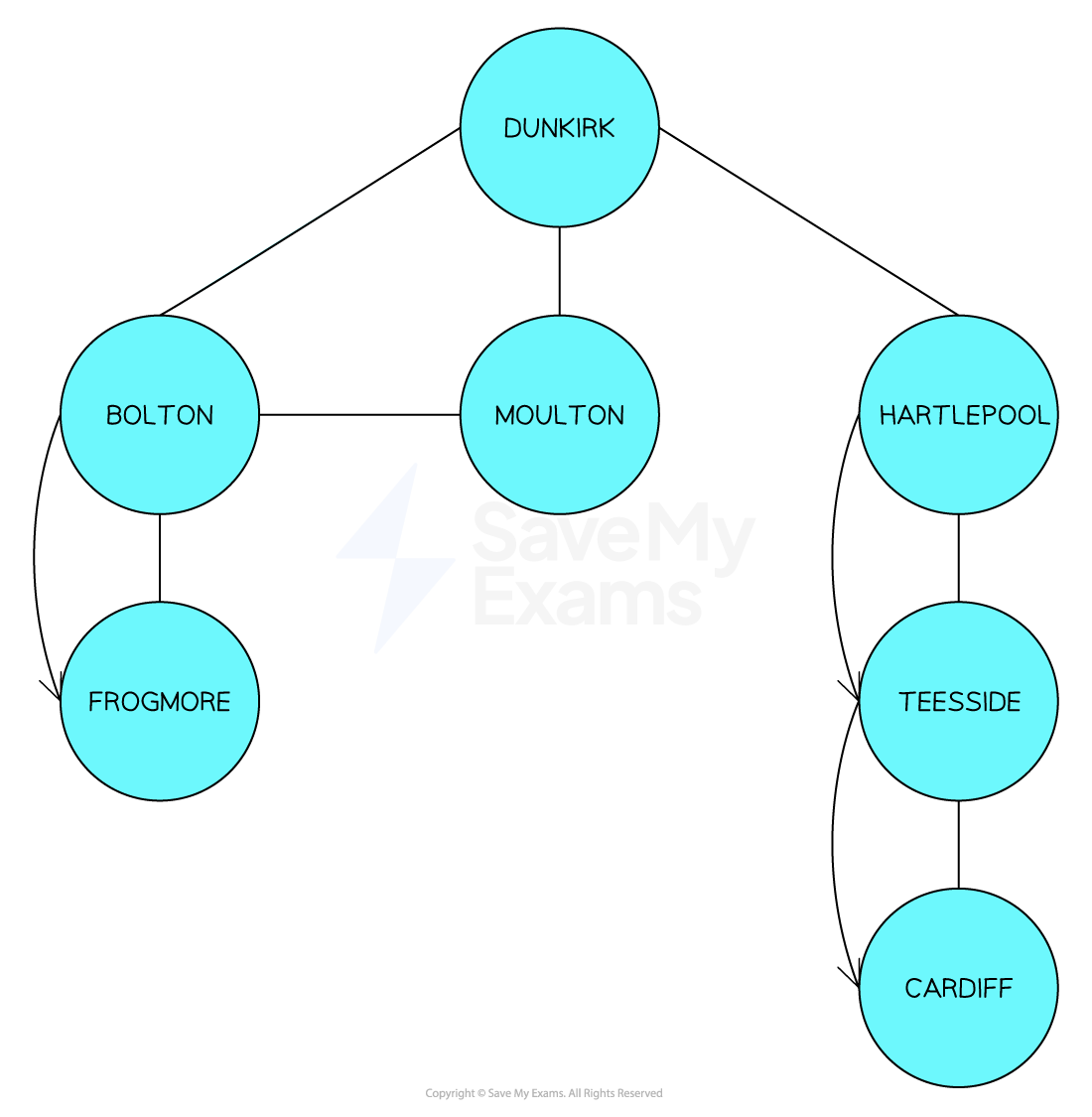
In A Level Computer Science, a depth-first search is a graph traversal algorithm which uses an edge-based system
-
This method makes use of a stack data structure to push each visited node onto the stack and then pop them from the stack when there are no nodes left to visit
Examiner Tips and Tricks
There is no right method to use when performing a depth-first search, it simply depends on how the algorithm is implemented. Most mark schemes commonly traverse the left-most path first, therefore that will be used in this example.
Using the example from above, Dunkirk, would be set as the current node and then added to the visited list
|
Dunkirk |
|---|
-
Then check if the connected node isn’t already in the visited list, if it is not, it pushed to the stack.
The first version of the stack would appear as
|
Pointer |
Position |
Data |
|---|---|---|
|
|
5 |
|
|
|
4 |
|
|
|
3 |
|
|
→ |
2 |
Bolton |
|
→ |
1 |
Moulton |
|
→ |
0 |
Hartlepool |
|
→ |
-1 |
Empty |
-
Next, any connected node that is not on the visited list is then pushed to the stack.
-
Then pop the stack to remove the item and set it as the current node.
-
Output all of the visited nodes
Our final visited list would appear as
|
Dunkirk, Bolton, Frogmore, Moulton, Hartlepool, Teesside, Cardiff |
|---|
You could visualise how the graph has been traversed below, with the left-most column first, then the middle, then the right-most column.
Adding & removing data in graphs
-
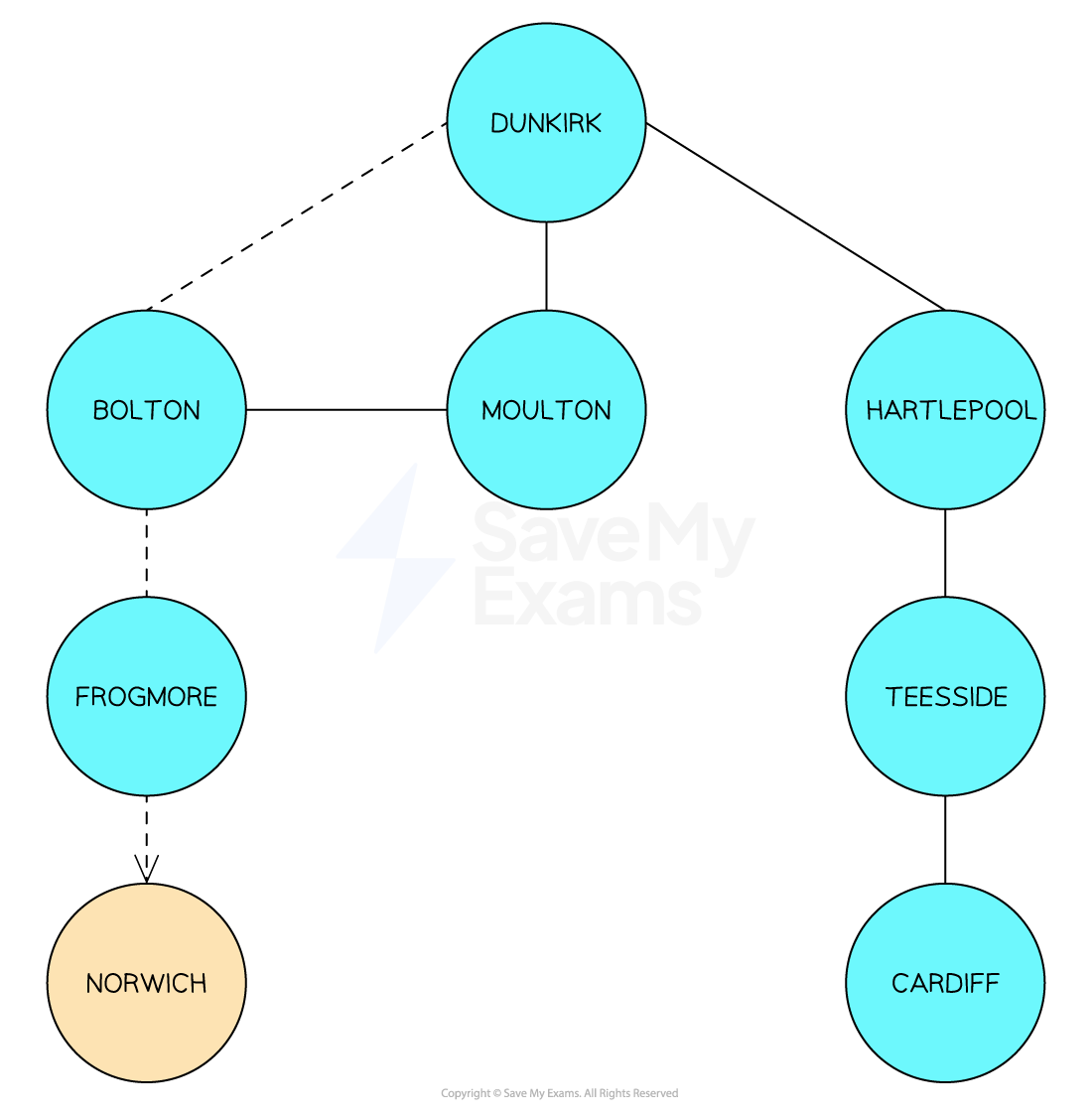
There is no single algorithm for adding or deleting a node in a graph. This is because a graph can have a number of nodes connected to any number of other nodes.
-
As a result, it is more important that there are a clear set of instructions to easily traverse the graph to find the specific node.
-
A Binary Tree is a special type of graph and it does have an algorithm for adding and deleting items. This is covered in the content titles’ Binary Search Trees’.
Examiner Tips and Tricks
</h
Responses