
Computer-Science-A-level-Ocr
-
3-3-networks8 主题
-
3-2-databases7 主题
-
3-1-compression-encryption-and-hashing4 主题
-
2-5-object-oriented-languages7 主题
-
2-4-types-of-programming-language4 主题
-
2-3-software-development5 主题
-
2-2-applications-generation6 主题
-
2-1-systems-software8 主题
-
1-3-input-output-and-storage2 主题
-
1-2-types-of-processor3 主题
-
1-1-structure-and-function-of-the-processor1 主题
-
structuring-your-responses3 主题
-
the-exam-papers2 主题
-
8-2-algorithms-for-the-main-data-structures4 主题
-
8-1-algorithms10 主题
-
7-2-computational-methods11 主题
-
7-1-programming-techniques14 主题
-
capturing-selecting-managing-and-exchanging-data
-
entity-relationship-diagrams
-
data-normalisation
-
relational-databases
-
hashing
-
symmetric-vs-asymmetric-encryption
-
run-length-encoding-and-dictionary-coding
-
lossy-and-lossless-compression
-
polymorphism-oop
-
encapsulation-oop
-
inheritance-oop
-
attributes-oop
-
methods-oop
-
objects-oop
-
capturing-selecting-managing-and-exchanging-data
-
6-5-thinking-concurrently2 主题
-
6-4-thinking-logically2 主题
-
6-3-thinking-procedurally3 主题
-
6-2-thinking-ahead1 主题
-
6-1-thinking-abstractly3 主题
-
5-2-moral-and-ethical-issues9 主题
-
5-1-computing-related-legislation4 主题
-
4-3-boolean-algebra5 主题
-
4-2-data-structures10 主题
-
4-1-data-types9 主题
-
3-4-web-technologies16 主题
-
environmental-effects
-
automated-decision-making
-
computers-in-the-workforce
-
layout-colour-paradigms-and-character-sets
-
piracy-and-offensive-communications
-
analysing-personal-information
-
monitoring-behaviour
-
censorship-and-the-internet
-
artificial-intelligence
-
the-regulation-of-investigatory-powers-act-2000
-
the-copyright-design-and-patents-act-1988
-
the-computer-misuse-act-1990
-
the-data-protection-act-1998
-
adder-circuits
-
flip-flop-circuits
-
simplifying-boolean-algebra
-
environmental-effects
simplifying-boolean-algebra
What is Boolean algebra?
-
In A Level Computer Science, Boolean algebra is a mathematical system used to manipulate Boolean values
-
Complex expressions can be made simpler using the rules of Boolean algebra
-
This is a more powerful simplification method than Karnaugh maps and can simplify expressions that Karnaugh maps cannot
-
There are various different rules that you need to learn and that can then be applied to certain expressions to simplify them
-
Combining these rules can mean that complex expressions can be reduced to much simpler ones
General rules
-
General AND rules
-
X AND 0 = 0
-
X AND 1 = X
-
X AND A = X
-
NOT X AND X = 0
-
-
Note, the value ox X is unknown and it is used as a placeholder. Therefore X AND 1 = X means that the output will be whatever the value of X is
-
General OR rules
-
X OR 0 = X
X OR 1 = 1
X OR A = X
NOT X OR X = 1
-
De Morgan’s Law
What is De Morgan’s Law?
-
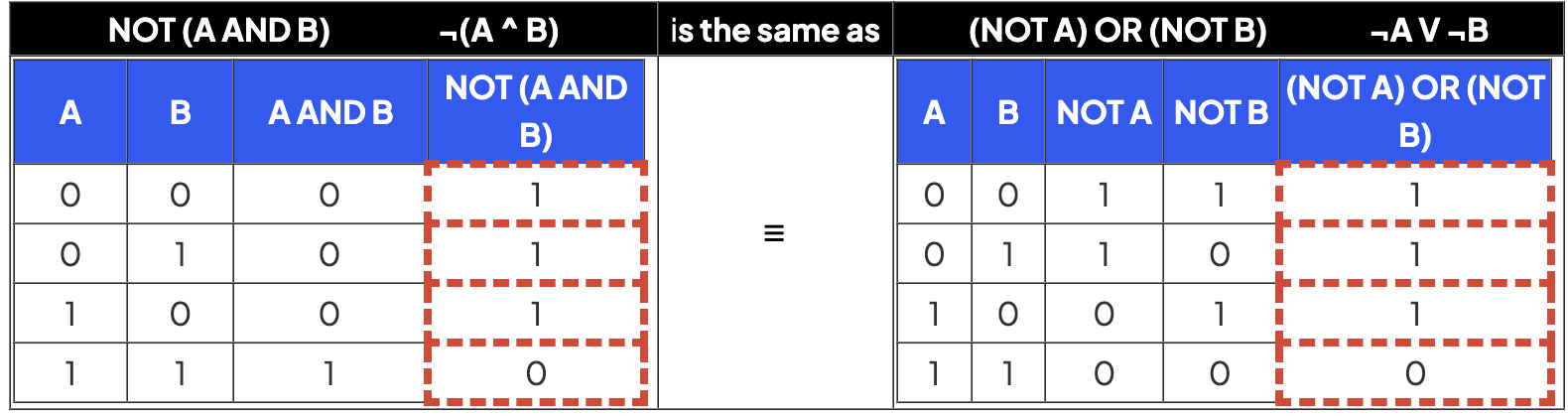
In A Level Computer Science, De Morgan’s Law is a strategy for simplifying expressions that include a negation of a conjunction or disjunction (simplifying by inverting all variable)
-
NOT(A AND B) is the same as (NOT A) OR (NOT B)
-
Step 1
-
Change AND to OR (or vice versa) – ¬(A V B)
-
-
Step 2
-
NOT the terms either side of the operator – ¬(¬A V ¬B)
-
-
Step 3
-
NOT everything that has changed – ¬¬(¬A V ¬B)
-
-
Step 4
-
Get rid of any double negation – (¬A V ¬B)
-
-
Step 5
-
Remove any unnecessary brackets – ¬A V ¬B
-
-
NOT(A OR B) is the same as (NOT A) AND (NOT B)

-
Step 1
-
Change AND to OR (or vice versa) – ¬(A ^ B)
-
-
Step 2
-
NOT the terms either side of the operator – ¬(¬A ^ ¬B)
-
-
Step 3
-
NOT everything that has changed – ¬¬(¬A ^ ¬B)
-
-
Step 4
-
Get rid of any double negation – (¬A ^ ¬B)
-
-
Step 5
-
Remove any unnecessary brackets – ¬A ^ ¬B
-
-
Simplifying using this law allows the use of only NAND or NOR gates which makes building microprocessors much easier (i.e. Flash drives)
Distribution
What is distributive law?
-
This explains how AND and OR interact with each other
-
This is a bit like factorising in normal maths
-
A AND (B OR C) is the same as (A AND B) OR (A AND C)
-
A OR (B AND C) is the same as (A OR B) AND (A OR C
Real-life example
-
“You can pick one subject from group A and either one from group B or group C“
-
is the same as
-
“You can pick one subject from group A and one from group B or one subject from group A and one from group C“
Association
What is associative law?
-
This explains how variables associate in expressions of more than two variables
-
Allows us to remove brackets and regroup variables
-
(A AND B) AND C is the same as A AND (B AND C) is the same as A AND B AND C
-
(A OR B) OR C is the same as A OR (B OR C) is the same as A OR B OR C
Real-life example
-
“Zarmeen and her friends, Zahra and Ella have been chosen to represent the school”
-
is the same as
-
“Zarmeen and Zahra, and their friend Ella have been chosen to represent the school”
-
is the same as
-
“Zarmeen, Zahra and Ella have been chosen to the represent the school”
Commutation
What is commutative law?
-
States that the order of the variables does not change the truth value of the expression
-
A AND B is the same as B AND A
-
A OR B is the same as B OR A
Real-life example
-
“Fynn and George won gold medals”
-
is the same as
-
George and Fynn won gold medals”
Double Negation
What is double negation law?
-
States that the double negation of a variable results in the original variable
-
NOT(NOT(A)) = A
Real-life example
-
“I don’t not want to visit the castle”
-
is the same as
-
“I do want to visit the castle”
Worked Example
SIMPLIFYING EXPRESSION EXAMPLE
Simplify (A v B) ^ (A v C)
How to answer this question:
Step one – Distribution
This is a bit like multiplying out the brackets in an expression in regular maths. Think of OR being like ADD and AND being like MULTIPLY.
(A v B) ^ (A v C)
becomes
(A ^ A) v (B ^ A) v (A ^ C) v (B ^ C)
Step two – General rules
Since (A ^ A) is just A we can replace this term in the expression with a simpler one.
(A ^ A) v (B ^ A) v (A ^ C) v (B ^ C)
becomes
A v (B ^ A) v (A ^ C) v (B ^ C)
Step three – Commutation
This means the order of the logical operators does not matter so can change (B ^ A) into (A ^ B).
A v (B ^ A) v (A ^ C) v (B ^ C)
becomes
A v (A ^ B) v (A ^ C) v (B ^ C)
Step four – Absorption
This rule says that A AND (A OR B) = A.
A v (A ^ B) v (A ^ C) v (B ^ C)
becomes
A v (A ^ C) v (B ^ C)
Step five – Another absorption
Again this rule says that A AND (A OR C) = A so
A v (A ^ C) v (B ^ C)
becomes
A v (B ^ C)
Example answer that gets full marks:
A v (B ^ C)
Responses