
Computer-Science-A-level-Ocr
-
3-3-networks8 主题
-
3-2-databases7 主题
-
3-1-compression-encryption-and-hashing4 主题
-
2-5-object-oriented-languages7 主题
-
2-4-types-of-programming-language4 主题
-
2-3-software-development5 主题
-
2-2-applications-generation6 主题
-
2-1-systems-software8 主题
-
1-3-input-output-and-storage2 主题
-
1-2-types-of-processor3 主题
-
1-1-structure-and-function-of-the-processor1 主题
-
structuring-your-responses3 主题
-
the-exam-papers2 主题
-
8-2-algorithms-for-the-main-data-structures4 主题
-
8-1-algorithms10 主题
-
7-2-computational-methods11 主题
-
7-1-programming-techniques14 主题
-
capturing-selecting-managing-and-exchanging-data
-
entity-relationship-diagrams
-
data-normalisation
-
relational-databases
-
hashing
-
symmetric-vs-asymmetric-encryption
-
run-length-encoding-and-dictionary-coding
-
lossy-and-lossless-compression
-
polymorphism-oop
-
encapsulation-oop
-
inheritance-oop
-
attributes-oop
-
methods-oop
-
objects-oop
-
capturing-selecting-managing-and-exchanging-data
-
6-5-thinking-concurrently2 主题
-
6-4-thinking-logically2 主题
-
6-3-thinking-procedurally3 主题
-
6-2-thinking-ahead1 主题
-
6-1-thinking-abstractly3 主题
-
5-2-moral-and-ethical-issues9 主题
-
5-1-computing-related-legislation4 主题
-
4-3-boolean-algebra5 主题
-
4-2-data-structures10 主题
-
4-1-data-types9 主题
-
3-4-web-technologies16 主题
-
environmental-effects
-
automated-decision-making
-
computers-in-the-workforce
-
layout-colour-paradigms-and-character-sets
-
piracy-and-offensive-communications
-
analysing-personal-information
-
monitoring-behaviour
-
censorship-and-the-internet
-
artificial-intelligence
-
the-regulation-of-investigatory-powers-act-2000
-
the-copyright-design-and-patents-act-1988
-
the-computer-misuse-act-1990
-
the-data-protection-act-1998
-
adder-circuits
-
flip-flop-circuits
-
simplifying-boolean-algebra
-
environmental-effects
programming-encapsulation
Programming Encapsulation
-
To program encapsulation, you should already have a solid understanding of what encapsulation in Object Oriented Programming (OOP) is.
How do you Define Encapsulation?
Get Methods
-
The “get” method is a common naming convention for a type of method that is used to retrieve the value of an object’s private attributes (instance variables).
-
These methods are also known as “getter” methods or “accessor” methods.
-
The main purpose of a get method is to provide controlled access to the internal state (data) of an object without allowing direct modification.
-
Attributes are often declared as private to achieve encapsulation, so cannot be accessed directly from outside the class.
-
External code can use the public get methods to read the values of these private attributes (also known as instance variables).
Pseudocode
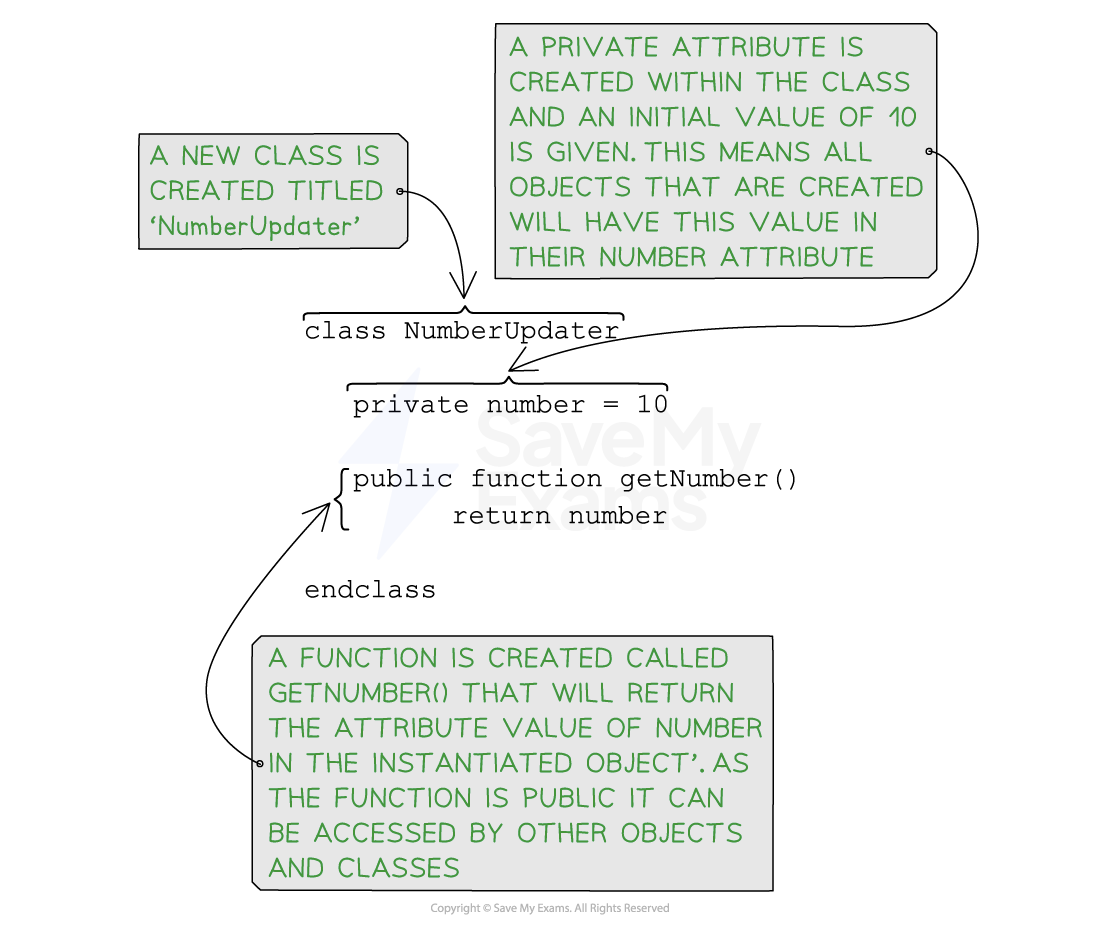
Pseudocode for a get method
Java
//creating a class called NumberUpdater
public class NumberUpdater {
//setting the private attribute to the value of 10
private int number = 10;
//creating a get method that will return the value store in the number attribute
public int getNumber() {
return number;
}
}
Python
#creating a class called NumberUpdater
class NumberUpdater:
#setting the private attribute to the value of 10
def __init__(self):
self.__number = 10
#creating a get method that will return the value stored in the number attribute
@property
def number(self):
return self.__number
Set Methods
-
The “set” method is a common naming convention for a type of method that is used to set the value of object’s private instance variables.
-
Setter methods, also known as “setter” methods or “mutator” methods
-
Generally additional code is written within the method to allow controlled access by enforcing certain conditions or validations before updating the attribute
Pseudocode
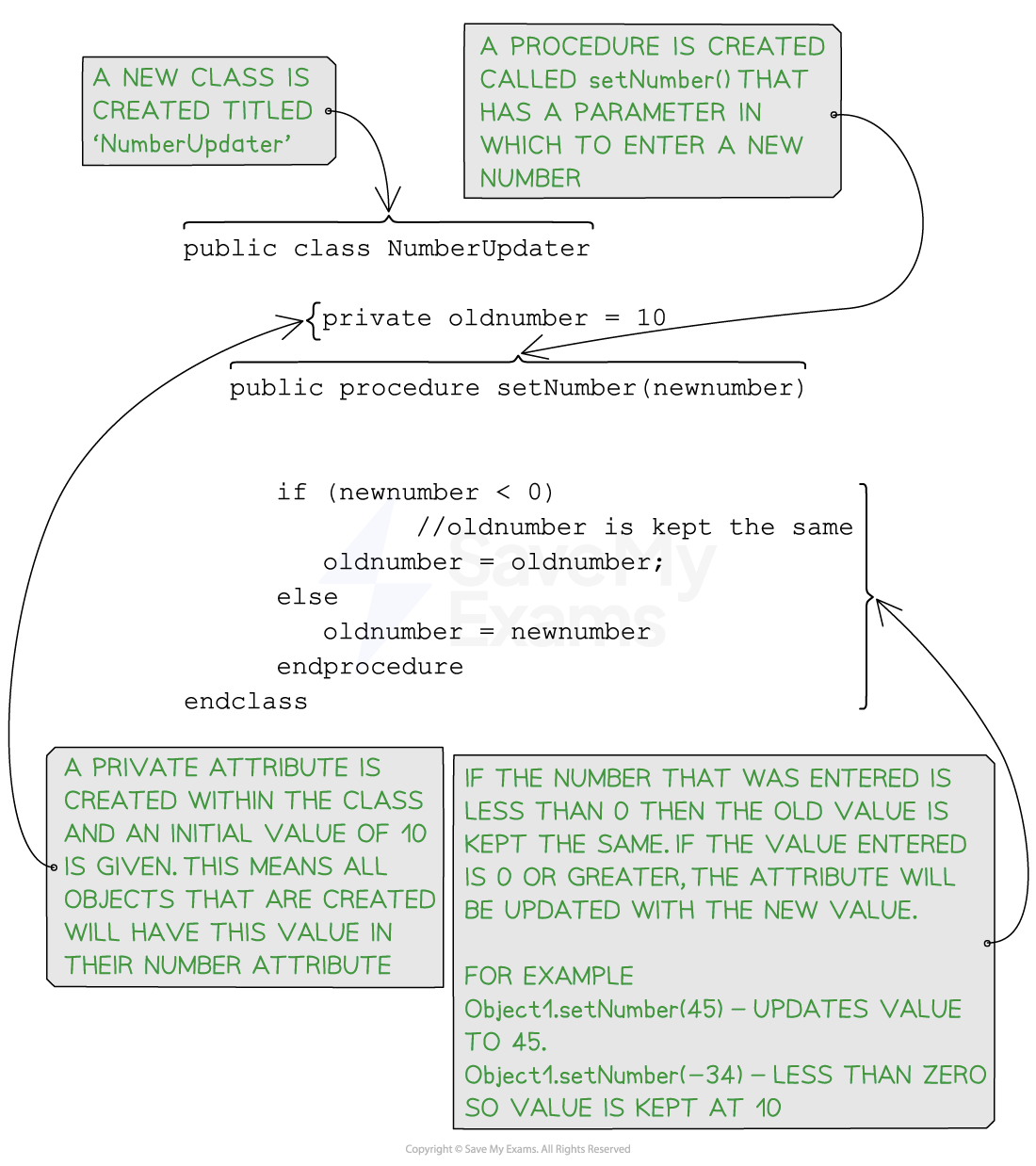
Pseudocode for a “setter” method
Java
//creating a class called NumberUpdater
public class NumberUpdater
//setting attribute value to 10
private int oldnumber = 10;
//creating a set method
public void setNumber(int newnumber) {
//if the new number is less than zero
if (newnumber < 0) {
//oldnumber is kept the same
oldnumber = oldnumber;
} else {
//oldnumber is updated with the new number value
oldnumber = newnumber;
}
}
}
Python
//creating a class called NumberUpdater
class NumberUpdater:
//setting attribute value to 10
def __init__(self):
self.__oldnumber = 10
//creating a set method
def setNumber(self, newnumber):
//if the new number is less than zero
if newnumber < 0:
//oldnumber is kept the same
self.__oldnumber = self.__oldnumber
else:
//oldnumber is updated with the new number value
self.__oldnumber = newnumber
Responses