
Push factors
-
Push factors are factors that push a business to expand outside of its own country
-
When faced with saturated markets or intense competition, businesses may consider engaging in international trade as a way to access new markets, diversify their customer base and gain a competitive advantage
-
There may be adverse conditions within a domestic market, which may cause a business to look at opportunities in countries abroad
-
E.g. due to the UK leaving the European Union, some businesses have decided to move their operations outside the country
-
Sony has moved its headquarters from the UK to the Netherlands
-
Honda closed a production plant in Wales in 2021
-
HSBC chose to move its London base to France
-
-
Saturated markets
-
Saturated markets occur when the demand for goods and services has reached a peak, so it becomes challenging for businesses to grow and expand within the local market
-
This often prompts businesses to explore opportunities in global markets, which can help sustain their growth and profitability
Intense competition
-
In a competitive market, businesses need to find ways to differentiate themselves and gain a competitive advantage
-
One way to achieve this is by exploring new markets and expanding their customer base
-
By exporting goods and services to new markets, businesses can reduce their reliance on a single market and diversify their revenue streams, thereby reducing their exposure to market volatility and competition
Pull factors
-
Pull factors encourage businesses to operate within markets abroad that present significant growth opportunities
-
Two pull factors that can prompt trade are economies of scale and risk spreading
Benefiting from economies of scale
-
Economies of scale usually occur when a business expands its production into new markets abroad
-
Businesses may also be able to purchase raw materials and labour at lower prices than within their domestic markets
-
E.g. Ikea expanded into China as there was opportunity for growth with families demanding more furniture due to the removal of the one-child policy
-
Producing furniture in China helped to reduce transportation and distribution costs
-
Spreading risk
-
By accessing multiple markets, businesses can diversify their customer base and reduce their exposure to risks associated with operating in a single market
-
This can include economic, political and other types of risks that could impact their operations and profitability
-
E.g. Aston Martin produces motor cars in the UK, but it exports them to multiple markets to reduce exposure to risks associated with operating in a single market
-
There may be a recession in the UK but not in the USA
-
-
Offshoring and outsourcing
-
Businesses use offshoring and outsourcing to develop their international trade
Offshoring
-
Offshoring is when a company moves part of the production process, or all of it, to another country
-
Reasons for offshoring include:
-
Lower labour costs
-
Access to raw materials
-
Access to skilled labour
-
Advantages and disadvantages of offshoring
|
Advantages of offshoring |
Disadvantages of offshoring |
|---|---|
|
|
|
|
|
|
Outsourcing
-
Outsourcing occurs when a business hires an external organisation to complete certain tasks or business functions
-
E.g. Apple outsources the production of the iPhone to Foxconn in China
-
-
The key reasons for a business choosing to outsource include:
-
Reduced costs
-
Allows businesses to focus on core competencies
-
Easier to comply with rules and regulations in other countries, as they are often less demanding for a local business
-
-
The main difference between offshoring and outsourcing is that offshoring is still carried out under the same business, whereas outsourcing is done by a completely different business
Advantages and Disadvantages of Outsourcing
|
Advantages of outsourcing |
Disadvantages of outsourcing |
|---|---|
|
|
Product life cycle extension
-
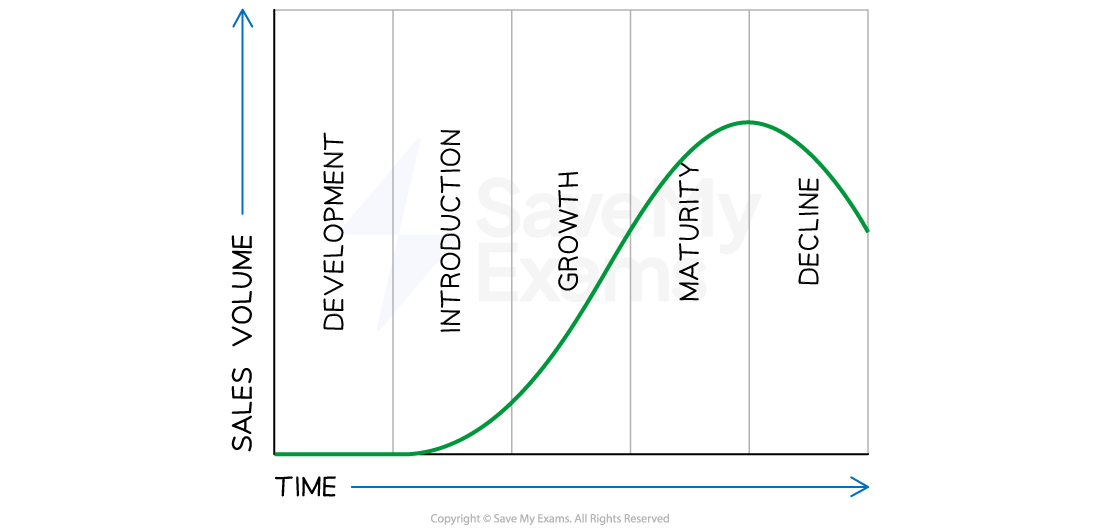
The product life cycle represents the value of sales from the time a product is introduced into the market until it is no longer sold
A typical product life cycle
-
The stages of the product life cycle include introduction, growth, maturity and decline
-
An extension strategy is a method used by a business to lengthen the life cycle of a product or service
-
E.g. a business could sell its product in new international markets
-
A product could reach maturity in one market but could then be introduced into another market
-
This allows the business to generate more revenue
-
-
Responses