
Business_A-level_Edexcel
-
1-marketing-and-people
1-1-meeting-customer-needs3 主题 -
1-2-market5 主题
-
1-3-marketing-mix-and-strategy5 主题
-
1-4-managing-people5 主题
-
1-5-entrepreneurs-and-leaders6 主题
-
2-managing-business-activities2-1-raising-finance4 主题
-
2-2-financial-planning4 主题
-
2-3-managing-finance3 主题
-
2-4-resource-management4 主题
-
2-5-external-influences3 主题
-
3-business-decisions-and-strategy3-1-business-objectives-and-strategy4 主题
-
3-2-business-growth4 主题
-
3-3-decision-making-techniques4 主题
-
3-4-influences-on-business-decisions4 主题
-
3-5-assessing-competitiveness3 主题
-
3-6-managing-change3 主题
-
4-global-business4-1-globalisation5 主题
-
4-2-global-markets-and-business-expansion5 主题
-
4-3-global-marketing3 主题
-
4-4-global-industries-and-multinational-corporations3 主题
-
5-exam-technique5-1-the-exam-papers4 主题
-
5-2-business-studies-skills1 主题
-
5-3-structuring-your-responses5 主题
-
6-pre-release-preparation2025-pre-release-music-industry9 主题
3-2-3-organic-growth
Organic business growth
-
Organic growth is growth that is driven by internal expansion using reinvested profits or loans
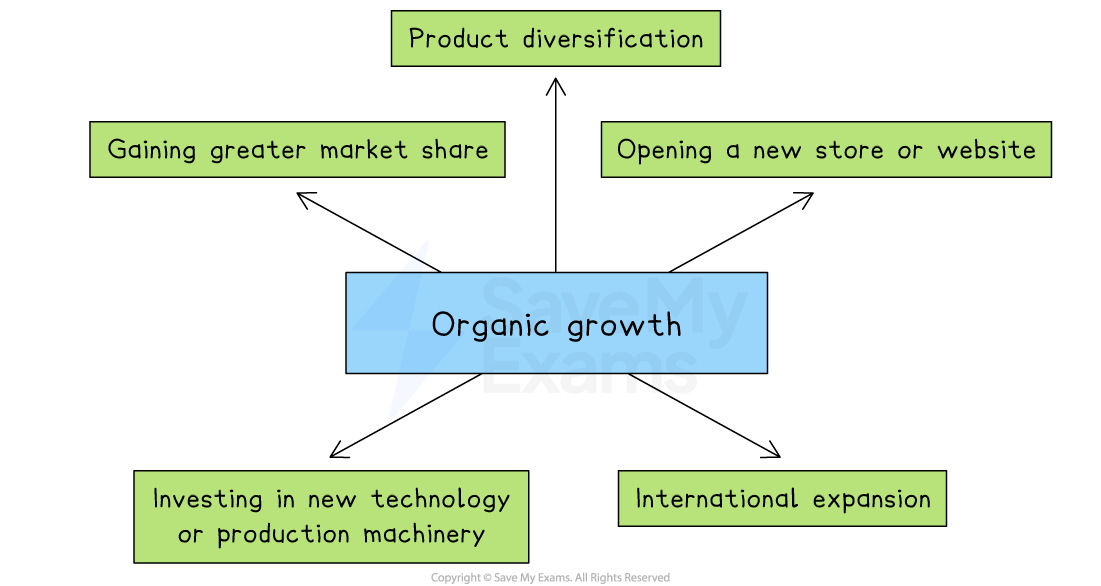
Types of organic growth
Gaining greater market share
-
By attracting more customers from competitors or increasing sales to existing customers, a business can grow its revenue without merging or acquiring another firm
-
E.g. Aldi has gained UK market share by offering low prices and expanding its product range
-
Product diversification
-
Launching new products allows a business to target new customer needs, increase sales and reduce reliance on just one product
-
E.g. Innocent has moved from smoothies into fruit juices and snacks
-
Opening a new physical or online store
-
Expanding the number of physical locations helps a business reach more customers and grow sales in new areas
-
E.g. Greggs has opened new outlets across the UK high street and within travel hubs such as railway stations
-
-
Launching an online store helps a business reach more customers and grow sales in new areas or through new channels
-
E.g. Primark launched its online click-and-collect service to reach more customers while keeping its focus on physical stores
-
International expansion
-
Selling products in other countries allows a business to access larger markets and benefit from new customer bases
-
E.g. WH Smith has expanded into airport locations worldwide whilst reducing its presence on UK high streets
-
Investing in new technology or production machinery
-
Improving production efficiency can increase output and reduce costs, allowing a business to meet rising demand and grow
-
E.g. Jaguar Land Rover invested in robotics and automation at its Solihull factory to boost production of electric and hybrid vehicles, helping it grow in the fast-changing automotive market
-
Evaluating organic growth
|
Advantages |
Disadvantages |
|---|---|
|
|
Responses