
Back to 课程

Business_A-level_Edexcel

0% Complete
0/0 Steps
  1. 1-marketing-and-people

    1-1-meeting-customer-needs
    3 主题
  2. 1-2-market
    5 主题
  3. 1-3-marketing-mix-and-strategy
    5 主题
  4. 1-4-managing-people
    5 主题
  5. 1-5-entrepreneurs-and-leaders
    6 主题
  6. 2-managing-business-activities
    2-1-raising-finance
    4 主题
  7. 2-2-financial-planning
    4 主题
  8. 2-3-managing-finance
    3 主题
  9. 2-4-resource-management
    4 主题
  10. 2-5-external-influences
    3 主题
  11. 3-business-decisions-and-strategy
    3-1-business-objectives-and-strategy
    4 主题
  12. 3-2-business-growth
    4 主题
  13. 3-3-decision-making-techniques
    4 主题
  14. 3-4-influences-on-business-decisions
    4 主题
  15. 3-5-assessing-competitiveness
    3 主题
  16. 3-6-managing-change
    3 主题
  17. 4-global-business
    4-1-globalisation
    5 主题
  18. 4-2-global-markets-and-business-expansion
    5 主题
  19. 4-3-global-marketing
    3 主题
  20. 4-4-global-industries-and-multinational-corporations
    3 主题
  21. 5-exam-technique
    5-1-the-exam-papers
    4 主题
  22. 5-2-business-studies-skills
    1 主题
  23. 5-3-structuring-your-responses
    5 主题
  24. 6-pre-release-preparation
    2025-pre-release-music-industry
    9 主题
课 Progress
0% Complete

Understanding PESTLE analysis

  • PESTLE analysis examines the external factors that are likely to impact the activities and outcomes of a business

  • PESTLE is an acronym for:

    • Political

    • Economic

    • Social

    • Technological

    • Legal

    • Environmental

  • PESTLE analysis can support effective decision-making by senior managers who will better understand the complex context within which the business operates

  • Managers can use the information gathered to understand the potential threats to the business’s performance and identify future difficulties so that action can be taken to help avoid and eliminate their effects

PESTLE factors

External factor

Explanation

Examples

Political

  • The extent to which local and national government is expected to influence the business, including:

    • Government stability and relationships with key trading partners

    • Tax regulations

    • Trade restrictions

    • Political ideology and attitudes to business

    • Fiscal policy

    • National security status

    • Investment in public services

  • The UK’s decision to leave the EU in 2016 has led to the reintroduction of trading restrictions for businesses importing goods from suppliers in Europe

  • The reduced level of threat from terrorism in the UK has helped to boost tourism

Economic

  • The extent to which economic indicators are expected to directly impact business performance, including:

    • Inflation

    • Exchange rates

    • Cost of living

    • The stage of the business cycle and GDP growth

    • Unemployment levels

  • High rates of fuel and food inflation in the UK have reduced the level of disposable income for most households

  • A historically low unemployment level has made recruitment more challenging for UK businesses

Social

  • The extent to which personal attitudes and values, culture, and demographic change are expected to affect the business, including:

    • Social mobility

    • Education

    • Ethics and religion

    • Migration

    • Health profile

    • Population growth and demographic structure

  • Greater numbers of people graduating from university have increased the quality of workers available to UK businesses

  • A more health-conscious population provides a lucrative market for businesses selling fitness and lifestyle products

Technological

  • The extent to which technological change and innovation are expected to impact the business, including: 

    • Research and development

    • Production and distribution processes and efficiency

    • Quality and new materials

    • Intellectual property

    • Online presence

    • The technology used in communication

  • Developments in communication technology have reduced the need for business travel

  • Rapid developments in technology have reduced the length of product life cycles and increased the need for businesses to carry out ongoing research, development and innovation

Legal

  • The extent to which changes in law and regulations are expected to impact the business, including: 

    • Taxation

    • Employment

    • Advertising

    • Health and safety

    • Compliance and “red tape” created by regulatory bodies, such as the Health and Safety Executive

  • Changes to the level of tax levied on high-sugar products (sodas) in the UK increased selling prices and prompted some businesses to redevelop their products to reduce their sugar content

  • A rise in the level of the minimum wage increases businesses’ staffing costs

Environmental

  • The extent to which changes in attitudes and government policy towards environmental protection, as well as the impact of global warming, are expected to impact the business, including: 

    • Changing infrastructure — for example, in favour of green transportation networks

    • Energy availability and cost

    • Disposal of materials

    • Changes in climate and weather patterns

    • Air quality

  • Increased interest in environmentally responsible and ethically produced goods has created new markets for businesses to exploit

  • Strict rules on the disposal of commercial waste have increased costs for businesses

Examiner Tips and Tricks

When using PESTLE analysis, you must focus on each factor’s impact on business activity rather than its origin. The cause is not so important, but the impact of the factor is what needs to be considered.

The changing competitive environment

  • The structure of the market in which a business operates is likely to change over time

  • Businesses have to respond to this changing competitive environment

Reasons for changes in market structure
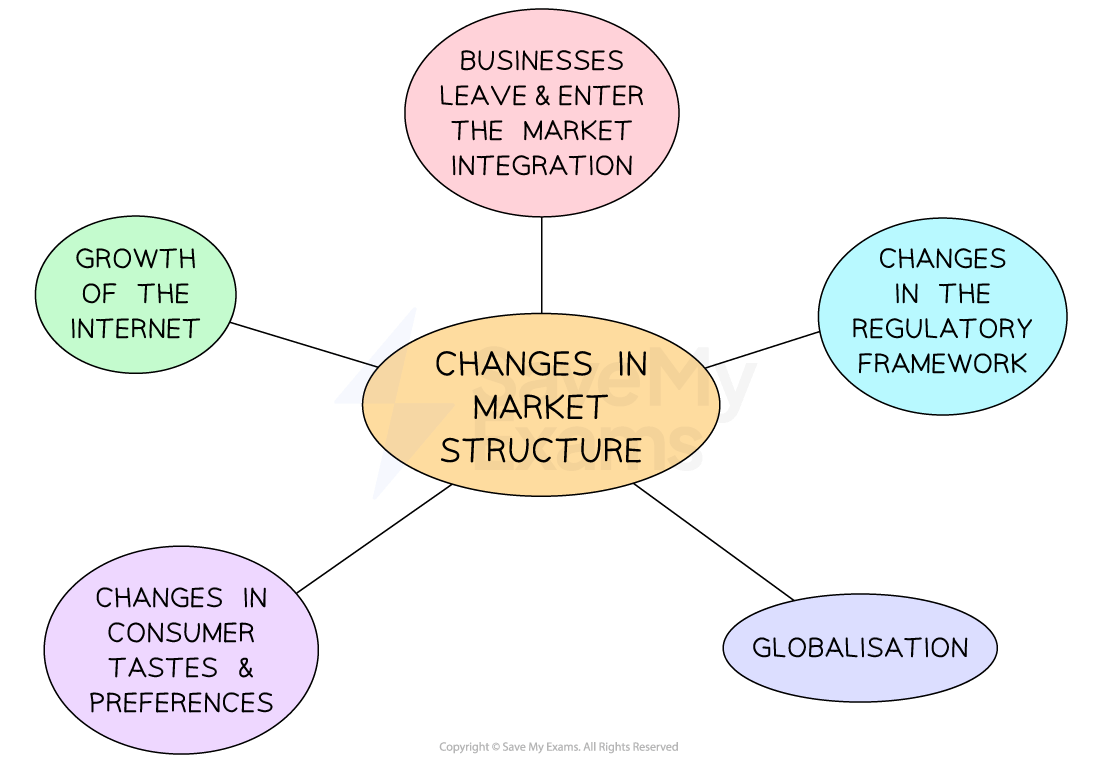
Diagram of factors affecting market structure: business integration, regulatory changes, globalisation, internet growth and consumer preferences.
Reasons for changes in the structure of markets over time include globalisation, growth of the internet and changes in consumer tastes
  • New businesses may enter the market, and existing businesses may leave or integrate with others

    • For example, until the early 2000s, UK supermarkets were dominated by a small number of giants, including Tesco, Sainsbury’s and Asda

    • The entry of businesses such as Aldi and Lidl has made the market more competitive, while takeovers involving leading brands, such as that of Somerfield by Morrisons in 2004, have had the opposite effect

  • The legislation (laws) may change, likely leading to fewer barriers to entry for new businesses

    • For example, until the 1980s, only local councils were permitted to operate local bus services in the UK, and following deregulation, any business with the financial resources to enter the market could run a bus service

  • The growth of the internet has increased the number of competitors businesses face in the majority of markets

    • For example, UK booksellers have faced severe price competition largely from the online giant Amazon 

      • Many smaller independent retailers have closed down, as they have been unable to compete

      • Remaining retailers such as Waterstones have needed to change their operations significantly to survive

  • Consumer tastes and preferences are changing more rapidly, leading to short product life cycles and a requirement for businesses to innovate to compete

    • For example, the growth in fast fashion has meant that many clothing retailers must now constantly update their product ranges rather than rely on seasonally focused product selections

    • Businesses such as Primark and Zara have been particularly successful in meeting customer demand for fast fashion, giving customers the chance to buy the latest fashions in as little as 13 days

  • Globalisation has increased competition with rivals from around the world

    • For example, between 1970 and 2010, trade barriers around the world were reduced, and customers were able to buy an increasing number of motor vehicle brands

      • By 2015, more than half of all cars sold in the UK were manufactured by Japanese companies

Porter’s Five Forces

  • Porter’s Five Forces identify the key pressures on an industry that impact the ability of a business to compete with rivals

The Five Forces model
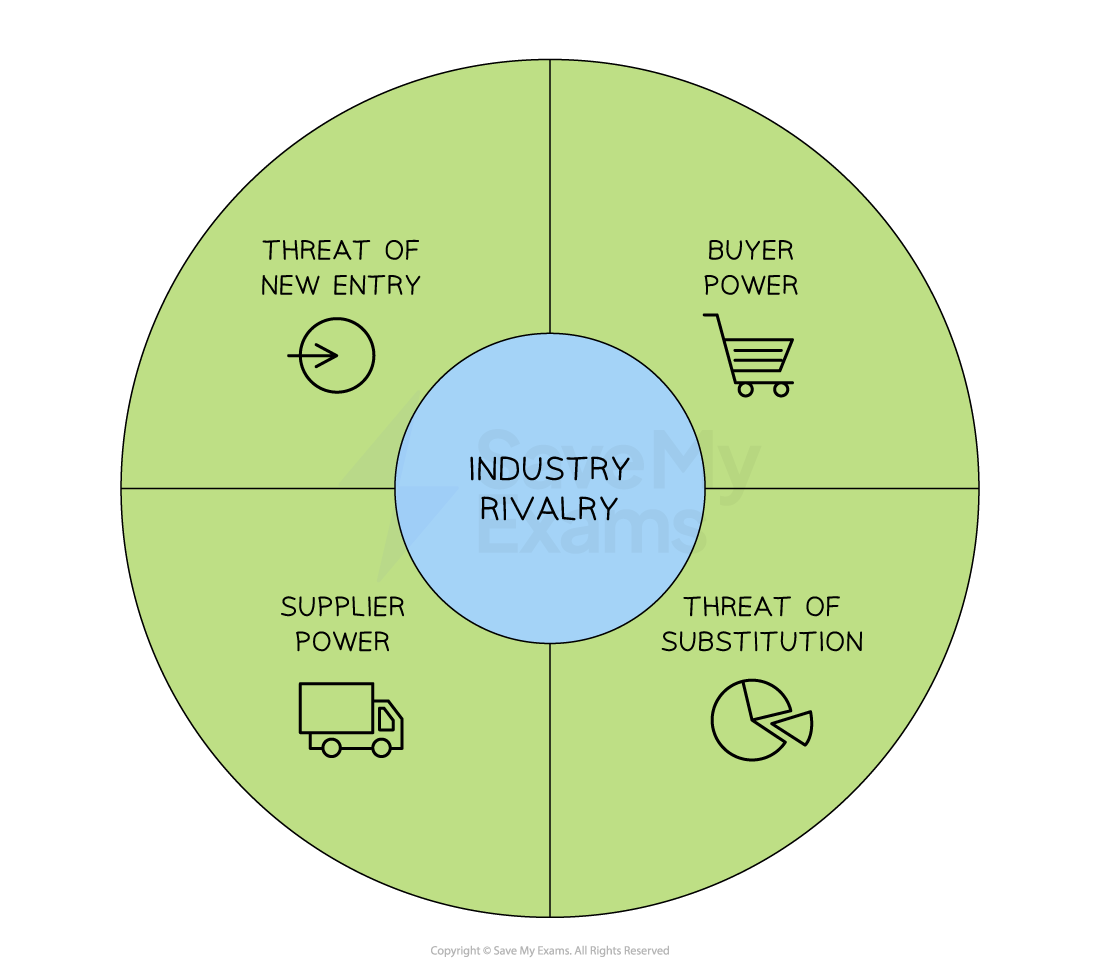
Diagram of Porter's Five Forces: industry rivalry centred in blue, surrounded by threat of new entry, buyer power, threat of substitution and supplier power.
The Porter’s Five Forces model identifies industry rivalry, supplier power, buyer power, threat of a new entrants and threat of substitution as key competitive pressures in a market
  • Porter argued that once a business fully understands these pressures in context, it can take strategic decisions to achieve and sustain a competitive advantage

  • This will then increase the business’s chances of success

Explanation of Porter’s Five Forces model

Force

Explanation

E

Responses

您的邮箱地址不会被公开。 必填项已用 * 标注