
Back to 课程

Business_A-level_Edexcel

0% Complete
0/0 Steps
  1. 1-marketing-and-people

    1-1-meeting-customer-needs
    3 主题
  2. 1-2-market
    5 主题
  3. 1-3-marketing-mix-and-strategy
    5 主题
  4. 1-4-managing-people
    5 主题
  5. 1-5-entrepreneurs-and-leaders
    6 主题
  6. 2-managing-business-activities
    2-1-raising-finance
    4 主题
  7. 2-2-financial-planning
    4 主题
  8. 2-3-managing-finance
    3 主题
  9. 2-4-resource-management
    4 主题
  10. 2-5-external-influences
    3 主题
  11. 3-business-decisions-and-strategy
    3-1-business-objectives-and-strategy
    4 主题
  12. 3-2-business-growth
    4 主题
  13. 3-3-decision-making-techniques
    4 主题
  14. 3-4-influences-on-business-decisions
    4 主题
  15. 3-5-assessing-competitiveness
    3 主题
  16. 3-6-managing-change
    3 主题
  17. 4-global-business
    4-1-globalisation
    5 主题
  18. 4-2-global-markets-and-business-expansion
    5 主题
  19. 4-3-global-marketing
    3 主题
  20. 4-4-global-industries-and-multinational-corporations
    3 主题
  21. 5-exam-technique
    5-1-the-exam-papers
    4 主题
  22. 5-2-business-studies-skills
    1 主题
  23. 5-3-structuring-your-responses
    5 主题
  24. 6-pre-release-preparation
    2025-pre-release-music-industry
    9 主题
课 Progress
0% Complete

Understanding SWOT analysis

  • SWOT analysis is an analytical tool used by businesses to identify:

    • Internal strengths and weaknesses

    • External opportunities and threats

An example of a SWOT analysis for a café business
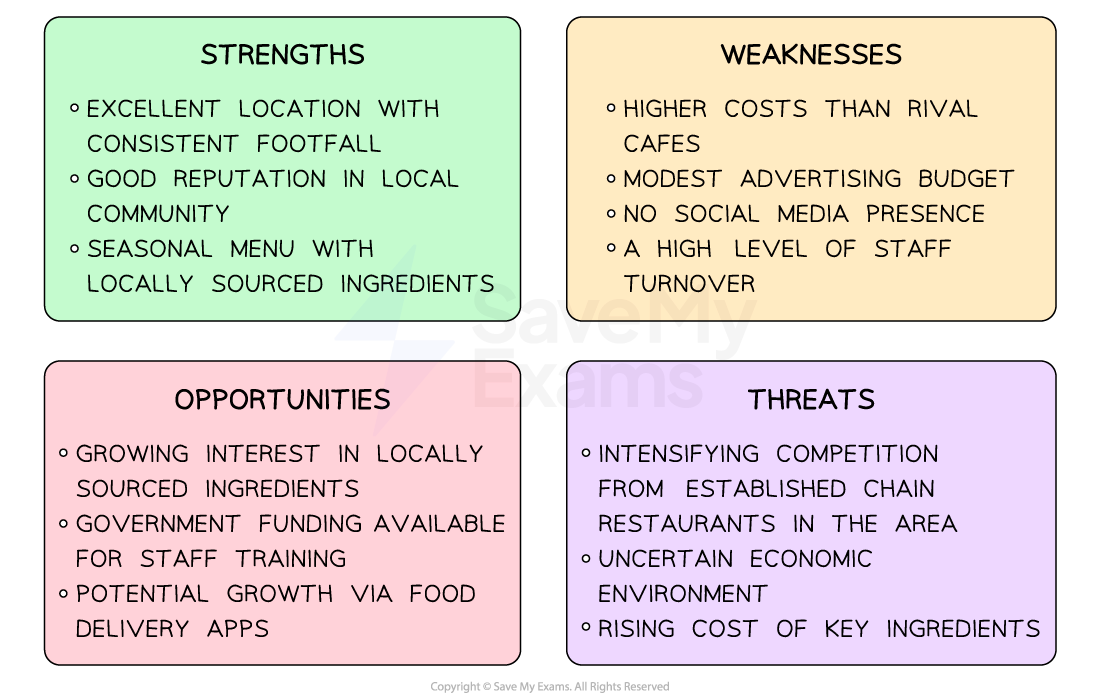
SWOT analysis with strengths, weaknesses, opportunities and threats for a local café, highlighting location, competition, staff and social media aspects.
An example of a SWOT analysis for a small café business, showing its internal strengths and weaknesses as well as external opportunities and threats
  • Once a SWOT analysis has been completed by a business, decisions can be made to improve performance:

    • Strengths should be harnessed

    • Weaknesses should be eliminated

    • Opportunities should be seized

    • Threats should be mitigated

  • An effective SWOT analysis can help senior managers understand the current business position so that appropriate strategic decisions may be made

Examples of factors considered in a SWOT analysis

Strengths

  • What the business is good at

For example:

  • Qualities that separate the business from its rivals

  • Internal resources, such as skilled staff or a particular innovation

  • Possession of assets, such as capital, patents or intellectual property

  • A loyal customer base

  • Effective leadership

Weaknesses

  • What the business does poorly

    For example:

    • Ways in which the business lags behind competitors

    • Resource or capital limitations, including labour and finance

    • Lack of a competitive advantage

    • Lack of a unique selling proposition

    • Poor online presence

Opportunities

  • Options a business may exploit to enjoy further success

    For example:

    • Developing markets for specific products becoming apparent

    • Few competitors existing

    • A changing legal or political environment positively impacting the business’s processes and decisions

    • Social or technological developments creating an emerging need for the business’s products

    • Economic indicators becoming more favourable

    • The potential for positive media coverage

Threats

  • Hazards that have the potential to damage business performance

    For example:

    • New or emerging competitors gaining market share

    • A changing legal or political environment negatively impacting the business’s processes and decisions

    • Social or technological developments threatening the obsolescence of products

    • Economic indicators becoming less favourable

    • Negative press coverage

    • Changing customer attitudes towards the business

Examiner Tips and Tricks

A SWOT analysis will vary significantly for businesses of different sizes, with different objectives and operations in different sectors.

For example, a micro startup business will face vastly different SWOT factors from a large multinational company. Having conducted a SWOT analysis, you should be able to make strategic and/or tactical decisions to achieve corporate objectives (see subtopic 3.1.2).

Responses

您的邮箱地址不会被公开。 必填项已用 * 标注