
Business_A-level_Edexcel
-
1-marketing-and-people
1-1-meeting-customer-needs3 主题 -
1-2-market5 主题
-
1-3-marketing-mix-and-strategy5 主题
-
1-4-managing-people5 主题
-
1-5-entrepreneurs-and-leaders6 主题
-
2-managing-business-activities2-1-raising-finance4 主题
-
2-2-financial-planning4 主题
-
2-3-managing-finance3 主题
-
2-4-resource-management4 主题
-
2-5-external-influences3 主题
-
3-business-decisions-and-strategy3-1-business-objectives-and-strategy4 主题
-
3-2-business-growth4 主题
-
3-3-decision-making-techniques4 主题
-
3-4-influences-on-business-decisions4 主题
-
3-5-assessing-competitiveness3 主题
-
3-6-managing-change3 主题
-
4-global-business4-1-globalisation5 主题
-
4-2-global-markets-and-business-expansion5 主题
-
4-3-global-marketing3 主题
-
4-4-global-industries-and-multinational-corporations3 主题
-
5-exam-technique5-1-the-exam-papers4 主题
-
5-2-business-studies-skills1 主题
-
5-3-structuring-your-responses5 主题
-
6-pre-release-preparation2025-pre-release-music-industry9 主题
1-4-5-leadership
The distinction between management and leadership
-
Leadership is about having a vision, sharing that vision with others and providing direction
-
Management is the day-to-day organisation of the business, its resources and its staffing
Leadership vs management
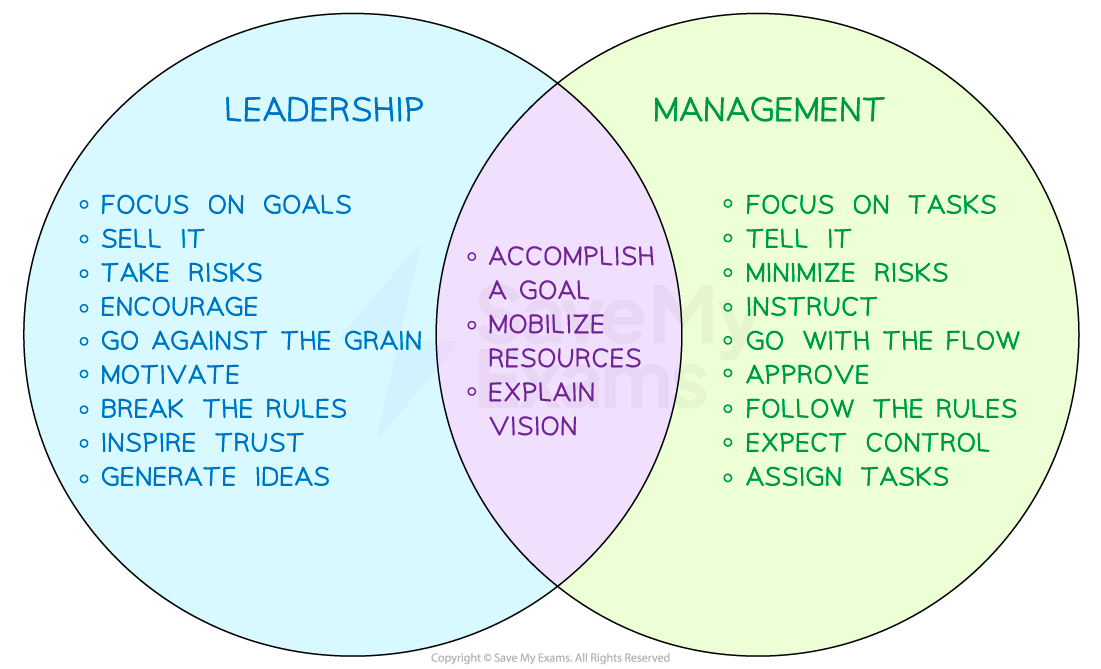
Key differences between leadership and management
-
Vision vs. Execution
-
Leadership focuses on creating a vision, setting direction and inspiring others to follow
-
Management focuses on executing plans, organising resources and ensuring tasks are completed on time
-
-
Influence vs. Control
-
Leadership focuses on influencing others to achieve a common goal by inspiring and motivating
-
Management focuses on controlling resources and processes to ensure that objectives are met
-
-
People vs. Processes
-
Leadership focuses on people, their needs and their motivation
-
Management focuses on processes, structures and systems
-
-
Long-term vs. Short-term
-
Leadership focuses on the long-term vision and strategy
-
Management focuses on short-term goals and targets
-
-
Creativity vs. Efficiency
-
Leadership encourages creativity and innovation
-
Management focuses more on efficiency and productivity
-
Different types of leadership styles
-
Leadership styles are different approaches to leading and managing a team or business
-
They reflect the behaviours and attitudes of a leader towards their team members and influence the organisational culture, productivity and performance
-
A successful leader will be able to use a variety of leadership styles, depending on the situation, to achieve the best results for their business
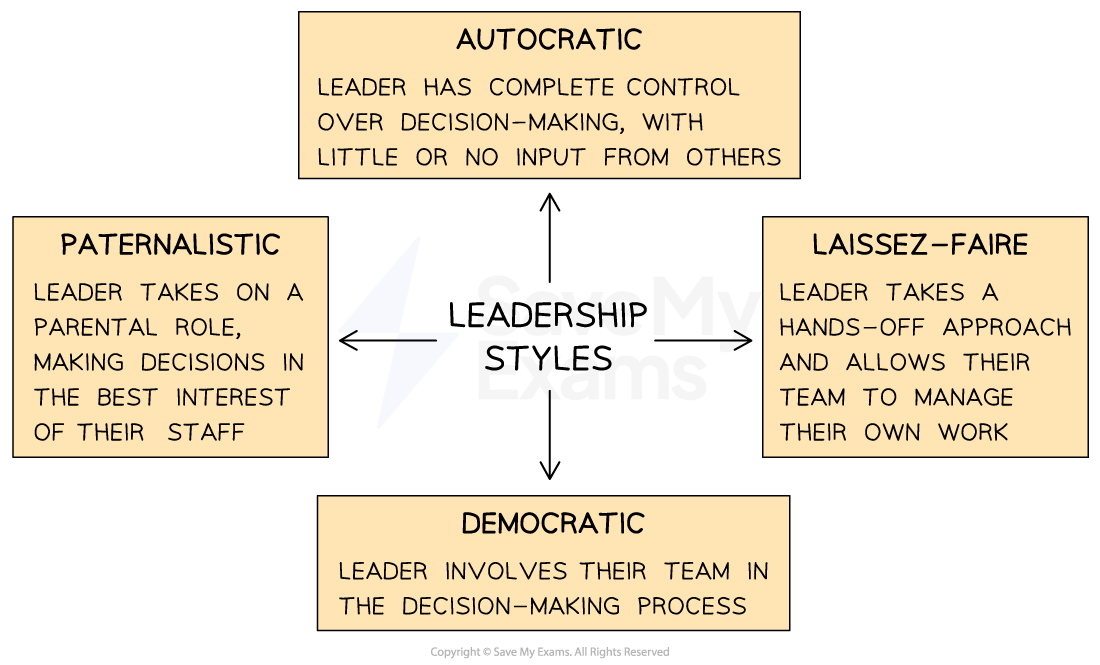
Common leadership styles
-
The choice of leadership style is influenced by the business’s circumstances as well as the nature and size of the business
Autocratic
-
This style is more appropriate when there is a need for quick decision-making, such as during a crisis
-
It may also be more suitable in a small business in which the owner is the primary decision-maker and has complete control over the business
Paternalistic
-
This style is more appropriate when the staff are uneducated or inexperienced
-
They require more guidance and support from their leader
-
It can also be effective when the leader needs to build a strong sense of loyalty from their employees
Democratic
-
This style is more appropriate when the business needs to encourage creativity, innovation and employee engagement
-
It is also effective in larger firms in which decisions require input from multiple stakeholders or when there is a need to build consensus
Laissez-faire
-
This style is more appropriate when the staff are very experienced and require minimal supervision
-
It is also effective when the leader wants to build a culture of independence and self-motivation
Responses