Back to 课程

Business_A-level_Edexcel

0% Complete
0/0 Steps
  1. 1-marketing-and-people

    1-1-meeting-customer-needs
    3 主题
  2. 1-2-market
    5 主题
  3. 1-3-marketing-mix-and-strategy
    5 主题
  4. 1-4-managing-people
    5 主题
  5. 1-5-entrepreneurs-and-leaders
    6 主题
  6. 2-managing-business-activities
    2-1-raising-finance
    4 主题
  7. 2-2-financial-planning
    4 主题
  8. 2-3-managing-finance
    3 主题
  9. 2-4-resource-management
    4 主题
  10. 2-5-external-influences
    3 主题
  11. 3-business-decisions-and-strategy
    3-1-business-objectives-and-strategy
    4 主题
  12. 3-2-business-growth
    4 主题
  13. 3-3-decision-making-techniques
    4 主题
  14. 3-4-influences-on-business-decisions
    4 主题
  15. 3-5-assessing-competitiveness
    3 主题
  16. 3-6-managing-change
    3 主题
  17. 4-global-business
    4-1-globalisation
    5 主题
  18. 4-2-global-markets-and-business-expansion
    5 主题
  19. 4-3-global-marketing
    3 主题
  20. 4-4-global-industries-and-multinational-corporations
    3 主题
  21. 5-exam-technique
    5-1-the-exam-papers
    4 主题
  22. 5-2-business-studies-skills
    1 主题
  23. 5-3-structuring-your-responses
    5 主题
  24. 6-pre-release-preparation
    2025-pre-release-music-industry
    9 主题
课 Progress
0% Complete

The recruitment and selection process

  • Recruitment is the process of attracting and identifying potential job candidates who are suitable for a particular role

    • Recruitment activities include job advertising, job fairs, social media outreach and referrals from current employees

    • The goal of recruitment is to create a pool of qualified candidates who can be considered for the role

  • Selection is the process of choosing the best candidate

    • Selection activities often involve reviewing curricula vitae (CVs) and conducting interviews or assessment tasks

    • The goal of selection is to hire the most suitable candidate for the job

The recruitment and selection process

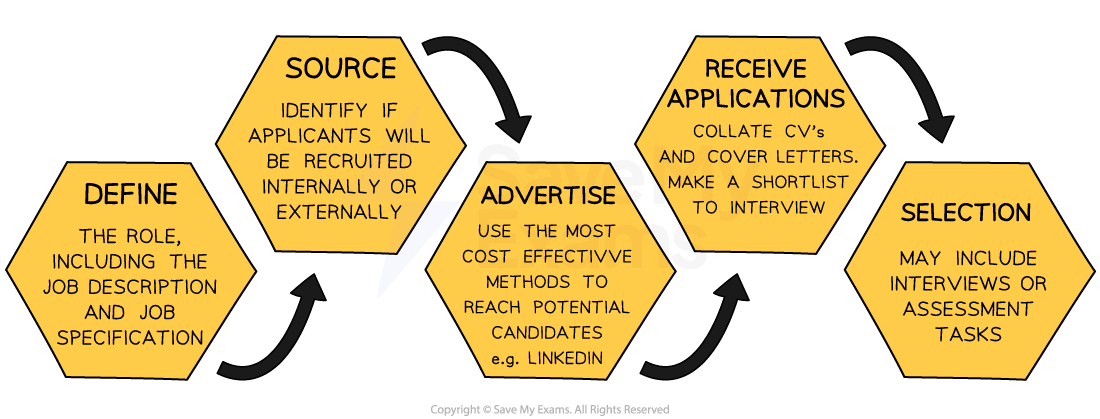
Flowchart with hexagonal steps: Define role, source applicants, advertise positions, receive applications and perform selection, including interviews or tasks.
The recruitment and selection process involves defining, sourcing, advertising roles and selecting a suitable candidate

1. Define the role

  • Businesses should determine exactly what is required, and part of that is developing a job description and a person/job specification

    • A job specification outlines the qualifications, skills, experience and personal qualities required from a candidate for a specific job; e.g. problem solver, good communicator, able to code in Java

    • A job description outlines the duties, responsibilities and requirements of a particular job

2. Determine the best source of candidates

  • The business can advertise the role internally, externally, or a combination of both

    • Internal recruitment is the process of hiring employees from within the organisation

      • It can involve the promotion or redeployment of staff to fill a vacant post

      • Vacancies are advertised internally on staff notice boards, in newsletters or via in-house electronic communications

Evaluation of internal recruitment

Advantages

Disadvantages

  • Internal candidates are already familiar with business culture and processes

    • Can adapt to the role quickly

    • Little need for induction training

  • Can lead to conflict or resentment

    • May affect motivation and working relationships between successful/rejected internal candidates

  • The business has a good understanding of the candidate’s strengths, weaknesses, skills and aptitudes

    • Less risky than employing an external candidate whose abilities are less well known

  • further vacancy is created when an employee is promoted/redeployed

    • External recruitment may be necessary to fill vacated job roles

  • Opportunities to progress can be motivating for existing employees

    • Improves loyalty and commitment

  • A limited number of suitable applicants may be available internally

  • Cheaper and quicker to promote or redeploy existing staff rather than recruit externally

  • Missed opportunity to inject new ideas, experience or skills into the business

  • External recruitment is the process of hiring employees from outside the organisation

    • External recruitment can bring fresh ideas, experiences and perspectives to the organisation

    • It overcomes some of the disadvantages of internal recruitment 

    • However, it is often more expensive than internal recruitment

    • There is also a greater degree of uncertainty, as external candidates are unknown to the business

Comparison of external recruitment methods

Method

Explanation

Referrals / personal recommendations

  • Current employees may recommend a suitable candidate for a vacancy

  • Employees may be rewarded if a candidate is successfully appointed

Online advertising

  • Vacancies can be advertised on a business’s own website or on a specialist recruitment website, such as Glassdoor or CharityJobs.com (opens in a new tab)

  • This method is relatively low-cost with a wide reach

Newspaper advertising

  • Adverts to attract local candidates can be placed in district or regional newspapers

  • High-profile vacancies, such as public sector roles, may be advertised in national newspapers

  • Although relatively expensive, these ads can be highly targeted

Specialist trade publications

  • Roles are advertised in magazines or newsletters that are read by professionals in a particular industry

  • Examples include fashion industry journal Drapers and education journal The Times Educational Supplement (TES)

Employment agencies

  • Specialist recruitment agents advertise roles on behalf of the business

  • Some also conduct interviews or other selection activities

  • A recruitment fee is charged when the business appoints a candidate

Headhunting

  • A headhunting agency makes attractive approaches to highly qualified specialists in a particular industry / with desired skills, experience or knowledge

  • significant fee is payable once a candidate is appointed

Job centres

  • Low-level vacancies can be advertised free of charge in government-funded centres and, increasingly, online

Career fairs

  • Events often hosted by universities or industry bodies to promote available opportunities

  • Attract significant numbers of highly qualified, interested candidates

3. Advertise

  • Businesses with a strong social media presence can use these platforms to advertise cost-effectively, e.g. Facebook, LinkedIn, TikTok

  • Depending on the nature of the business, there may be specialist recruitment portals through which they can advertise; these tend to cost more, e.g. The TES is one of the main publications used to recruit teaching staff

4. Receive applications

  • The application stage involves collecting information from potential candidates

  • A business may have its own application form, which should gather information such as personal details, qualifications and work experience

  • Applicants may also be asked to submit their CV and a cover letter explaining why they believe they are the right person for the role

  • Someone within the business must be nominated to manage the application process

    • This person (possibly together with others) will draw up a shortlist of candidates from the many applications received

    • The shortlist usually includes three to five candidates who are invited to interview

5. The selection process

  • This process varies significantly between organisations

  • Businesses must decide on the most appropriate method that will help them identify the best candidate

  • The most commonly used methods include interviews and assessment tasks

Interviews and assessment tasks

Interviews

Assessment tasks

  • Involves meeting (face-to-face or virtually, e.g. Zoom) and asking questions about the candidate’s skills, experience and knowledge

  • It is important to prepare a set of relevant questions to ask all candidates and to ensure that the interview is conducted in a fair and consistent manner

  • Provide shortlisted candidates with the opportunity to demonstrate their skills and suitability for the job

  • The assessment tasks may include psychometric tests, group exercises, presentations and interviews

Costs of recruitment, selection and training

  • Recruitment, training and selection are essential processes for any business to attract, develop and retain a skilled workforce

  • These processes involve significant costs for businesses, which can impact their overall profitability and competitiveness

Costs of recruitment, selection and training

Recruitment costs

Training costs

Selection costs

  • Recruitment costs refer to the expenses incurred in the process of hiring new employees

  • These include advertising, recruiting, interviewing and screening candidates

  • High labour turnover rates can significantly increase these costs

    • When employees leave, the business has to spend money and time recruiting and training new employees to fill the vacant positions

  • Training costs refer to the expenses incurred in the process of providing training to new or existing employees

  • These include the cost of trainers, training materials and facilities

  • The effectiveness of training can impact these costs

    • If the training is not effective, employees may require additional training or take longer to learn new skills, which can increase the cost of training

  • Selection costs refer to the expenses incurred in the process of selecting candidates for employment

  • These include background checks and visa costs

  • High labour turnover rates can increase selection costs as the business has to spend more regularly

  • By reducing labour turnover rates and improving the effectiveness of their training programmes, businesses can minimise these costs and improve their overall profitability and competitiveness

Types of training provided by businesses

  • Different types of training have their advantages and disadvantages for the business

Training types
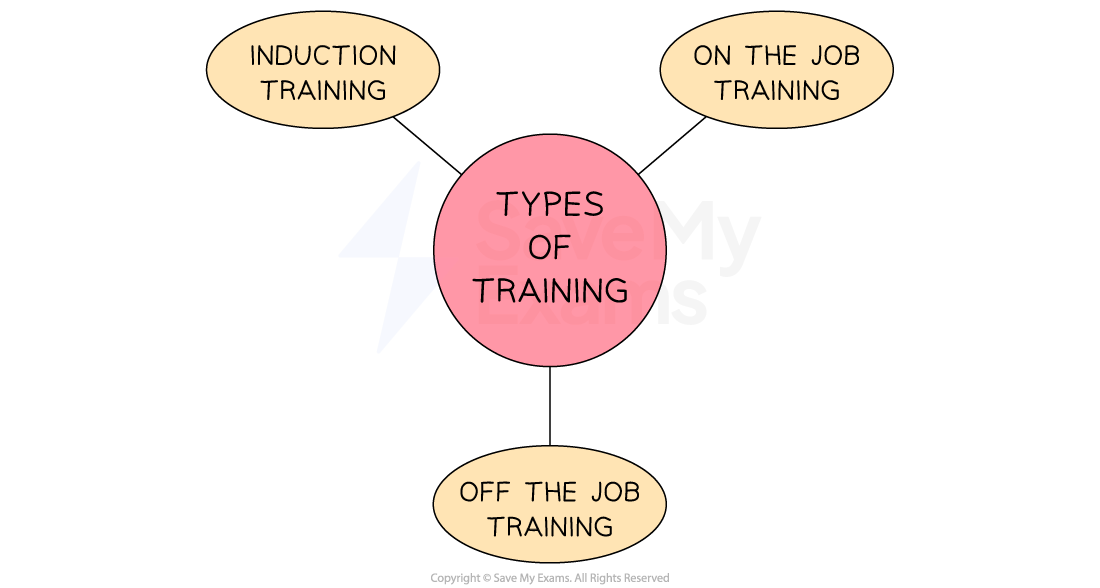
Diagram of training types: Central circle reads "Types of Training", with branches to three ovals — "Induction Training", "On-the-Job Training" and "Off-the-Job Training".
Three common types of training that businesses put their new employees through

Induction training

  • Induction training is a type of training that new employees receive when they start working for a company

    • It introduces them to the company, its culture, policies and procedures, and their job roles and responsibilities

      • E.g. when a new employee joins Marks & Spencer, they receive induction training that covers customer service, product knowledge, store policies and safety procedures

Evaluation of induction training

Advantages

Disadvantages

  • Helps new employees understand their job roles and responsibilities

  • Introduces employees to the company culture, policies and procedures

  • Improves employee confidence and motivation

  • Reduces the time taken for new e

Responses

您的邮箱地址不会被公开。 必填项已用 * 标注