
Business_A-level_Cie
-
business-and-its-environment
enterprise6 主题 -
business-structure6 主题
-
size-of-business3 主题
-
business-objectives3 主题
-
stakeholders-in-a-business2 主题
-
external-influences-on-business12 主题
-
political-influences
-
legal-influences
-
economic-influences
-
economic-government-macroeconomic-objectives
-
economic-government-policies
-
social-influences
-
the-impact-of-corporate-social-responsibility
-
demographic-influences
-
technology-competitors-and-suppliers
-
international-trade
-
the-impact-of-multinationals
-
environmental-influences
-
political-influences
-
business-strategy10 主题
-
human-resource-managementhuman-resource-management-hrm8 主题
-
motivation4 主题
-
management2 主题
-
organisational-structure5 主题
-
business-communication5 主题
-
leadership2 主题
-
human-resource-strategy3 主题
-
marketingthe-nature-of-marketing7 主题
-
market-research3 主题
-
the-marketing-mix6 主题
-
marketing-analysis5 主题
-
marketing-strategy3 主题
-
operations-managementthe-nature-of-operations3 主题
-
inventory-management2 主题
-
capacity-utilisation-and-outsourcing1 主题
-
location-and-scale2 主题
-
quality-management1 主题
-
operations-strategy4 主题
-
finance-and-accountingbusiness-finance2 主题
-
sources-of-finance3 主题
-
forecasting-and-managing-cash-flows1 主题
-
costs4 主题
-
budgets1 主题
-
financial-statements4 主题
-
analysing-published-accounts6 主题
-
investment-appraisal2 主题
business-growth
Why do businesses grow?
-
Business growth involves a business increasing its size, scope, or scale
-
Their leaders or owners may have ambitions for growth for a range of reasons
|
Reason |
Explanation |
Example |
|---|---|---|
|
Rising customer demand |
|
|
|
Economies of scale |
|
|
|
Entering new markets or products |
|
|
Internal (organic) growth
-
Organic growth (internal) is usually generated by
-
Gaining greater market share
-
Product diversification
-
Opening a new store
-
International expansion
-
Investing in new technology or production machinery
-
-
Firms will often grow organically to the point where they are in a financial position to integrate with others
-
Integration speeds up growth but also creates new challenges
-
Evaluating organic growth
|
Advantages |
Disadvantages |
|---|---|
|
|
External growth
-
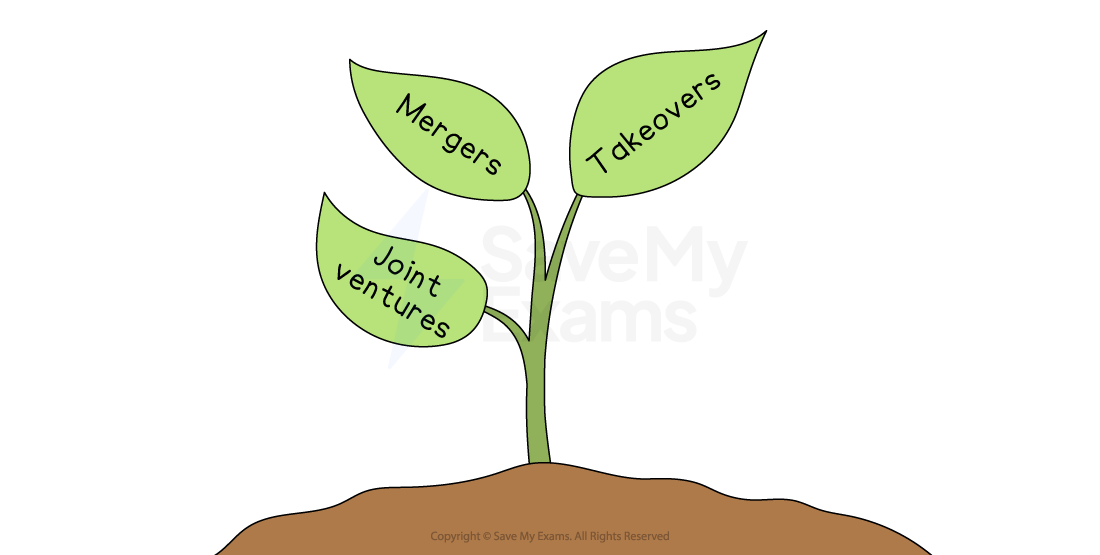
Integration in the form of mergers, takeovers, and joint ventures results in rapid business growth and is referred to as external (or inorganic) growth
Methods of external growth
-
A merger occurs when two or more companies combine to form a new company, usually on a friendly basis
-
The original companies cease to exist, and their assets and liabilities are transferred to the newly created entity
-
Firms merge to become stronger together than they would be apart
-
That strength comes from lower costs, more customers, new capabilities or less competition
-
-
-
A takeover occurs when one company purchases another company, often against its will (hostile takeover)
-
The acquiring company buys a controlling stake (more than 50% of shares) in the target company’s shares and gains control of its operations
-
-
A joint venture occurs when two businesses join together to share their knowledge, resources, and skills to form a separate business entity, usually for a limited period of time
-
E.g., the mobile network EE is in a joint venture formed by the French mobile network, Orange, and the German mobile network, T-Mobile
-
-
There are several reasons why companies may choose to pursue external growth
Reasons for external growth
|
Reason |
Explanation |
Example |
|---|---|---|
|
Strategic fit |
|
|
|
Economies of scale |
|
|
|
Synergies |
|
|
|
Elimination of competition |
|
|
|
Shareholder value |
|
|
Types of integration
-
External growth usually takes place when firms join in one of three broad ways
1. Vertical integration
-
This is a merger or takeover of another firm in the supply chain or different stage of the production process
-
E.g. An ice cream manufacturer merges with a dairy farm or an ice cream cafe chain
-
Examples of vertical integration

-
Forward vertical integration involves a merger or takeover with a firm further forward in the supply chain
-
E.g. A dairy farmer merges with an ice cream manufacturer
-
-
Backward vertical integration involves a merger/takeover with a firm further backwards in the supply chain
-
E.g. An ice cream retailer takes over an ice cream manufacturer
-
Evaluating vertical integration
|
Advantages |
Disadvantages |
|---|---|
|
|
2. Horizontal integration
-
This is a merger or takeover of a firm at the same stage of the production process
-
E.g. An ice cream manufacturer buys another ice cream manufacturer
-
Evaluating horizontal integration
|
Advantages |
Disadvantages |
|---|---|
|
|
3. Conglomerate integration
-
This is a merger or takeover between firms in entirely different industries
-
E.g., An ice cream manufacturer buys a clothing company
-
Evaluating conglomerate integration
|
Advantages |
Disadvantages |
|---|---|
|
|