
Back to 课程

Business_A-level_Cie

0% Complete
0/0 Steps
  1. business-and-its-environment

    enterprise
    6 主题
  2. business-structure
    6 主题
  3. size-of-business
    3 主题
  4. business-objectives
    3 主题
  5. stakeholders-in-a-business
    2 主题
  6. external-influences-on-business
    12 主题
  7. business-strategy
    10 主题
  8. human-resource-management
    human-resource-management-hrm
    8 主题
  9. motivation
    4 主题
  10. management
    2 主题
  11. organisational-structure
    5 主题
  12. business-communication
    5 主题
  13. leadership
    2 主题
  14. human-resource-strategy
    3 主题
  15. marketing
    the-nature-of-marketing
    7 主题
  16. market-research
    3 主题
  17. the-marketing-mix
    6 主题
  18. marketing-analysis
    5 主题
  19. marketing-strategy
    3 主题
  20. operations-management
    the-nature-of-operations
    3 主题
  21. inventory-management
    2 主题
  22. capacity-utilisation-and-outsourcing
    1 主题
  23. location-and-scale
    2 主题
  24. quality-management
    1 主题
  25. operations-strategy
    4 主题
  26. finance-and-accounting
    business-finance
    2 主题
  27. sources-of-finance
    3 主题
  28. forecasting-and-managing-cash-flows
    1 主题
  29. costs
    4 主题
  30. budgets
    1 主题
  31. financial-statements
    4 主题
  32. analysing-published-accounts
    6 主题
  33. investment-appraisal
    2 主题
课 Progress
0% Complete

The aims and purposes of lean production

  • Lean production is a management philosophy that aims to maximise value while minimising waste

  • It focuses on maximising efficiency, improving quality and reducing costs

  • Lean production is likely to lead to a competitive advantage 

    • Lower unit costs  are achieved due to minimal wastage so prices may be lower than those offered by competitors

    • Better quality of output is likely as a result of supplier reliability and carefully managed production processes

The main principles of lean production
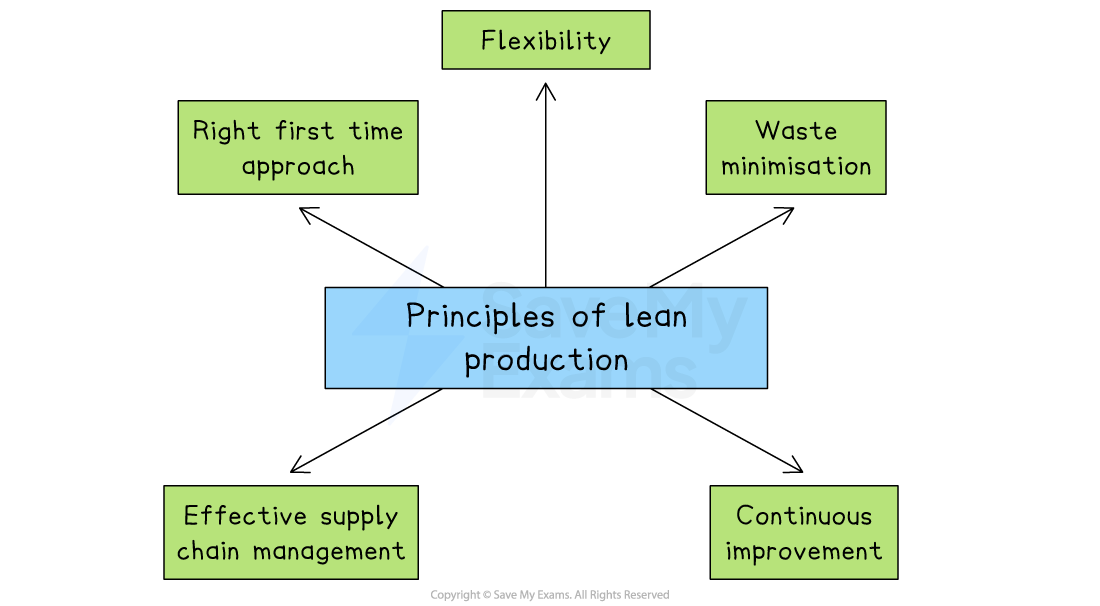
Diagram of lean production principles with arrows pointing to flexibility, waste minimisation, continuous improvement, effective supply chain, right first time.
Lean production involves adopting a right first time approach, flexibility, waste minimisation, effective supply chain management and continuous improvement
  • Right first time approach

    • Aim for zero defects in output

    • Identify and solve problems as they arise

    • Prevent rather than correct errors

  • Flexibility

    • Adaptable capital equipment and physical resources

    • Multiskilled staff and team working

    • Flexible management styles

  • Waste minimisation

    • Remove processes that do not contribute to added value

    • Consume as little as is necessary

    • Rework rather than replace

  • Effective supply chain management

    • Develop excellent relationships with suppliers

    • Minimal number of suppliers

  • Continuous improvement

    • Ongoing, small steps

    • All staff involved in improvement

Lean production strategies

  • Businesses that pursue lean production can adopt a range of strategies

1. Kaizen

  • Kaizen means “continuous improvement” in Japanese

  • It involves small, regular changes made by employees at all levels

    • Workers are encouraged to suggest ways to improve efficiency, quality and processes

    • These ideas are implemented gradually over time

A comparison of Kaizen with one-off improvements

Graph showing output per worker over time, with a solid line representing one-off improvements and a dotted line indicating continuous improvements.
Kaizen involves small, regular changes made by employees at all levels, implemented continuously over time

Evaluating the use of Kaizen

Advantages

Disadvantages

  • It involves all staff in improving the business

  • It helps identify problems early

  • It can boost employee morale and teamwork

  • It can be time-consuming to collect and review employee suggestions

  • Improvements may be small and take time to show results

  • It requires a long-term commitment from management

2. Quality circles

  • Small groups of employees who meet regularly to discuss work-related problems and suggest improvements

  • These groups usually focus on improving quality, safety or productivity and include workers from different levels of the business

Evaluating the use of quality circles

Advantages

Disadvantages

  • They encourage teamwork and employee involvement

  • They generate practical ideas from people who do the job daily

  • They can improve quality and reduce waste

  • They may not be effective without strong leadership willing to implement suggestions

  • They can be costly in time, training and time away from work

  • Ideas may not always be implemented or taken seriously

3. Simultaneous engineering

  • A production method where product development stages happen at the same time, rather than one after another

    • For example, design, engineering and marketing teams work together to reduce the time it takes to launch a new product

Evaluating the use of simultaneous engineering

Advantages

Disadvantages

  • It can speed up product development

  • Design issues can be identified early and rectified quickly

  • It can provide a competitive edge with faster product launches

  • It requires strong coordination between departments

  • Mistakes in one area can affect others more quickly

  • It can be difficult to manage in very large organisations

4. Cell production

  • A method of organising production into small teams that complete a whole part of the product process

  • Instead of passing work along a production line, each cell is responsible for a complete unit of work, encouraging ownership and teamwork

Evaluating the use of cell production

Advantages

Disadvantages

  • It can improve motivation through team responsibility

  • It may also improve communication between workers

  • It reduces movement of part-finished goods and waste

  • The initial setup and employee training can be expensive

  • It is not suitable for all types of production

  • Team performance can be affected if members are absent

5. Just-in-time manufacturing

  • Where products are made only when there is demand, and each stage of production begins only when needed by the next stage

  • This approach aims to match production with customer demand

    • This minimises waste, speeds up workflows, and reduces the need for warehousing

Evaluating the use of just-in-time manufacturing

Advantages

Disadvantages

  • It reduces waste by only producing what is needed

  • It improves cash flow by avoiding overproduction and reduces cash tied up in stock

  • It increases efficiency by streamlining workflows

  • It frees up space and reduces shrinkage, as goods are not stored between stages

  • It is sensitive to disruptions in supply or production stages

  • It requires very reliable suppliers and accurate forecasting of demand

  • There is less flexibility to respond to sudden increases in demand

  • Delays at one stage can halt the entire production process

6. Waste management

  • Waste can be anything that does not add value, such as overproduction, excess inventory, delays or defects

  • Lean waste management aims to simplify processes and reduce costs

Evaluating the use of waste management

Advantages

Disadvantages

  • It can reduce costs as resources are used most efficiently

  • It can help a business reduce its environmental impact

  • It focuses on value-added activities, improving profitability

  • It requires constant monitoring and careful evaluation

  • Staff may resist changes or fear job losses when it is implemented

  • It needs a strong culture of improvement to be effective

The impact of lean production

  • Lean production affects not only how goods are made but also how people work, how quality is maintained and how inventoryis managed

Lean production impacts

Area of Impact

Explanation

Inventory Control

  • Lean production uses systems like Just-in-Time (JIT) to reduce the need for large inventories

    • This saves space, lowers storage costs and reduces waste

    • Businesses rely on accurate demand forecasting and reliable suppliers to avoid delays

Quality

  • Lean production builds quality into every stage, not just at the end

    • Methods like Kaizen and quality circles help staff spot problems early

    • This results in consistent products and higher customer satisfaction

Employee roles

  • Employees take an active role, suggesting improvements, working in teams and taking responsibility for quality

    • This improves motivation but requires training and trust

Capacity management

  • Lean production helps match output to demand, reducing waste and idle time

    • Techniques like simultaneous engineering and cell production improve responsiveness

  • However, responding to sudden demand increases can be challenging

Efficiency

  • Lean production systems cut unnecessary steps and reduce delays using methods like flow production, JIT and waste reduction

    • This leads to lower costs and faster production, and can allow a business to price products more competitively.

Limitations of lean production strategies

  • Lean production can improve efficiency and reduce waste, but it also presents several challenges and limitations that businesses must carefully manage

<img alt=”Flowchart showing limitations of lean production: vulnerability to demand fluctuation, initial setup costs, limited flexibility, pressure on workers, supplier reliance.” data-nimg=”1″ decoding=”async” height=”641″ loading=”lazy” sizes=”(max-width: 320px) 320w, (max-width: 640px) 640w, (max-width: 960px) 960w, (max-width: 1280px) 1280w, 1920w” src=”https://cdn.savemyexams.com/cdn-cgi/image/f=auto,width=3840/https://cdn.savemyexams.com/uploads/2025/07/52377_limitations-of-lean-producti