
Business_A-level_Cie
-
business-and-its-environment
enterprise6 主题 -
business-structure6 主题
-
size-of-business3 主题
-
business-objectives3 主题
-
stakeholders-in-a-business2 主题
-
external-influences-on-business12 主题
-
political-influences
-
legal-influences
-
economic-influences
-
economic-government-macroeconomic-objectives
-
economic-government-policies
-
social-influences
-
the-impact-of-corporate-social-responsibility
-
demographic-influences
-
technology-competitors-and-suppliers
-
international-trade
-
the-impact-of-multinationals
-
environmental-influences
-
political-influences
-
business-strategy10 主题
-
human-resource-managementhuman-resource-management-hrm8 主题
-
motivation4 主题
-
management2 主题
-
organisational-structure5 主题
-
business-communication5 主题
-
leadership2 主题
-
human-resource-strategy3 主题
-
marketingthe-nature-of-marketing7 主题
-
market-research3 主题
-
the-marketing-mix6 主题
-
marketing-analysis5 主题
-
marketing-strategy3 主题
-
operations-managementthe-nature-of-operations3 主题
-
inventory-management2 主题
-
capacity-utilisation-and-outsourcing1 主题
-
location-and-scale2 主题
-
quality-management1 主题
-
operations-strategy4 主题
-
finance-and-accountingbusiness-finance2 主题
-
sources-of-finance3 主题
-
forecasting-and-managing-cash-flows1 主题
-
costs4 主题
-
budgets1 主题
-
financial-statements4 主题
-
analysing-published-accounts6 主题
-
investment-appraisal2 主题
scale-of-operations
Factors influencing the scale of business operations
-
The scale of operations refers to the size and extent of a business’s activities, including:
-
how much it produces
-
how widely it sells
-
how many resources it uses
-
-
Businesses do not all grow to the same size, as a range of internal and external factors influence how large they become
Internal and external factors affecting the scale of operations
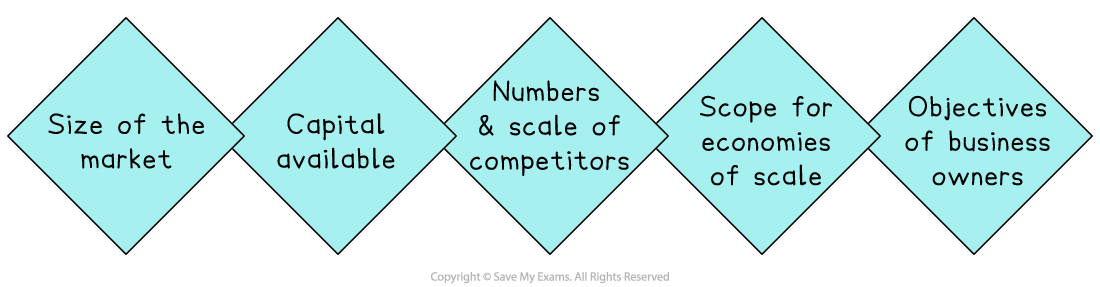
Size of the market
-
If the business operates in a large or fast-growing market, it may have more opportunities to grow
-
In contrast, niche or local markets may limit how large a firm can become
-
Bigger markets = more potential customers
-
Smaller markets = fewer opportunities to expand
-
Capital available
-
A firm with access to large amounts of capital, such as retained profit, loans or share capital, is more likely to expand
-
More capital = more investment in equipment, staff or premises
-
Limited finance = restricted growth
-
Number and scale of competitors
-
A highly competitive market may force firms to grow quickly to survive
-
Too many rivals may prevent growth if it is hard to gain market share
-
Fewer competitors = easier to dominate the market
-
Too many competitors = harder to grow profitably
-
Scope for economies of scale
-
Businesses that can reduce their average costs as they grow may be more motivated to expand
-
This is common in manufacturing or transport industries
-
Businesses in services may have fewer cost-saving benefits from growing larger
-
Objectives of business owners
-
Some owners prefer to keep their businesses small for easier control, better work-life balance or to maintain quality
-
Some owners prioritise independence or lifestyle
-
Others want rapid growth, high profits or global expansion
Economies of scale
-
As a firm grows, it is able to increase its scale of output, generating efficiencies that lower its average costs of production
-
These efficiencies are called economies of scale
-
Internal economies of scale
-
Internal economies of scale occur as a result of the growth in the scale of production within the firm
Types of internal economies of scale
Financial
-
Large firms often receive lower interest rates on loans than smaller firms, as they are perceived as less risky
Managerial
-
It occurs when large firms can employ specialist managers who are more efficient at certain tasks
-
Managers in small firms often have to fulfil multiple roles and are less specialised
Marketing
-
Large firms spread the cost of advertising over a large number of sales
-
They can also reuse marketing materials in different geographic regions
Purchasing
-
This occurs when large firms buy raw materials in greater volumes and receive a bulk purchase discount
Technical
-
Occur as a firm is able to use its machinery at a higher level of capacity due to the increased output, thereby spreading the cost of the machinery over more units
External economies of scale
-
External economies of scale occur when there is an increase in the size of the industry in which the firm operates
Sources of external economies of scale
|
Source |
Explanation |
|---|---|
|
Geographic cluster |
|
|
Transport links |
|
|
Skilled labour |
|
|
Favourable legislation |
|
Diseconomies of scale
-
Diseconomies of scale occur when a business grows too large, causing its average costs per unit to increase as output rises
-
Diseconomies of scale highlight that it is possible for a business to become so large that it becomes less and less efficient
-
-
A business experiencing diseconomies of scale may reconsider its organisational structure to improve communication and coordination problems
-
Many very large businesses often break themselves up into autonomous smaller units, which can communicate more effectively
-
The causes of diseconomies of scale
Poor communication
-
As a business increases in size, more managers and employees join the business
-
Communication becomes slower and mistakes may be made, leading to worsening efficiency
Weak coordination
-
Time-consuming decision-making may make it harder to coordinate workers and physical resources
-
The chain of command is likely to lengthen, limiting interaction with employees
Lack of commitment from employees
-
As the business grows, workers may feel less valued as their interaction with management is limited
-
Workers may become demotivated, leading to a fall in output
Unit costs and economies and diseconomies of scale
-
Economies of scale help large firms lower their costs of production beyond what small firms are able to achieve
-
They are the reason that firms generate increasing returns to scale in the long run
The long-run average cost curve

-
With relatively low levels of output, average costs are high
-
As output increases, the business begins to benefit from economies of scale, which lower the average cost per unit
-
At some level of output, the business will not be able to reduce costs any further; this point is called productive efficiency
-
Beyond this level of output, the average cost will begin to rise as a result of diseconomies of scale