
Business GCSE AQA
-
The Purpose And Nature Of Businesses Aqa6 主题
-
Business Ownership Aqa4 主题
-
Setting Business Aims And Objectives Aqa3 主题
-
Stakeholders Aqa1 主题
-
Business Location Aqa1 主题
-
Business Planning Aqa1 主题
-
Expanding A Business Aqa2 主题
-
Technology Aqa1 主题
-
Ethical And Environmental Considerations Aqa3 主题
-
The Economic Climate Aqa1 主题
-
Globalisation Aqa2 主题
-
Legislation Aqa1 主题
-
Competitive Environment Aqa2 主题
-
Production Processes Aqa2 主题
-
The Role Of Procurement Aqa3 主题
-
The Concept Of Quality Aqa3 主题
-
Good Customer Service Aqa2 主题
-
Organisational Structures Aqa2 主题
-
Recruitment And Selection Of Employees Aqa4 主题
-
Motivating Employees Aqa1 主题
-
Training Aqa2 主题
-
Identifying And Understanding Customers Aqa1 主题
-
Segmentation Aqa1 主题
-
The Purpose And Methods Of Market Research Aqa3 主题
-
The Elements Of The Marketing Mix Aqa9 主题
-
Sources Of Finance Aqa2 主题
-
Cash Flow Aqa3 主题
-
Financial Terms And Calculations Aqa4 主题
-
Analysing The Financial Performance Of A Business Aqa5 主题
The Statement Of Financial Position aqa
Exam code:8132
Assets and liabilities
Assets
-
Assets are items that are owned by a business
-
Two types of assets appear in the statement of financial position
-
Non-Current Assets are items owned by the business in the long-term
-
Examples include tangible assets such as buildings, land, machinery and vehicles
-
Non-current assets may be intangible such as patents, goodwill or brand value
-
-
Current Assets include cash and items that can be turned into cash relatively quickly, usually within 12 months
-
The four types of current assets are cash in hand, cash in bank, trade receivables and inventory
-
-
Liabilities
-
Liabilities are items that are owed by a business
-
Two types of liabilities appear in the statement of financial position
-
Current Liabilities are short-term financial obligations that a business must usually pay within one year, or as demanded by its creditors
-
E.g. Trade payables and bank overdrafts
-
-
Non-current Liabilities are moneys owed by a business that are due to be repaid over a period longer than twelve months
-
E.g. Long term loans and mortgages
-
-
Structure of the statement of financial position
-
The Statement of Financial Position shows the financial structure of a business at a specific point in time
-
It is included as a key financial statement in the annual report
-
-
It identifies a businesses assets and liabilities and specifies the capital (equity) used to fund the business operations
-
The Statement of Financial Position is sometimes known as the Balance Sheet
-
It is called the balance sheet as the net assets are equal to the total equity
-
-
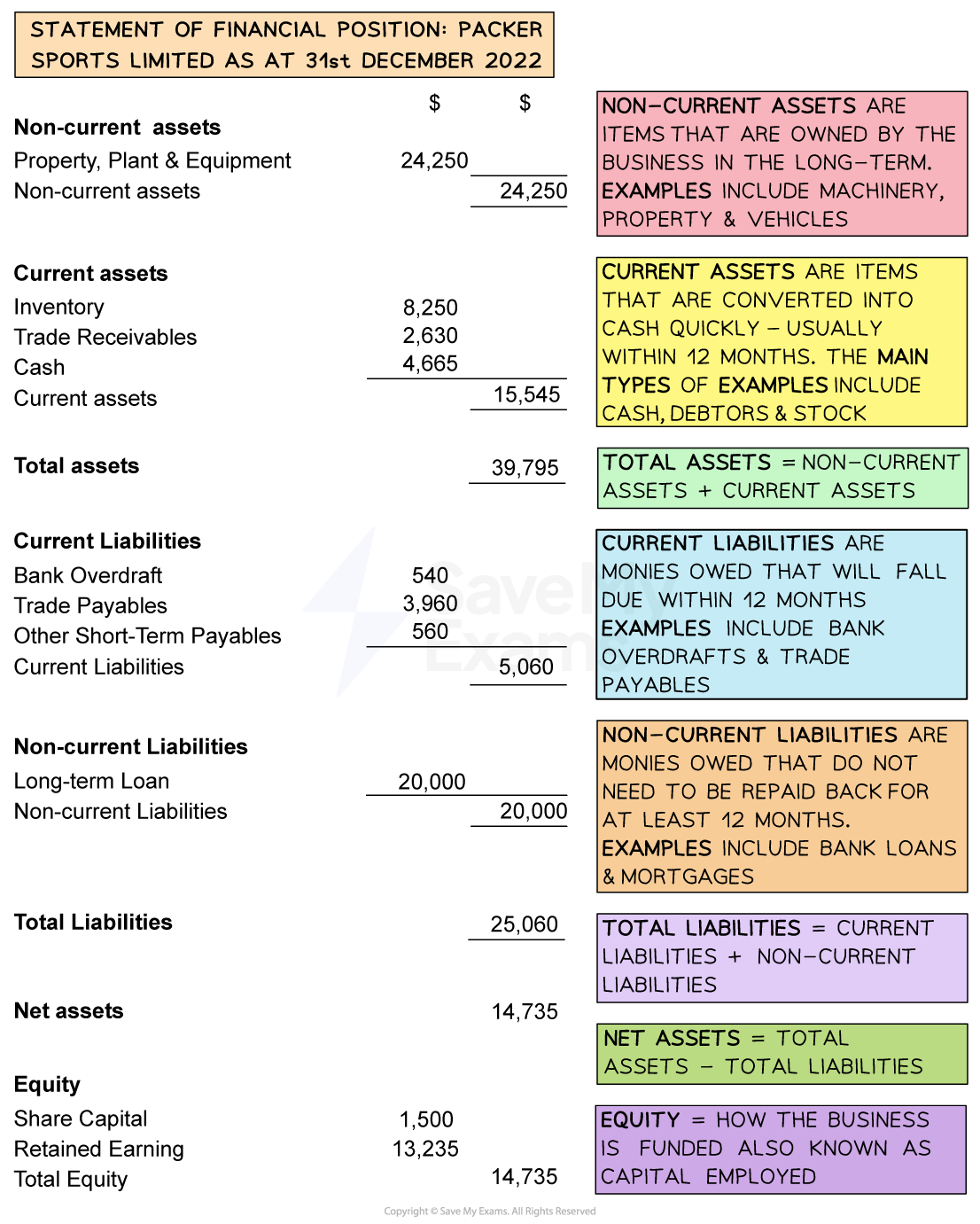
The statement of financial position generally follows the structure shown below
Statement of financial position
Interpreting the statement of financial position
-
Several deductions can be made from the statement about how a business finances its activities,
Financing its activities
-
Packer Sports Limited is funded through share capital of $1,500 and retained earnings of $13,235
-
The business has long-term liabilities in the form of a loan for $20,000
-
This is significantly greater than share capital so its gearing is high
-
Future applications for loans may be declined as the business is likely to be seen as a lending risk
-
-
What the business owns
-
On the stated date, Packer Sports Ltd owned assets worth $39,795 in total
-
Non-current assets of $24,250 consisting of property, machinery (plant) and other equipment
-
Current assets worth $15,545, comprised of inventory, trade receivables and cash
-
Inventory will be sold and converted to cash or trade receivables
-
-
When trade payables pay their invoices they will become cash
-
What the business owes
-
On the stated date, the business had total liabilities of $25,060
-
Its current liabilities were $5,060, comprised of a bank overdraft, trade payables and other short-term loans
-
Its long-term liabilities were valued at $20,000
-
Examiner Tips and Tricks
You are not required to construct a statement of financial position in the exam, but you may be asked to define assets and liabilities or identify the statement’s uses and key components.
Responses