
Exam code:9609
Consumer and industrial markets
-
An industrial market is where businesses sell their products or services to other businesses
-
Goods are not usually for final consumption, but are used to help make other products or to support business operations
-
It is also known as B2B (business-to-business) selling
-
E.g. a company that produces steel may sell it to a car manufacturer
-
-
-
A consumer market is where businesses sell products or services directly to individuals for their own personal use
-
It is often called B2C (business-to-consumer) selling
-
These include markets for goods and services such as clothing, smartphones, fast food or video streaming platforms
-
Key differences between consumer and industrial markets
|
Feature |
Industrial market |
Consumer market |
|---|---|---|
|
Target customer |
|
|
|
Purchase purpose |
|
|
|
Purchase volume |
|
|
|
Product type |
|
|
|
Sales process |
|
|
|
Promotion |
|
|
Local, national and international markets
-
A local market is where goods and services are bought and sold within a small geographical area, such as a town or city
-
They serve nearby consumers and are often run by small businesses
-
E.g. a local bakery selling fresh bread to people in the same neighbourhood or a hairdresser serving clients in their local town
-
-
-
A national market is where a business operates and sells its products or services across the entire country
-
Customers can come from anywhere within that country, and businesses use websites, advertising and delivery services to reach a wider audience
-
E.g. Ale Hop sells gifts, stationery and homewares through stores and online across the whole of Spain
-
-
-
An international market is where businesses sell their products or services in more than one country
-
Businesses operating in these markets have to deal with different languages, cultures, laws and currencies
-
E.g. Coca-Cola sells drinks globally and Samsung sells electronics in many different countries
-
-
Product orientation and customer orientation
Product orientation
-
A business with a product orientation focuses primarily on manufacturing a product rather than the needs of the consumer
-
The emphasis is on creating a product first and then finding a market
-
Over time, being too product orientated means the business may move further and further away from what the market is looking for, thus increasing the risk of business failure
-
E.g. Gillette‘s razors can be classified as a product-orientated business as the business focuses on the quality of its products and regular innovations aimed at increasing sales
-
-

Benefits of product orientation
-
Focus on quality and innovation
-
Businesses can develop high-quality or unique products by concentrating on design and production
-
-
Strong brand image
-
Offering something distinctive or well-made can build a strong reputation and brand loyalty
-
-
Less need for constant market research
-
Product-oriented firms rely more on internal expertise than customer feedback
-
-
Efficient production
-
Standardised products allow for economies of scale and streamlined processes
-
Customer (market) orientation
-
Customer (market) orientation is a business approach that focuses on the consumer demand and designs products that meet customer needs
-
Consumers are at the centre of marketing decisions
-
Products are designed to meet consumers’ needs
-
E.g. Universities often develop new courses based on the feedback they receive from students and employers
-
-
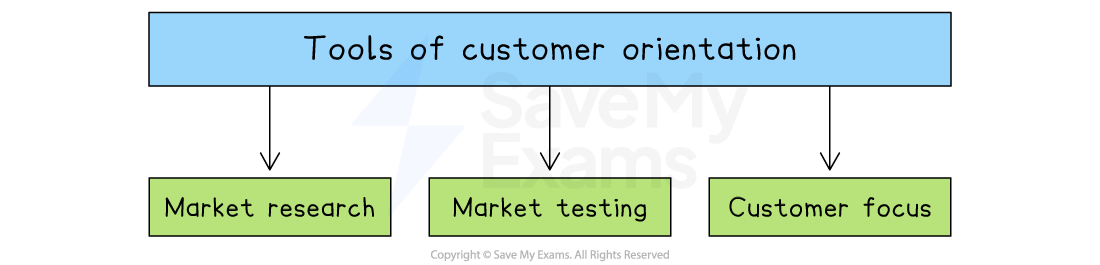
Benefits of customer orientation
-
Better customer satisfaction
-
Products are developed based on what customers actually want and need
-
-
Stronger customer loyalty
-
Meeting customer expectations can lead to repeat purchases and positive word-of-mouth
-
-
Faster response to market changes
-
Businesses can adapt quickly to changes in tastes, trends, or demand
-
-
Higher sales potential
-
Products are more likely to succeed when they’re tailored to the target market
-
Market share and market growth
-
Market share is the proportion of the total sales of a product or service compared to the market as a whole
-
e.g. Tesco has 26% of the UK grocery market
-
-
Market share can be calculated using the formula
format('truetype')%3Bfont-weight%3Anormal%3Bfont-style%3Anormal%3B%7D%3C%2Fstyle%3E%3C%2Fdefs%3E%3Ctext%20font-family%3D%22Times%20New%20Roman%22%20font-size%3D%2218%22%20text-anchor%3D%22middle%22%20x%3D%2226.5%22%20y%3D%2230%22%3EMarket%3C%2Ftext%3E%3Ctext%20font-family%3D%22Times%20New%20Roman%22%20font-size%3D%2218%22%20text-anchor%3D%22middle%22%20x%3D%2275.5%22%20y%3D%2230%22%3Eshare%3C%2Ftext%3E%3Ctext%20font-family%3D%22math102a87acd26f5771b4d57a7dfb3%22%20font-size%3D%2216%22%20text-anchor%3D%22middle%22%20x%3D%22106.5%22%20y%3D%2230%22%3E%3D%3C%2Ftext%3E%3Cline%20stroke%3D%22%23000000%22%20stroke-linecap%3D%22square%22%20stroke-width%3D%221%22%20x1%3D%22121.5%22%20x2%3D%22374.5%22%20y1%3D%2223.5%22%20y2%3D%2223.5%22%2F%3E%3Ctext%20font-family%3D%22Times%20New%20Roman%22%20font-size%3D%2218%22%20text-anchor%3D%22middle%22%20x%3D%22142.5%22%20y%3D%2216%22%3ESales%3C%2Ftext%3E%3Ctext%20font-family%3D%22Times%20New%20Roman%22%20font-size%3D%2218%22%20text-anchor%3D%22middle%22%20x%3D%22172.5%22%20y%3D%2216%22%3Eof%3C%2Ftext%3E%3Ctext%20font-family%3D%22Times%20New%20Roman%22%20font-size%3D%2218%22%20text-anchor%3D%22middle%22%20x%3D%22188.5%22%20y%3D%2216%22%3Ea%3C%2Ftext%3E%3Ctext%20font-family%3D%22Times%20New%20Roman%22%20font-size%3D%2218%22%20text-anchor%3D%22middle%22%20x%3D%22226.5%22%20y%3D%2216%22%3Ebusiness%3C%2Ftext%3E%3Ctext%20font-family%3D%22Times%20New%20Roman%22%20font-size%3D%2218%22%20text-anchor%3D%22middle%22%20x%3D%22268.5%22%20y%3D%2216%22%3Ein%3C%2Ftext%3E%3Ctext%20font-family%3D%22Times%20New%20Roman%22%20font-size%3D%2218%22%20text-anchor%3D%22middle%22%20x%3D%22283.5%22%20y%3D%2216%22%3Ea%3C%2Ftext%3E%3Ctext%20font-family%3D%22Times%20New%20Roman%22%20font-size%3D%2218%22%20text-anchor%3D%22middle%22%20x%3D%22307.5%22%20y%3D%2216%22%3Etime%3C%2Ftext%3E%3Ctext%20font-family%3D%22Times%20New%20Roman%22%20font-size%3D%2218%22%20text-anchor%3D%22middle%22%20x%3D%22350.5%22%20y%3D%2216%22%3Eperiod%3C%2Ftext%3E%3Ctext%20font-family%3D%22Times%20New%20Roman%22%20font-size%3D%2218%22%20text-anchor%3D%22middle%22%20x%3D%22144.5%22%20y%3D%2241%22%3ETotal%3C%2Ftext%3E%3Ctext%20font-family%3D%22Times%20New%20Roman%22%20font-size%3D%2218%22%20text-anchor%3D%22middle%22%20x%3D%22192.5%22%20y%3D%2241%22%3Emarket%3C%2Ftext%3E%3Ctext%20font-family%3D%22Times%20New%20Roman%22%20font-size%3D%2218%22%20text-anchor%3D%22middle%22%20x%3D%22238.5%22%20y%3D%2241%22%3Esales%3C%2Ftext%3E%3Ctext%20font-family%3D%22Times%20New%20Roman%22%20font-size%3D%2218%22%20text-anchor%3D%22middle%22%20x%3D%22267.5%22%20y%3D%2241%22%3Ein%3C%2Ftext%3E%3Ctext%20font-family%3D%22Times%20New%20Roman%22%20font-size%3D%2218%22%20text-anchor%3D%22middle%22%20x%3D%22282.5%22%20y%3D%2241%22%3Ea%3C%2Ftext%3E%3Ctext%20font-family%3D%22Times%20New%20Roman%22%20font-size%3D%2218%22%20text-anchor%3D%22middle%22%20x%3D%22306.5%22%20y%3D%2241%22%3Etime%3C%2Ftext%3E%3Ctext%20font-family%3D%22Times%20New%20Roman%22%20font-size%3D%2218%22%20text-anchor%3D%22middle%22%20x%3D%22349.5%22%20y%3D%2241%22%3Eperiod%3C%2Ftext%3E%3Ctext%20font-family%3D%22math102a87acd26f5771b4d57a7dfb3%22%20font-size%3D%2216%22%20text-anchor%3D%22middle%22%20x%3D%22389.5%22%20y%3D%2230%22%3E%26%23xD7%3B%3C%2Ftext%3E%3Ctext%20font-family%3D%22Times%20New%20Roman%22%20font-size%3D%2218%22%20text-anchor%3D%22middle%22%20x%3D%22415.5%22%20y%3D%2230%22%3E100%3C%2Ftext%3E%3C%2Fsvg%3E)
Responses