
Exam code:9609
Financial motivators
-
Financial incentives are rewards or payments given to employees in return for their labour or improved performance
Financial incentives and motivation theory
|
Financial incentive |
Explanation |
Link to motivation theory |
|---|---|---|
|
Piece rate |
|
|
|
Time rate |
|
|
|
Salary |
|
|
|
Commission |
|
|
|
Bonus |
|
|
|
Profit share |
|
|
|
Performance-related pay |
|
|
|
Fringe benefits |
|
|
Advantages of using financial motivators
-
Quickly boosts performance
-
Financial rewards like bonuses or commissions can lead to an immediate increase in effort and output
-
-
Easy to measure and manage
-
Targets linked to pay, such as volume of sales or units produced, are clear and simple to monitor
-
-
Attracts skilled employees
-
High pay and incentives can help a business compete for top talent in the job market
-
Disadvantages of using financial motivators
-
Can reduce teamwork
-
If pay is based on individual results, employees may compete instead of working together
-
-
Short-term focus
-
Employees may focus only on rewards and ignore quality, customer service or long-term goals
-
-
Costly for the business
-
Bonuses, commission and other financial rewards can become expensive, especially if not linked to overall profit
-
Non-financial motivators
-
Many people want challenge, recognition and opportunities for development from their work
-
According to Herzberg, motivators like job enrichment, promotion, and recognition increase job satisfaction by giving responsibility and purpose
-
Empowerment and participation in decision-making help employees feel trusted, which boosts motivation
-
-
According to Maslow, non-financial rewards meet higher-level needs like belonging, esteem and self-fulfilment
Examples of non-financial motivators
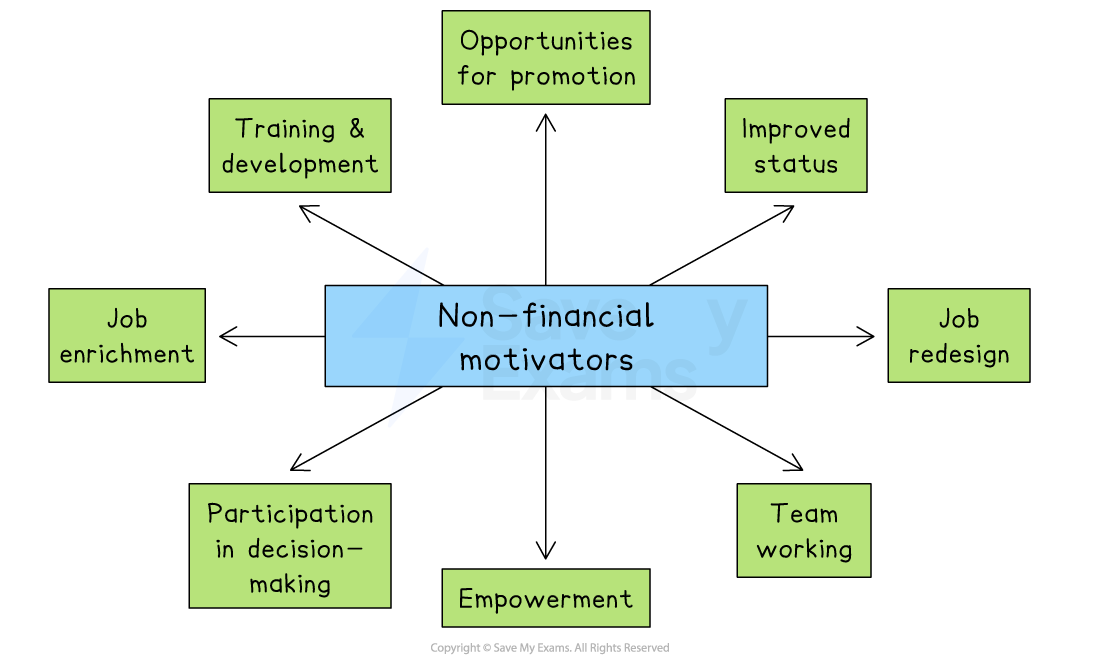
-
Training and development help employees improve their skills and grow in confidence, making them feel more capable and valued
-
Opportunities for promotion encourage employees to work harder by offering a clear path to higher-level roles and responsibilities
-
Improved status gives employees a higher job title or position, increasing their sense of importance and recognition
-
Job redesign involves changing job roles to make them more interesting or meaningful, which can reduce boredom and boost motivation
-
Team working encourages collaboration and a sense of belonging, helping employees feel supported and connected
-
Empowerment means giving employees the freedom to make decisions, which increases trust, confidence, and motivation
-
Participation in decision-making involves employees in business decisions, making them feel respected and more committed to the outcomes
-
Job enrichment adds more challenging or meaningful tasks to a role, giving employees a sense of achievement and purpose
Motivation theories in practical situations
-
Businesses use motivation theories to understand what motivates their staff and then apply these ideas to improve performance, job satisfaction, and staff retention
Applying Taylor’s theory
-
Taylor suggested that workers should be given simple tasks and paid based on how much they produce
-
Businesses may use performance-based pay systems
-
For example, factory workers are paid per unit made
-
Tasks are often simplified and repeated to improve speed and efficiency
-
Close supervision and clear instructions are given to employees
-
Case Study
Dhaka Stitchworks Ltd is a clothing manufacturer based in Bangladesh that supplies T-shirts to international fashion brands

The business employs over 200 factory workers and follows a piece-rate payment system, where each worker is paid £2 for every completed T-shirt
This system encourages workers to sew as many garments as possible each day, as their earnings depend on how much they produce
Supervisors monitor the production line closely and give clear instructions, in line with Frederick Taylor’s idea that efficiency improves when tasks are simple and output is rewarded
The factory has achieved high productivity levels using this approach. However, some workers feel their work is repetitive and physically tiring. A few have left the job due to the lack of variety and long hours
Applying Herzberg’s two-factor theory
-
Businesses make sure basic hygiene factors, such as fair pay and a clean and safe environment, are in place
-
Then they focus on motivators by giving employees responsibility, chances for promotion or by recognising achievements
Case Study
KrakSoft Technologies is a software company based in Kraków, Poland, specialising in developing mobile apps and digital solutions for clients across Europe. The business employs over 80 software developers, designers and project managers

Hygiene factors
-
Employees receive competitive salaries and enjoy modern, comfortable offices
-
They also benefit from flexible working arrangements and remote work options
Motivators
-
Staff are regularly praised for achievements, with monthly recognition awards and performance bonuses
-
They are encouraged to lead projects and attend international technology conferences
-
They also take part in career development programmes tailored to their goals
Outcomes
-
Employees are engaged, creative and willing to take on responsibility
-
Staff turnover is low, and the work environment is known for being both productive and positive
Employee participation
-
Employee participation means involving workers in decisions that affect the running of the business
Responses