
Exam code:9609
The purpose of inventory
-
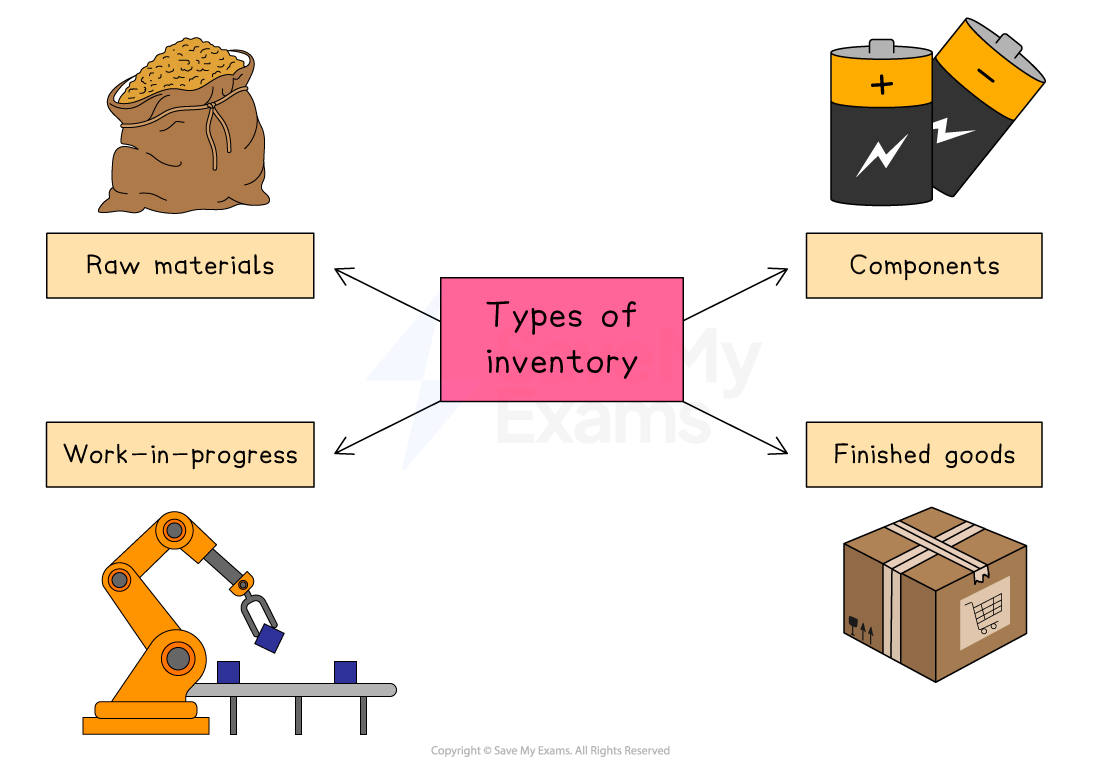
Inventory is the goods and materials a business holds for the ultimate goal of resale or for use in production
Types of inventory
|
Raw materials |
Components |
|---|---|
|
|
|
Work-in-progress |
Finished goods |
|
|
Costs and benefits of holding inventory
-
The management of stock is an important consideration for businesses
-
Problems may arise from holding inventory
-
Storage costs (e.g. warehouse rental, security costs) will be higher than necessary
-
The risk of spoilage and stock shrinkage is increased, leading to increased costs
-
Money tied up in stock could be used elsewhere in the business
-
Time and resources are needed to monitor and track stock levels
-
-
However, if a business holds inventory, it means that
-
Products are available when needed, improving customer satisfaction
-
Buying quantities of inventory and storing it may reduce unit costs due to bulk buying discounts
-
Production isn’t held up by supply issues
-
Extra stock helps meet peaks in sales, such as during holiday periods
-
The importance of supply chain management
-
The supply chain is the network of organisations, people, activities and resources that move a product from its basic raw material right through to the final customer
-
It includes the following:
-
Stock control: planning, implementing and monitoring the movement of raw materials, components, work-in-progress and finished goods
-
Quality control: ensuring output meets standards so that the end product is safe and meets customer expectations
-
Transport networks: ensuring efficient deliveries of goods to customers, taking account of speed, reliability and costs
-
Supplier networks: developing strong relationships with suppliers willing to work collaboratively to improve quality
-
-
Global supply chains require these activities to be coordinated across international borders
-
Some stages can be completed at lower cost in certain countries
-
E.g. China has a reputation for producing high quality, low-cost electronics components
-
-
Labour-intensive processing, such as clothes manufacturing, is outsourced to countries with low labour costs, such as Vietnam
-
Scarce raw materials may only be available in certain countries/regions
-
Building an effective supply chain
|
Decision area |
What it involves |
|---|---|
|
Make or buy (produce in-house or outsource) |
|
|
Choosing suppliers |
|
|
Purchasing approach |
|
|
Information sharing and use of technology |
|
|
Logistics structure |
|
Why does an effective supply chain matter?
-
Faster delivery to customers
-
When every link is well-coordinated, products move quickly from factory to shelf, beating slower rivals
-
-
Lower operating costs
-
Just-in-time (JIT) deliveries and bulk purchasing agreements reduce storage, handling and material expenses
-
E.g. Aldi negotiates long-term contracts with a small group of trusted suppliers, helping it minimise warehouse inventory and keep prices low
-
-
Consistent quality
-
Close, long-term relationships with suppliers make it easier to enforce standards and fix problems early
-
-
Greater resilience to shocks
-
A well-planned supply chain includes backup suppliers and effective data sharing so the business can adapt when something goes wrong
-
Inventory control charts
-
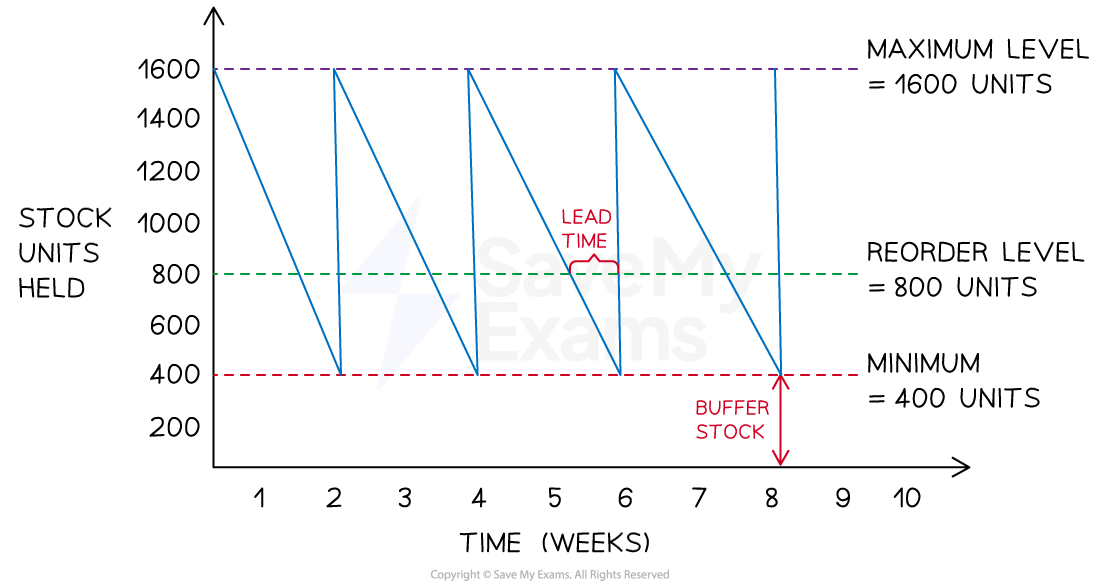
An inventory control diagram shows how inventory moves into and out of a business over time
An inventory control diagram
-
The maximum inventory level is the maximum amount of stock a business is able to hold in normal circumstances (1,600)
-
The reorder level is the level at which a business places a new order with its supplier (800)
-
The minimum stock level is also known as the buffer inventory level and is the lowest level to which a business is willing to allow inventory levels to fall (400)
-
Lead time is the length of time from the point of inventory being ordered from the supplier to it being delivered (one week)
-
The stock level line shows how inventory levels change over the given time period
-
As inventory is used up, a downwards slope is plotted
-
When an order is delivered by a supplier, the stock level line shoots upwards
-
Worked Example
The diagram below shows inventory movements of kitchen shelving units sold by TamFix Limited.
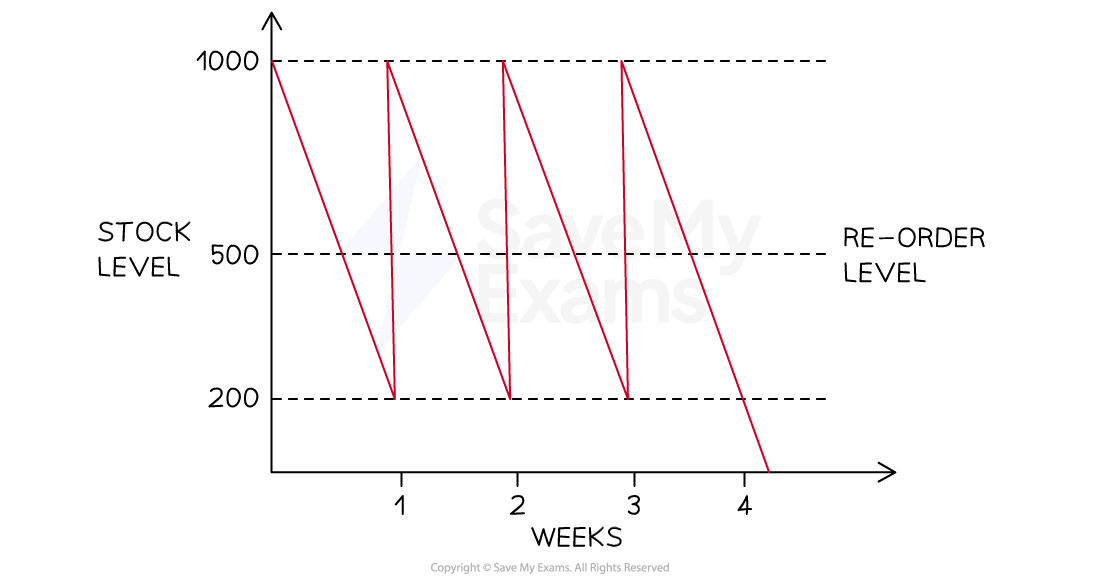
Identify the following points:
-
The minimum stock level
-
The reorder level
-
The reorder quantity
-
The lead time for kitchen shelving units
(4)
Answer:
Step 1: Identify the minimum stock level
-
The minimum stock level is identified by the bottommost dotted line
-
In this case, it shows that the minimum stock level is 200 units (1)
Step 2: Identify the reorder level
-
The reorder level is clearly identified on the diagram
-
In this case, it shows that the reorder level is 500 units (1)
Step 3: Identify the reorder quantity
-
The reorder quantity is the difference between the maximum stock level (shown by the topmost dotted line) and the minimum stock level
<img alt=”equals space 1000 space units space minus space 200 space units space equals space 800 space units” data-mathml=”<math ><semantics><mrow><mo>=</mo><mo> </mo><mn>1000</mn><mo> </mo><mi>units</mi><mo> </mo><mo>-</mo><mo> </mo><mn>200</mn><mo> </mo><mi>units</mi><mo> </mo><mspace linebreak=”newline”/><mspace linebreak=”newline”/><mo>=</mo><mo> </mo><mn>800</mn><mo> </mo><mi>units</mi></mrow><annotation encoding=”application/vnd.wiris.mtweb-params+json”>{“fontFamily”:”Times New Roman”,”fontSize”:”18″,”autoformat”:true,”toolbar”:”<toolbar ref=’general’><tab ref=’general’><removeItem ref=’setColor’/><removeItem ref=’bold’/><removeItem ref=’italic’/><removeItem ref=’autoItalic’/><removeItem ref=’setUnicode’/><removeItem ref=’mtext’ /><removeItem ref=’rtl’/><removeItem ref=’forceLigature’/><removeItem ref=’setFontFamily’ /><removeItem ref=’setFontSize’/></tab></toolbar>”}</annotation></semantics></math>” height=”69″ role=”math” src=”data:image/svg+xml;charset=utf8,%3Csvg%20xmlns%3D%22http%3A%2F%2Fwww.w3.org%2F2000%2Fsvg%22%20xmlns%3Awrs%3D%22http%3A%2F%2Fwww.wiris.com%2Fxml%2Fmathml-extension%22%20height%3D%2269%22%20width%3D%22192%22%20wrs%3Abaseline%3D%2234%22%3E%3C!–MathML%3A%20%3Cmath%20xmlns%3D%22http%3A%2F%2Fwww.w3.org%2F1998%2FMath%2FMathML%22%3E%3Cmo%3E%3D%3C%2Fmo%3E%3Cmo%3E%26%23xA0%3B%3C%2Fmo%3E%3Cmn%3E1000%3C%2Fmn%3E%3Cmo%3E%26%23xA0%3B%3C%2Fmo%3E%3Cmi%3Eunits%3C%2Fmi%3E%3Cmo%3E%26%23xA0%3B%3C%2Fmo%3E%3Cmo%3E-%3C%2Fmo%3E%3Cmo%3E%26%23xA0%3B%3C%2Fmo%3E%3Cmn%3E200%3C%2Fmn%3E%3Cmo%3E%26%23xA0%3B%3C%2Fmo%3E%3Cmi%3Eunits%3C%2Fmi%3E%3Cmo%3E%26%23xA0%3B%3C%2Fmo%3E%3Cmspace%20linebreak%3D%22newline%22%2F%3E%3Cmspace%20linebreak%3D%22newline%22%2F%3E%3Cmo%3E%3D%3C%2Fmo%3E%3Cmo%3E%26%23xA0%3B%3C%2Fmo%3E%3Cmn%3E800%3C%2Fmn%3E%3Cmo%3E%26%23xA0%3B%3C%2Fmo%3E%3Cmi%3Eunits%3C%2Fmi%3E%3C%2Fmath%3E–%3E%3Cdefs%3E%3Cstyle%20type%3D%22text%2Fcss%22%3E%40font-face%7Bfont-family%3A’math143f4d31b04031e49f5eb18baba’%3Bsrc%3Aurl(data%3Afont%2Ftruetype%3Bcharset%3Dutf-8%3Bbase64%2CAAEAAAAMAIAAAwBAT1MvMi7iBBMAAADMAAAATmNtYXDEvmKUAAABHAAAADxjdnQgDVUNBwAAAVgAAAA6Z2x5ZoPi2VsAAAGUAAAA%2FGhlYWQQC2qxAAACkAAAADZoaGVhCGsXSAAAAsgAAAAkaG10eE2rRkcAAALsAAAADGxvY2EAHTwYAAAC%2BAAAABBtYXhwBT0FPgAAAwgAAAAgbmFtZaBxlY4AAAMoAAABn3Bvc3QB9wD6AAAEyAAAACBwcmVwa1uragAABOgAAAAUAAADSwGQAAUAAAQABAAAAAAABAAEAAAAAAAAAQEAAAAAAAAAAAAAAAAAAAAAAAAAAAAAAAAAAAAAACAgICAAAAAg1UADev96AAAD6ACWAAAAA
Responses