
Exam code:7131
Why match supply and demand?
-
Managing supply to match demand means ensuring a business has just the right amount of resources, products or staff available to meet customer needs
-
Getting this right is vital for operational efficiency and customer satisfaction
-
If supply exceeds demand, the business may waste money on storage or unsold goods
-
If supply falls short, customers may face delays or go elsewhere
-
-
Businesses can use several methods to match supply to demand, such as:
-
outsourcing
-
hiring temporary or part-time staff
-
producing to order
-
-
Each option offers benefits and trade-offs — explored in more detail below
Outsourcing
-
Outsourcing is the process where a business delegates specific business activities, such as IT, customer support or HR, to external service providers
-
Businesses choose to outsource these functions to reduce costs, access specialised expertise or focus on core competencies
-
-
Subcontracting occurs when specific parts of a larger project or contract are assigned to third parties
-
The business remains responsible for the overall project or contract
-
Certain components or tasks are delegated to other companies or individuals with specialised skills
-
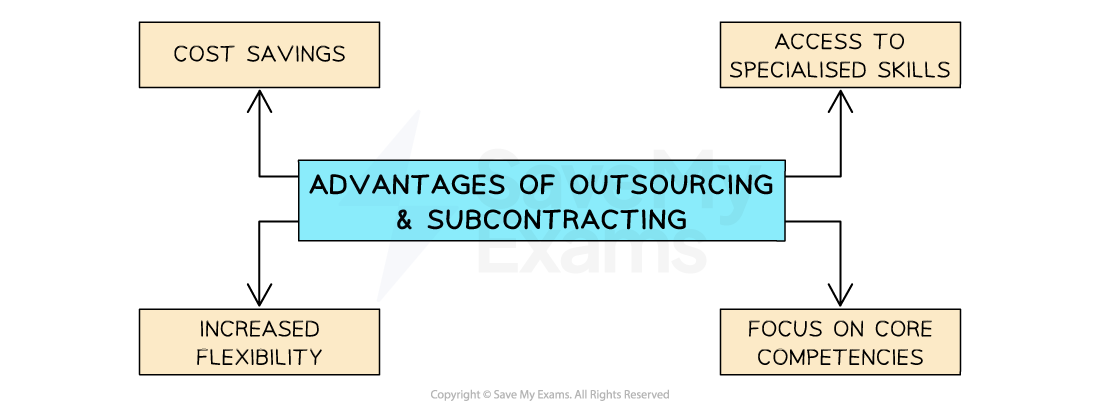
Advantages of outsourcing and subcontracting
-
Cost savings
-
Businesses can often reduce expenses such as hiring and training employees, maintaining facilities and managing IT systems
-
-
Access to specialised skills
-
External specialists have resources that a business may lack
-
This allows the business to benefit from the knowledge and experience of industry specialists as and when required
-
-
Increased flexibility
-
Businesses can provide greater flexibility to scale their operations up or down based on demand fluctuations
-
This is particularly valuable in industries with seasonal or unpredictable demand
-
-
Focus on core competencies
-
Businesses can concentrate their resources and efforts on their core competencies where they can add value
-
Limitations of outsourcing and subcontracting
-
Quality control
-
Using external providers makes it harder to ensure consistent quality and adherence to company standards
-
-
Loss of control
-
Handing direct control over those activities to others outside of the business may be risky
-
Companies must carefully select reliable outsourcing partners and establish clear expectations to protect their interests
-
-
Data security and confidentiality
-
Sharing sensitive information outside of the business introduces potential risks to data security and confidentiality
-
-
Communication and cultural differences
-
Using global providers may result in language barriers or problems with time zone differences
-
Using temporary and part-time employees
-
Flexible working is the development of a culture where workers are equipped to do different roles or work in a range of employment patterns
-
Examples include temporary or part-time contracts, flexible hours and working from home
Examples of flexible employment
|
Approach |
Explanation |
|---|---|
|
Part-time contracts |
|
|
Temporary (fixed-term or seasonal) contracts |
|
|
Working from home / remote work |
|
|
Flexible hours |
|
Benefits of flexible employment
-
Ability to attract and retain good staff
-
Giving staff options such as flexitime or part-time hours makes the job fit their lives, so fewer staff leave and more applicants apply
-
-
Higher productivity and well-being
-
When employees can choose where or when they work, many focus better and feel less stressed, and output often rises
-
E.g. Atom Bank’s four-day-week trial saw staff complete the same work in fewer hours while customer service scores went up
-
-
-
Lower overhead costs for the business
-
Hybrid or home working means firms can reduce the size of offices, use fewer desks and cut rent and energy bills
-
Challenges of flexible employment
-
Communication and collaboration can suffer
-
When staff work on-screen instead of sharing the same physical space, informal chats and quick problem-solving decline
-
A recent UK survey (opens in a new tab)found that 55% of remote workers suffer video-call fatigue and lower team energy than their in-office counterparts
-
-
-
Equipping home offices costs money
-
Businesses must buy or reimburse staff for laptops, monitors and ergonomic chairs
-
-
Less face-to-face time can slow innovation
-
Remote teams are less likely to generate ideas than on-site groups or workers because spontaneous brainstorming drops with remote work
-
-
Need for monitoring to keep everyone on task
-
Many UK companies now install time-tracking or screen-monitoring software to check remote productivity, raising privacy concerns and extra work for managers
-
Producing to order
-
Producing to order is when a product is built only after a customer confirms an order, rather than being made for stock
-
The customer’s exact choices, such as size, style, colour and features, drive production, so nothing is finished in advance
Examples of products often made to order

Evaluating producing to order
|
Advantages |
Disadvantages |
|---|---|
|
|
|
|
|
|
|
|
Responses