
Biology_Edexcel_A-snab_Alevel
-
the-circulatory-system8 主题
-
diet-and-health11 主题
-
gas-exchange-cell-membranes-and-transport8 主题
-
nucleic-acids3 主题
-
proteins10 主题
-
inheritance7 主题
-
cell-structure-and-organisation7 主题
-
cell-division3 主题
-
reproduction-and-inheritance4 主题
-
differentiation-and-variation5 主题
-
biodiversity9 主题
-
resources-from-plants10 主题
-
plant-cell-structure
-
plant-stems
-
importance-of-water-and-inorganic-ions-to-plants
-
starch-and-cellulose-structure-and-function
-
plant-fibres
-
practical-identifying-tissue-types-within-stems
-
tensile-strength-plant-fibres
-
development-of-drug-testing
-
antimicrobial-properties-of-plants
-
sustainability-and-plant-materials
-
plant-cell-structure
-
ecosystems-and-energy-transfer7 主题
-
photosynthesis7 主题
-
climate-change10 主题
-
the-effects-of-climate-change
-
temperature-and-enzyme-activity
-
practical-temperature-and-development-of-organisms
-
climate-change-and-the-scientific-community
-
carbon-cycle-and-reduction-of-atmospheric-carbon-dioxide
-
reducing-climate-change
-
introduction-to-climate-change
-
evidence-for-the-causes-of-climate-change
-
the-greenhouse-effect
-
models-of-future-climate-change
-
the-effects-of-climate-change
-
evolution3 主题
-
forensics3 主题
-
microorganisms-and-immunity11 主题
-
muscles-and-movement3 主题
-
respiration7 主题
-
homeostasis4 主题
-
exercise4 主题
-
response-to-the-environment8 主题
-
the-brain-behaviour-and-disease10 主题
mode-of-enzyme-action
Mode of Enzyme Action
-
Enzymes are globular proteins
-
This means their 3D shape (as well as the shape of the active site of an enzyme) is determined by the complex tertiary structure of the protein that makes up the enzyme and is therefore highly specific
-
Enzymes have a unique active site where specific substrates bind forming an enzyme-substrate complex
-
The active site of an enzyme has a specific shape to fit a specific substrate
-
Extremes of heat or pH can alter the protein structure and change the shape of the active site, preventing substrate binding – this is called denaturation
-
Substrates collide with the enzymes active site and this must happen at the correct orientation and speed in order for a reaction to occur

The active site of an enzyme has a specific shape to fit a specific substrate (when the substrate binds an enzyme-substrate complex is formed)
Enzyme specificity
-
The specificity of an enzyme is a result of the complementary nature between the shape of the active site on the enzyme and its substrate(s)
-
Only one specific substrate will fit into one specific active site
-
The shape of the active site (and therefore the specificity of the enzyme) is determined by the complex tertiary structure of the protein that makes up the enzyme:
-
Proteins are formed from chains of amino acids held together by peptide bonds
-
The order of amino acids determines the shape of an enzyme
-
If the order is altered, the resulting three-dimensional shape changes
-
-
If the tertiary structure of the protein is altered in any way, the shape of the active site will change and the substrate will no longer fit the active site
-
This means that an enzyme-substrate complex will not be able to form and the product(s) will not be produced: the enzyme will not be able to carry out its function

An example of enzyme specificity
The lock-and-key hypothesis
-
In the 1890’s the first model of enzyme activity was described by Emil Fischer:
-
He suggested that both enzymes and substrates were rigid structures that locked into each other very precisely, much like a key going into a lock
-
This is known as the ‘lock-and-key hypothesis’
-

The Lock and Key hypothesis
The induced-fit hypothesis
-
The lock-and-key model was later modified and adapted to our current understanding of enzyme activity, permitted by advances in techniques in the molecular sciences
-
The modified model of enzyme activity (first proposed in 1959) is known as the ‘induced-fit hypothesis’
-
Although it is very similar to the lock and key hypothesis, in this model the enzyme and substrate interact with each other:
-
The enzyme and its active site (and sometimes the substrate) can change shape slightly as the substrate molecule enters the enzyme
-
These changes in shape are known as conformational changes
-
The conformational changes ensure an ideal binding arrangement between the enzyme and substrate is achieved
-
This maximises the ability of the enzyme to catalyse the reaction
-
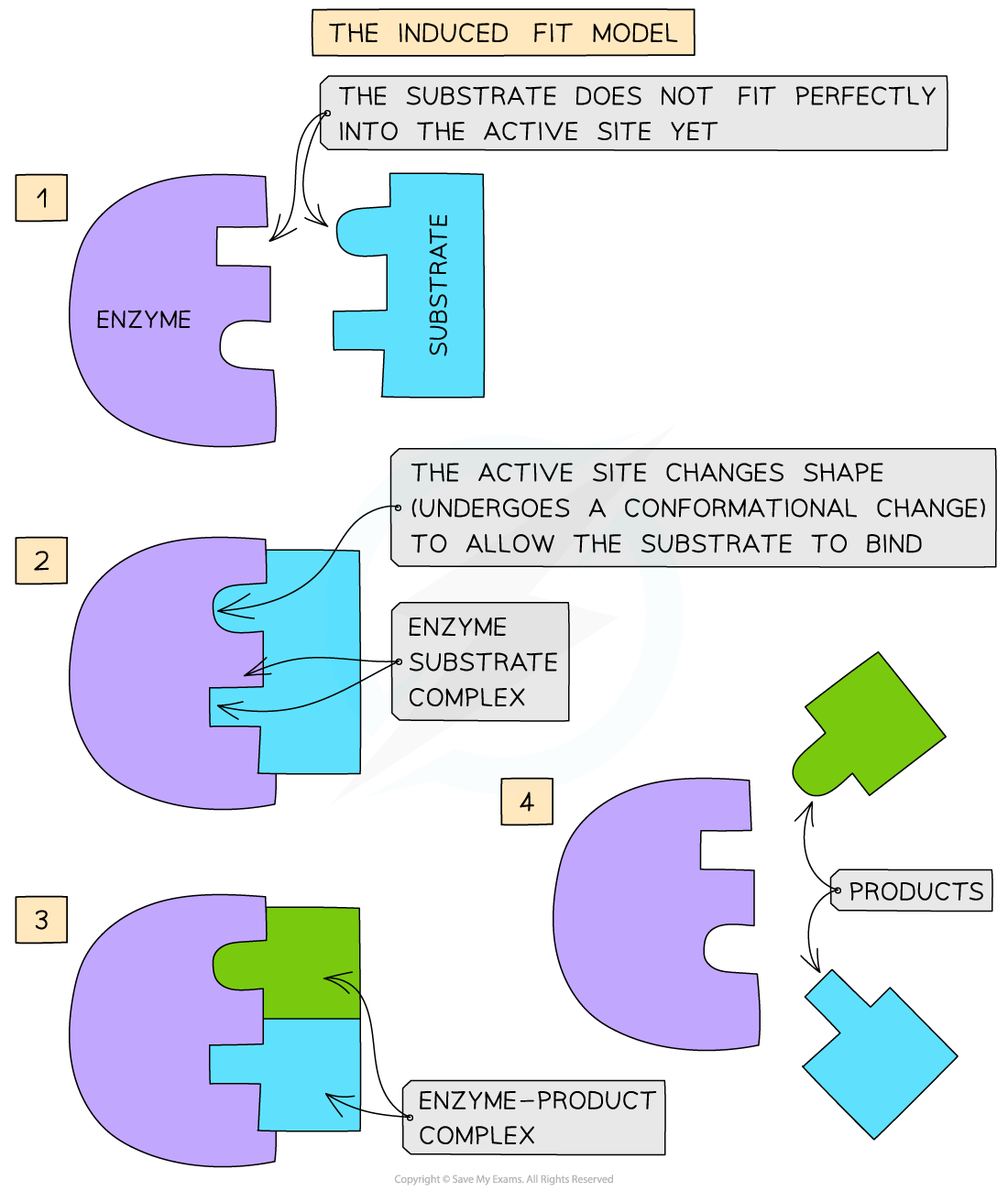
The Induced Fit model of enzyme action