Biology_Alevel_Ocr
-
4-1-communicable-diseases-disease-prevention-and-the-immune-system16 主题
-
4-1-1-common-pathogens-and-communicable-diseases
-
4-1-2-transmission-of-communicable-pathogens
-
4-1-3-plant-defences-against-pathogens
-
4-1-4-non-specific-immune-responses
-
4-1-5-phagocytes
-
4-1-6-blood-cells
-
4-1-7-the-t-lymphocyte-response
-
4-1-8-the-b-lymphocyte-response
-
4-1-9-primary-and-secondary-immune-responses
-
4-1-10-antibodies
-
4-1-11-opsonins-agglutinins-and-anti-toxins
-
4-1-12-types-of-immunity
-
4-1-13-autoimmune-diseases
-
4-1-14-principles-of-vaccination
-
4-1-15-sources-of-medicine
-
4-1-16-antibiotics
-
4-1-1-common-pathogens-and-communicable-diseases
-
4-2-biodiversity10 主题
-
4-2-1-biodiversity
-
4-2-2-sampling-to-determine-biodiversity
-
4-2-3-practical-investigating-biodiversity-using-sampling
-
4-2-4-measuring-species-richness-and-species-evenness
-
4-2-5-simpsons-index
-
4-2-6-genetic-diversity
-
4-2-7-factors-affecting-biodiversity
-
4-2-8-reasons-for-maintaining-biodiversity
-
4-2-9-methods-of-maintaining-biodiversity
-
4-2-10-conservation-agreements
-
4-2-1-biodiversity
-
4-3-classification-and-evolution15 主题
-
4-3-1-classification-of-species
-
4-3-2-binomial-system
-
4-3-3-classification-of-the-three-domains
-
4-3-4-classification-of-the-five-kingdoms
-
4-3-5-classification-and-phylogeny
-
4-3-6-evidence-of-evolution
-
4-3-7-types-of-variation
-
4-3-8-standard-deviation
-
4-3-9-variation-t-test-method
-
4-3-10-variation-t-test-worked-example
-
4-3-11-spearmans-rank-correlation
-
4-3-12-adaptation
-
4-3-13-natural-selection
-
4-3-14-evolution-of-resistance
-
4-3-15-consequences-of-resistance
-
4-3-1-classification-of-species
-
5-1-communication-and-homeostasis4 主题
-
5-2-excretion10 主题
-
5-2-1-the-importance-of-excretion
-
5-2-2-the-mammalian-liver-structure
-
5-2-3-the-mammalian-liver-function
-
5-2-4-the-liver-under-the-microscope
-
5-2-5-the-mammalian-kidney-structure
-
5-2-6-the-mammalian-kidney-function
-
5-2-7-the-kidney-under-the-microscope
-
5-2-8-osmoregulation
-
5-2-9-kidney-failure
-
5-2-10-excretory-products-and-medical-diagnosis
-
5-2-1-the-importance-of-excretion
-
5-3-neuronal-communication9 主题
-
5-4-hormonal-communication4 主题
-
5-5-plant-and-animal-responses16 主题
-
5-5-1-plant-responses
-
5-5-2-investigating-phototropism-and-geotropism
-
5-5-3-plant-hormones
-
5-5-4-auxins-and-apical-dominance
-
5-5-5-gibberellin
-
5-5-6-practical-effect-of-plant-hormones-on-growth
-
5-5-7-commercial-use-of-plant-hormones
-
5-5-8-mammalian-nervous-system
-
5-5-9-the-human-brain
-
5-5-10-reflex-actions
-
5-5-11-coordination-of-responses
-
5-5-12-factors-affecting-heart-rate
-
5-5-13-investigating-factors-affecting-heart-rate
-
5-5-14-mammalian-muscle-structure
-
5-5-15-transmission-across-a-neuromuscular-junction
-
5-5-16-the-sliding-filament-model
-
5-5-1-plant-responses
-
5-6-photosynthesis10 主题
-
5-6-1-photosynthesis-and-respiration
-
5-6-2-chloroplast-structure-and-function
-
5-6-3-photosynthetic-pigments
-
5-6-4-practical-investigating-photosynthetic-pigments-with-chromatography
-
5-6-5-the-light-dependent-stage
-
5-6-6-using-the-products-of-the-light-dependent-reaction
-
5-6-7-the-light-independent-stage
-
5-6-8-uses-of-triose-phosphate
-
5-6-9-factors-affecting-the-rate-of-photosynthesis
-
5-6-10-practical-investigating-factors-affecting-the-rate-of-photosynthesis
-
5-6-1-photosynthesis-and-respiration
-
5-7-respiration14 主题
-
5-7-14-practical-respirometer
-
5-7-1-the-need-for-cellular-respiration
-
5-7-2-structure-of-the-mitochondrion
-
5-7-3-the-four-stages-in-aerobic-respiration
-
5-7-4-glycolysis
-
5-7-5-the-link-reaction
-
5-7-6-the-krebs-cycle
-
5-7-7-the-role-of-coenzymes
-
5-7-8-oxidative-phosphorylation
-
5-7-9-anaerobic-respiration
-
5-7-10-energy-yield-of-aerobic-vs-anaerobic-respiration
-
5-7-11-practical-investigating-the-rate-of-respiration
-
5-7-12-respiratory-substrates
-
5-7-13-respiratory-quotient-rq
-
5-7-14-practical-respirometer
-
6-1-cellular-control7 主题
-
6-2-patterns-of-inheritance13 主题
-
6-2-1-key-terms-in-genetics
-
6-2-2-variation-phenotype
-
6-2-3-variation-sexual-reproduction
-
6-2-4-predicting-inheritance-monohybrid-crosses
-
6-2-5-predicting-inheritance-dihybrid-crosses
-
6-2-6-predicting-inheritance-identifying-linkage
-
6-2-7-predicting-inheritance-identifying-epistasis
-
6-2-8-predicting-inheritance-chi-squared-test
-
6-2-9-continuous-and-discontinuous-variation
-
6-2-10-factors-affecting-evolution
-
6-2-11-the-hardy-weinberg-principle
-
6-2-12-isolation-and-speciation
-
6-2-13-artificial-selection
-
6-2-1-key-terms-in-genetics
-
6-3-manipulating-genomes11 主题
-
6-3-1-dna-sequencing
-
6-3-2-comparing-genomes
-
6-3-3-non-coding-dna-and-regulatory-genes
-
6-3-4-synthetic-biology
-
6-3-5-polymerase-chain-reaction
-
6-3-6-electrophoresis
-
6-3-7-dna-profiling
-
6-3-8-genetic-engineering
-
6-3-9-genetic-engineering-techniques
-
6-3-10-uses-of-genetic-engineering
-
6-3-11-gene-therapy
-
6-3-1-dna-sequencing
-
6-4-cloning-and-biotechnology14 主题
-
6-4-1-natural-clones-in-plants
-
6-4-2-producing-cuttings
-
6-4-3-production-of-artificial-clones-in-plants
-
6-4-4-uses-of-plant-cloning
-
6-4-5-natural-clones-in-animals
-
6-4-6-production-of-artificial-clones-in-animals
-
6-4-7-uses-of-animal-cloning
-
6-4-8-microorganisms-and-biotechnology
-
6-4-9-microorganisms-and-food-production
-
6-4-10-culturing-microorganisms
-
6-4-11-batch-and-continuous-fermentation
-
6-4-12-standard-growth-curve-of-microorganisms
-
6-4-13-factors-affecting-the-growth-of-microorganisms
-
6-4-14-immobilised-enzymes-in-biotechnology
-
6-4-1-natural-clones-in-plants
-
6-5-ecosystems7 主题
-
6-6-populations-and-sustainability6 主题
-
1-1-practical-skills-written-assessment7 主题
-
1-2-practical-skills-endorsement-assessment16 主题
-
1-2-1-practical-ethical-use-of-organisms
-
1-2-2-practical-aseptic-techniques
-
1-2-3-practical-dissection-of-gas-exchange-surfaces-in-fish-and-insects
-
1-2-4-drawing-cells-from-blood-smears
-
1-2-5-practical-investigating-biodiversity-using-sampling
-
1-2-6-practical-data-loggers-and-computer-modelling
-
1-2-7-practical-investigating-the-rate-of-diffusion
-
1-2-8-practical-investigating-water-potential
-
1-2-9-practical-factors-affecting-membrane-structure-and-permeability
-
1-2-10-biochemical-tests-reducing-sugars-and-starch
-
1-2-11-biochemical-tests-lipids
-
1-2-12-biochemical-tests-proteins
-
1-2-13-chromatography
-
1-2-14-serial-dilutions
-
1-2-15-practical-investigating-the-rate-of-transpiration
-
1-2-16-practical-using-a-light-microscope
-
1-2-1-practical-ethical-use-of-organisms
-
2-1-cell-structure9 主题
-
2-2-biological-molecules17 主题
-
2-2-1-properties-of-water
-
2-2-2-monomers-and-polymers
-
2-2-3-monosaccharides
-
2-2-4-the-glycosidic-bond
-
2-2-5-polysaccharides
-
2-2-6-biochemical-tests-reducing-sugars-and-starch
-
2-2-7-lipids-and-ester-bonds
-
2-2-8-lipids-structure-and-function
-
2-2-9-biochemical-tests-lipids
-
2-2-10-amino-acids-and-peptide-bonds
-
2-2-11-protein-structure
-
2-2-12-globular-proteins
-
2-2-13-fibrous-proteins
-
2-2-14-inorganic-ions
-
2-2-15-biochemical-tests-proteins
-
2-2-16-finding-the-concentration-of-a-substance
-
2-2-17-chromatography
-
2-2-1-properties-of-water
-
2-3-nucleotides-and-nucleic-acids8 主题
-
2-4-enzymes9 主题
-
2-4-1-the-role-of-enzymes
-
2-4-2-enzyme-action
-
2-4-3-enzyme-activity-ph
-
2-4-4-enzyme-activity-temperature
-
2-4-5-enzyme-activity-enzyme-concentration
-
2-4-6-enzyme-activity-substrate-concentration
-
2-4-7-enzyme-activity-enzyme-inhibitors
-
2-4-8-coenzymes-cofactors-and-prosthetic-groups
-
2-4-9-practical-measuring-enzyme-activity
-
2-4-1-the-role-of-enzymes
-
2-5-biological-membranes9 主题
-
2-5-1-the-cell-surface-membrane
-
2-5-2-membrane-structure-and-permeability
-
2-5-3-diffusion-and-facilitated-diffusion
-
2-5-4-practical-investigating-the-rate-of-diffusion
-
2-5-5-active-transport
-
2-5-6-endocytosis-and-exocytosis
-
2-5-7-osmosis
-
2-5-8-osmosis-in-animal-and-plant-cells
-
2-5-9-practical-investigating-water-potential
-
2-5-1-the-cell-surface-membrane
-
2-6-cell-division-cell-diversity-and-cellular-organisation11 主题
-
2-6-1-the-cell-cycle
-
2-6-2-the-stages-of-mitosis
-
2-6-3-identifying-mitosis-in-plant-cells
-
2-6-4-the-significance-of-mitosis
-
2-6-5-the-stages-of-meiosis
-
2-6-6-the-significance-of-meiosis
-
2-6-7-specialised-cells
-
2-6-8-the-organisation-of-cells
-
2-6-9-stem-cells
-
2-6-10-stem-cells-in-animals-and-plants
-
2-6-11-the-use-of-stem-cells
-
2-6-1-the-cell-cycle
-
3-1-exchange-surfaces7 主题
-
3-2-transport-in-animals12 主题
-
3-2-1-the-need-for-transport-systems-in-animals
-
3-2-2-circulatory-systems
-
3-2-3-blood-vessels
-
3-2-4-tissue-fluid
-
3-2-5-the-mammalian-heart
-
3-2-6-practical-mammalian-heart-dissection
-
3-2-7-the-cardiac-cycle
-
3-2-8-cardiac-output
-
3-2-9-heart-action-initiation-and-control
-
3-2-10-electrocardiograms-ecgs
-
3-2-11-the-role-of-haemoglobin
-
3-2-12-adult-and-fetal-haemoglobin
-
3-2-1-the-need-for-transport-systems-in-animals
-
3-3-transport-in-plants11 主题
-
3-3-1-the-need-for-transport-systems-in-plants
-
3-3-2-the-xylem-and-phloem
-
3-3-3-the-xylem
-
3-3-4-the-phloem
-
3-3-5-transverse-sections-stems-roots-and-leaves
-
3-3-6-the-process-of-transpiration
-
3-3-7-transpiration-in-plants
-
3-3-8-practical-investigating-the-rate-of-transpiration
-
3-3-9-translocation
-
3-3-10-the-mass-flow-hypothesis
-
3-3-11-the-adaptations-of-xerophytic-and-hydrophytic-plants
-
3-3-1-the-need-for-transport-systems-in-plants
1-1-6-mathematical-analysis-of-results
Mathematical Analysis of Results
-
Quantitative investigations of variation can involve the interpretation of mean values and their standard deviations
-
A mean value describes the average value of a data set
-
Standard deviation is a measure of the spread or dispersion of data around the mean
-
A small standard deviation indicates that the results lie close to the mean (less variation)
-
Large standard deviation indicates that the results are more spread out

Two graphs showing the distribution of values when the mean is the same but one has a large standard deviation and the other a small standard deviation
Comparison between groups
-
When comparing the results from different groups or samples, using a measure of central tendency, such as the mean, can be quite misleading
-
For example, looking at the two groups below
-
Group A: 2, 15, 14, 15, 16, 15, 14
-
Group B: 1, 3, 10, 15, 20, 22, 20
-
-
Both groups have the same mean of 13
-
However, most of the values in group A lie close to the mean, whereas in group B most values lie quite far from the mean
-
For comparison between groups or samples it is better practice to use standard deviation in conjunction with the mean
-
Whether or not the standard deviations of different data sets overlap can provide a lot of information:
-
If there is an overlap between the standard deviations then it can be said that two sets of results are not significantly different
-
If there is no overlap between the standard deviations then it can be said that two sets of results are significantly different
-
Worked Example
A group of scientists wanted to investigate the effects of a specific diet on the risk of coronary heart disease. One group was given a specific diet for 8 weeks, while the other group acted as a control. After the 8 weeks scientists measured the diameter of the lumen of the main artery in the arm of the volunteers. The results of the experiment are shown in Table 1 below:
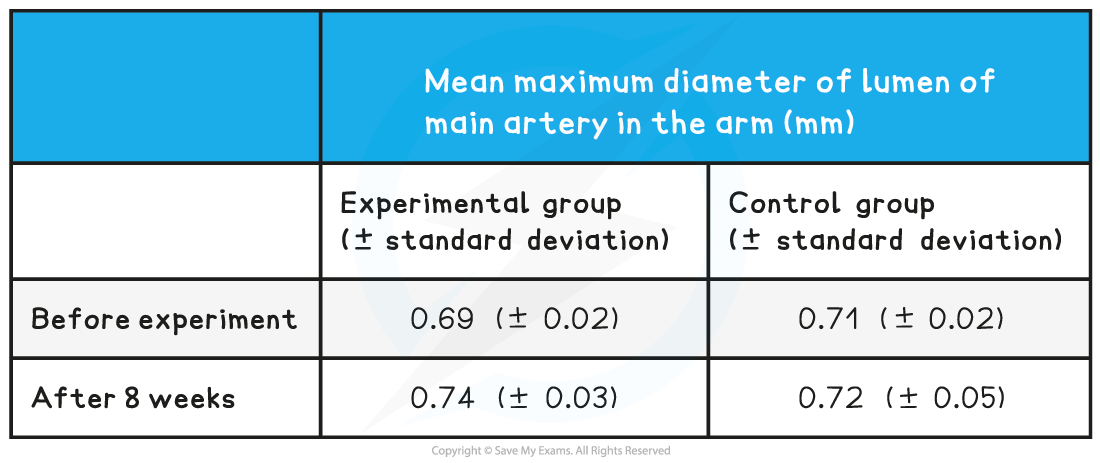
Use the standard deviations above to evaluate whether the diet had a significant effect?
[2 marks]
Answer:
Step one: find the full range of values included within the standard deviations for each data set
Experimental group before: 0.67 to 0.71mm
Experimental group after: 0.71 to 0.77mm
Control group before: 0.69 to 0.73mm
Control group after: 0.67 to 0.77mm
Step two: use this information to form your answer
There is an overlap of standard deviations in the experimental group before and after the experiment (0.67~0.71mm and 0.71~0.77mm) so it can be said that the difference before and after the experiment is not significant; [1 mark]
There is also an overlap of standard deviations between the experimental and control groups after the eight weeks (0.71~0.77mm and 0.67~0.77mm) so it can be said that the difference between groups is not significant; [1 mark]
Examiner Tips and Tricks
The standard deviations of a data set are not always presented in a table, they can also be represented by standard deviation error bars on a graph.
Plotting & Interpreting Graphs
-
Plotting data from investigations in the appropriate format allows you to more clearly see the relationship between two variables
-
This makes the results of experiments much easier to interpret
-
First, you need to consider what type of data you have:
-
Qualitative data (non-numerical data e.g. blood group)
-
Discrete data (numerical data that can only take certain values in a range e.g. shoe size)
-
Continuous data (numerical data that can take any value in a range e.g. height or weight)
-
-
For qualitative and discrete data, bar charts or pie charts are most suitable
-
For continuous data, line graphs or scatter graphs are most suitable
-
Scatter graphs are especially useful for showing how two variables are correlated (related to one another)
-
Tips for plotting data
-
Whatever type of graph you use, remember the following:
-
The data should be plotted with the independent variable on the x-axis and the dependent variable on the y-axis
-
Plot data points accurately
-
Use appropriate linear scales on axes
-
Choose scales that enable all data points to be plotted within the graph area
-
Label axes, with units included
-
Make graphs that fill the space the exam paper gives you
-
Draw a line of best fit. This may be straight or curved depending on the trend shown by the data. If the line of best fit is a curve make sure it is drawn smoothly. A line of best-fit should have a balance of data points above and below the line
-
In some cases, the line or curve of best fit should be drawn through the origin (but only if the data and trend allow it)
-
Using a tangent to find the initial rate of a reaction
-
For linear graphs (i.e. graphs with a straight-line), the gradient is the same throughout
-
This makes it easy to calculate the rate of change (rate of change = change ÷ time)
-
-
However, many enzyme rate experiments produce non-linear graphs (i.e. graphs with a curved line), meaning they have an ever-changing gradient
-
They are shaped this way because the reaction rate is changing over time
-
-
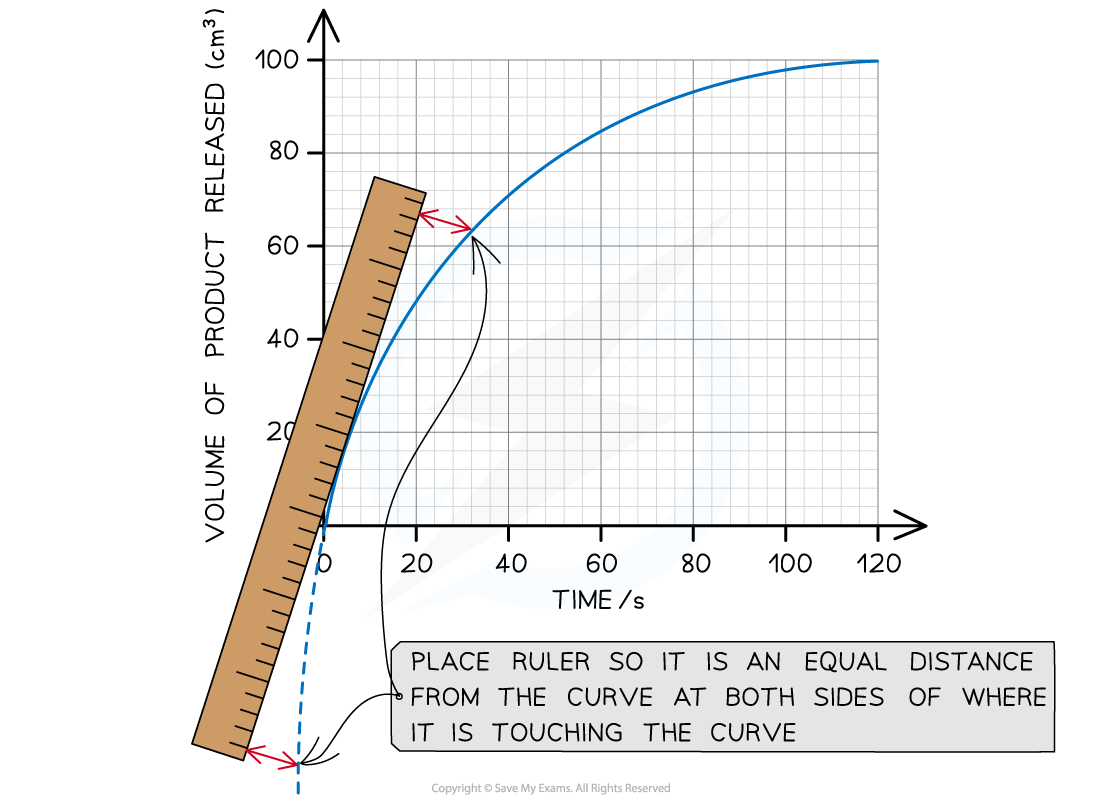
In these cases, a tangent can be used to find the reaction rate at any one point on the graph:
-
A tangent is a straight line that is drawn so it just touches the curve at a single point
-
The slope of this tangent matches the slope of the curve at just that point
-
You then simply find the gradient of the straight line (tangent) you have drawn
-
-
The initial rate of reaction is the rate of reaction at the start of the reaction (i.e. where time = 0)
Worked Example
The graph below shows the results of an enzyme rate reaction. Using this graph, calculate the initial rate of reaction.

Answer:
Step 1: Estimate the extrapolated curve of the graph
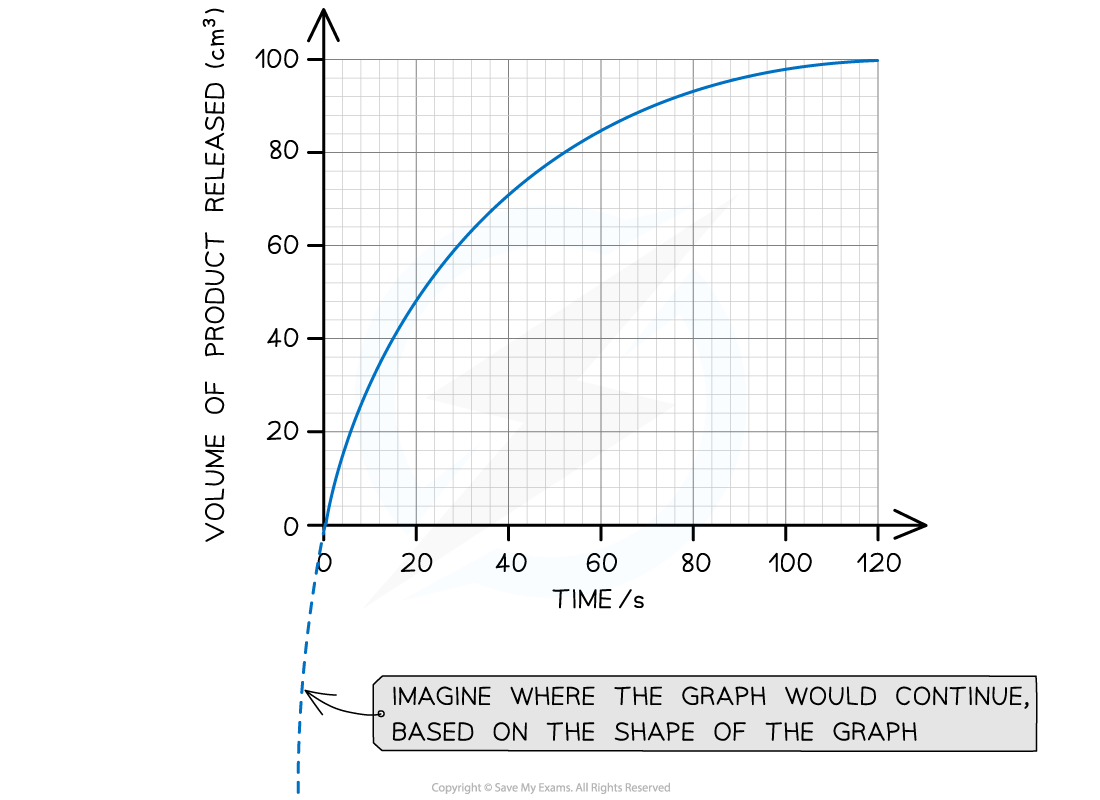
Step 2: Find the tangent to the curve at 0 seconds (the start of the reaction)