
Biology_A-level_Cie
-
1-1-the-microscope-in-cell-studies5 主题
-
1-2-cells-as-the-basic-units-of-living-organisms5 主题
-
2-1-testing-for-biological-molecules3 主题
-
2-2-carbohydrates-and-lipids8 主题
-
2-3-proteins6 主题
-
2-4-water2 主题
-
3-1-mode-of-action-of-enzymes5 主题
-
3-2-factors-that-affect-enzyme-action8 主题
-
4-1-fluid-mosaic-membranes4 主题
-
4-2-movement-into-and-out-of-cells12 主题
-
diffusion
-
osmosis
-
active-transport
-
endocytosis-and-exocytosis
-
investigating-transport-processes-in-plants
-
investigating-diffusion
-
surface-area-to-volume-ratios
-
investigating-surface-area
-
estimating-water-potential-in-plants
-
osmosis-in-plant-cells
-
osmosis-in-animals
-
comparing-osmosis-in-plants-and-animals
-
diffusion
-
5-1-replication-and-division-of-nuclei-and-cells6 主题
-
5-2-chromosome-behaviour-in-mitosis2 主题
-
6-1-structure-of-nucleic-acids-and-replication-of-dna4 主题
-
6-2-protein-synthesis5 主题
-
7-1-structure-of-transport-tissues4 主题
-
7-2-transport-mechanisms7 主题
-
8-1-the-circulatory-system7 主题
-
8-2-transport-of-oxygen-and-carbon-dioxide5 主题
-
8-3-the-heart4 主题
-
9-1-the-gas-exchange-system6 主题
-
10-1-infectious-diseases3 主题
-
10-2-antibiotics3 主题
-
11-1-the-immune-system4 主题
-
11-2-antibodies-and-vaccination6 主题
-
12-1-energy5 主题
-
12-2-respiration11 主题
-
aerobic-respiration-the-krebs-cycle
-
aerobic-respiration-role-of-nad-and-fad
-
aerobic-respiration-oxidative-phosphorylation
-
anaerobic-respiration
-
energy-yield-aerobic-and-anaerobic-respiration
-
anaerobic-adaptation-of-rice
-
aerobic-respiration-effect-of-temperature-and-substrate-concentration
-
structure-and-function-of-mitochondria
-
the-four-stages-in-aerobic-respiration
-
aerobic-respiration-glycolysis
-
aerobic-respiration-the-link-reaction
-
aerobic-respiration-the-krebs-cycle
-
13-1-photosynthesis-as-an-energy-transfer-process8 主题
-
13-2-investigation-of-limiting-factors2 主题
-
14-1-homeostasis-in-mammals8 主题
-
14-2-homeostasis-in-plants3 主题
-
15-1-control-and-coordination-in-mammals12 主题
-
the-endocrine-system
-
the-nervous-system
-
neurones
-
sensory-receptor-cells
-
sequence-of-events-resulting-in-an-action-potential
-
transmission-of-nerve-impulses
-
speed-of-conduction-of-impulses
-
the-refractory-period
-
cholinergic-synapses
-
stimulating-contraction-in-striated-muscle
-
ultrastructure-of-striated-muscle
-
sliding-filament-model-of-muscular-contraction
-
the-endocrine-system
-
15-2-control-and-coordination-in-plants3 主题
-
16-1-passage-of-information-from-parents-to-offspring5 主题
-
16-2-the-roles-of-genes-in-determining-the-phenotype7 主题
-
16-3-gene-control3 主题
-
17-1-variation4 主题
-
17-2-natural-and-artificial-selection7 主题
-
17-3-evolution2 主题
-
18-1-classification5 主题
-
18-2-biodiversity7 主题
-
18-3-conservation6 主题
-
19-1-principles-of-genetic-technology11 主题
-
19-2-genetic-technology-applied-to-medicine4 主题
-
19-3-genetically-modified-organisms-in-agriculture2 主题
-
1-1-the-microscope-in-cell-studies
-
1-2-cells-as-the-basic-units-of-living-organisms
-
2-1-testing-for-biological-molecules
-
2-2-carbohydrates-and-lipids
-
2-3-proteins
-
2-4-water
-
3-1-mode-of-action-of-enzymes
-
3-2-factors-that-affect-enzyme-action
-
4-1-fluid-mosaic-membranes
-
4-2-movement-into-and-out-of-cells
-
5-1-replication-and-division-of-nuclei-and-cells
-
5-2-chromosome-behaviour-in-mitosis
-
6-1-structure-of-nucleic-acids-and-replication-of-dna
-
6-2-protein-synthesis
-
7-1-structure-of-transport-tissues
-
7-2-transport-mechanisms
-
8-1-the-circulatory-system
-
8-2-transport-of-oxygen-and-carbon-dioxide
-
8-3-the-heart
-
9-1-the-gas-exchange-system
-
10-1-infectious-diseases
-
10-2-antibiotics
-
11-1-the-immune-system
-
11-2-antibodies-and-vaccination
the-oxygen-dissociation-curve
The oxygen dissociation curve
-
The oxygen dissociation curve shows the rate at which oxygen associates and dissociates with haemoglobin at different partial pressures of oxygen (pO2)
-
Partial pressure of oxygen refers to the pressure exerted by oxygen within a mixture of gases
-
It is a measure of oxygen concentration
-
-
Haemoglobin is referred to as being saturated when all of its oxygen binding sites are taken up with oxygen
-
This is when it contains four oxygen molecules
-
-
-
The ease with which haemoglobin binds and dissociates with oxygen can be described as its affinity for oxygen
-
When haemoglobin has a high affinity it binds easily and dissociates slowly
-
When haemoglobin has a low affinity for oxygen it binds slowly and dissociates easily
-
-
In other liquids, such as water, we would expect oxygen to become associated with water, or to dissolve, at a constant rate, providing a straight line on a graph
-
However, with haemoglobin, oxygen binds at different rates as the pO2 changes
-
This results in a curve when plotted
-
It can be said that haemoglobin’s affinity for oxygen changes at different partial pressures of oxygen
-
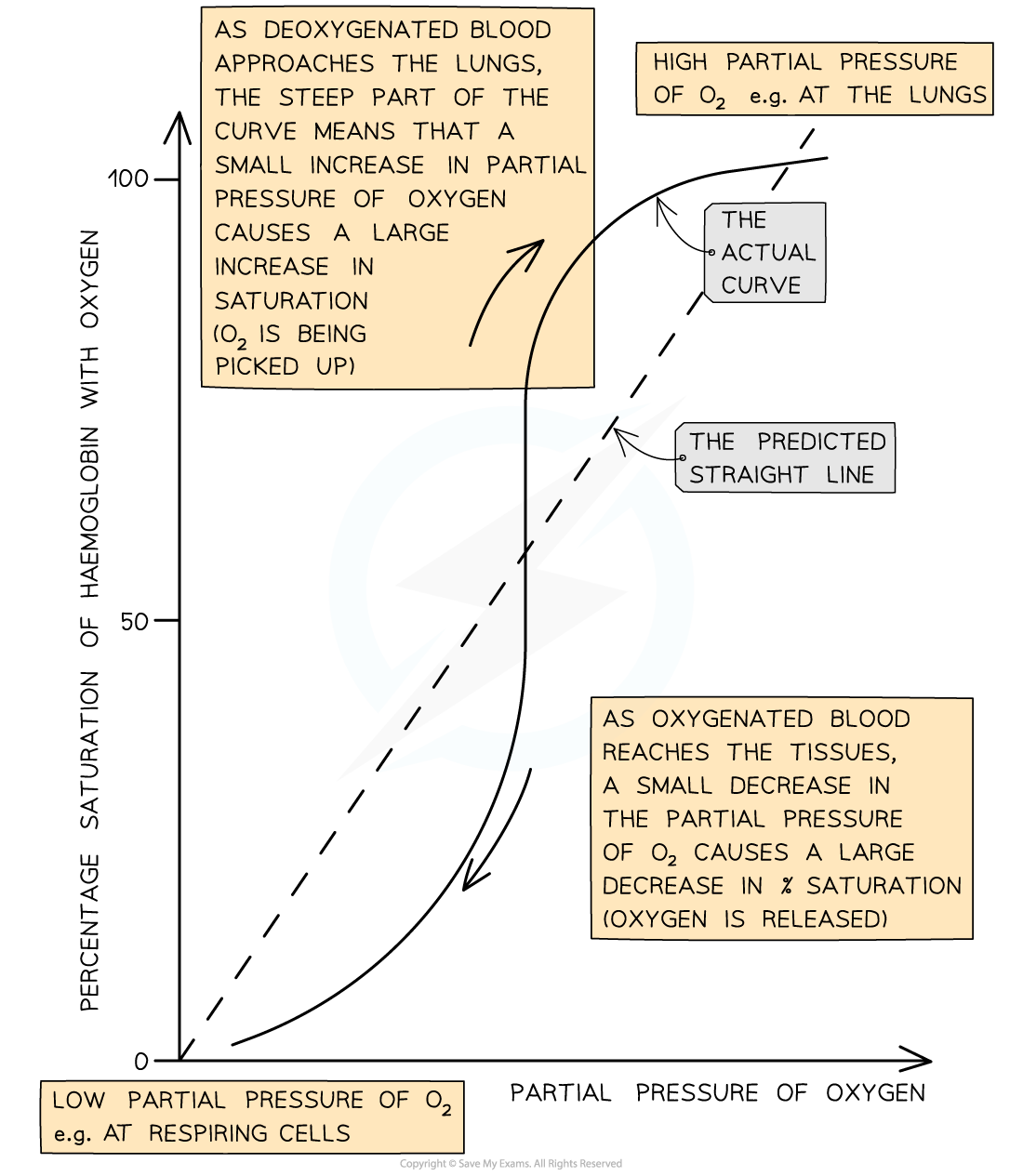
Interpreting the curve
-
When the curve is read from left to right, it provides information about the rate at which haemoglobin binds to oxygen at different partial pressures of oxygen
-
At low pO2 (in the bottom left corner of the graph) oxygen binds slowly to haemoglobin
-
This means that haemoglobin cannot pick up oxygen and become saturated as blood passes through the body’s oxygen-depleted tissues
-
Haemoglobin has a low affinity for oxygen at low pO2, so saturation percentage is low
-
-
At medium pO2 (in the central region of the graph) oxygen binds more easily to haemoglobin and saturation increases quickly
-
At this point on the graph a small increase in pO2 causes a large increase in haemoglobin saturation
-
-
At high pO2 (in the top right corner of the graph) oxygen binds easily to haemoglobin
-
This means that haemoglobin can pick up oxygen and become saturated as blood passes through the lungs
-
Haemoglobin has a high affinity for oxygen at high pO2, so saturation percentage is high
-
Note that at this point on the graph, increasing the pO2 by a large amount only has a small effect on the percentage saturation of haemoglobin
-
This is because most oxygen binding sites on haemoglobin are already occupied
-
-
-
When read from right to left, the curve provides information about the rate at which haemoglobin dissociates with oxygen at different partial pressures of oxygen
-
In the lungs, where pO2 is high
-
There is very little dissociation of oxygen from haemoglobin
-
-
At medium pO2, oxygen dissociates readily from haemoglobin, as shown by the steep region of the curve
-
This region corresponds with the partial pressures of oxygen present in the respiring tissues of the body, so release of oxygen is important for cellular respiration
-
At this point on the graph a small decrease in pO2 causes a large decrease in percentage saturation of haemoglobin, leading to easy release of plenty of oxygen to the cells
-
-
At low pO2 dissociation slows again
-
There are few oxygen molecules left on the binding sites, and the release of the final oxygen molecule becomes more difficult, in a similar way to the slow binding of the first oxygen molecule
-
-
Explaining the Oxygen Dissociation Curve
-
The curved shape of the oxygen dissociation curve for haemoglobin can be explained as follows
-
Due to the shape of the haemoglobin molecule it is difficult for the first oxygen molecule to bind to haemoglobin
-
This means that binding of the first oxygen occurs slowly
-
This explains the relatively shallow curve at the bottom left corner of the graph
-
-
After the first oxygen molecule binds to haemoglobin, the haemoglobin protein changes shape, or conformation
-
This makes it easier for the next oxygen molecules to bind
-
This speeds up binding of the remaining oxygen molecules and explains the steeper part of the curve in the middle of the graph
-
The shape change of haemoglobin leading to easier oxygen binding is known as cooperative binding
-
-
As the haemoglobin molecule approaches saturation it takes longer for the fourth oxygen molecule to bind due to the shortage of remaining binding sites
-
This explains the levelling off of the curve in the top right corner of the graph
-
-