
Biology_A-level_Cie
-
1-1-the-microscope-in-cell-studies5 主题
-
1-2-cells-as-the-basic-units-of-living-organisms5 主题
-
2-1-testing-for-biological-molecules3 主题
-
2-2-carbohydrates-and-lipids8 主题
-
2-3-proteins6 主题
-
2-4-water2 主题
-
3-1-mode-of-action-of-enzymes5 主题
-
3-2-factors-that-affect-enzyme-action8 主题
-
4-1-fluid-mosaic-membranes4 主题
-
4-2-movement-into-and-out-of-cells12 主题
-
diffusion
-
osmosis
-
active-transport
-
endocytosis-and-exocytosis
-
investigating-transport-processes-in-plants
-
investigating-diffusion
-
surface-area-to-volume-ratios
-
investigating-surface-area
-
estimating-water-potential-in-plants
-
osmosis-in-plant-cells
-
osmosis-in-animals
-
comparing-osmosis-in-plants-and-animals
-
diffusion
-
5-1-replication-and-division-of-nuclei-and-cells6 主题
-
5-2-chromosome-behaviour-in-mitosis2 主题
-
6-1-structure-of-nucleic-acids-and-replication-of-dna4 主题
-
6-2-protein-synthesis5 主题
-
7-1-structure-of-transport-tissues4 主题
-
7-2-transport-mechanisms7 主题
-
8-1-the-circulatory-system7 主题
-
8-2-transport-of-oxygen-and-carbon-dioxide5 主题
-
8-3-the-heart4 主题
-
9-1-the-gas-exchange-system6 主题
-
10-1-infectious-diseases3 主题
-
10-2-antibiotics3 主题
-
11-1-the-immune-system4 主题
-
11-2-antibodies-and-vaccination6 主题
-
12-1-energy5 主题
-
12-2-respiration11 主题
-
aerobic-respiration-the-krebs-cycle
-
aerobic-respiration-role-of-nad-and-fad
-
aerobic-respiration-oxidative-phosphorylation
-
anaerobic-respiration
-
energy-yield-aerobic-and-anaerobic-respiration
-
anaerobic-adaptation-of-rice
-
aerobic-respiration-effect-of-temperature-and-substrate-concentration
-
structure-and-function-of-mitochondria
-
the-four-stages-in-aerobic-respiration
-
aerobic-respiration-glycolysis
-
aerobic-respiration-the-link-reaction
-
aerobic-respiration-the-krebs-cycle
-
13-1-photosynthesis-as-an-energy-transfer-process8 主题
-
13-2-investigation-of-limiting-factors2 主题
-
14-1-homeostasis-in-mammals8 主题
-
14-2-homeostasis-in-plants3 主题
-
15-1-control-and-coordination-in-mammals12 主题
-
the-endocrine-system
-
the-nervous-system
-
neurones
-
sensory-receptor-cells
-
sequence-of-events-resulting-in-an-action-potential
-
transmission-of-nerve-impulses
-
speed-of-conduction-of-impulses
-
the-refractory-period
-
cholinergic-synapses
-
stimulating-contraction-in-striated-muscle
-
ultrastructure-of-striated-muscle
-
sliding-filament-model-of-muscular-contraction
-
the-endocrine-system
-
15-2-control-and-coordination-in-plants3 主题
-
16-1-passage-of-information-from-parents-to-offspring5 主题
-
16-2-the-roles-of-genes-in-determining-the-phenotype7 主题
-
16-3-gene-control3 主题
-
17-1-variation4 主题
-
17-2-natural-and-artificial-selection7 主题
-
17-3-evolution2 主题
-
18-1-classification5 主题
-
18-2-biodiversity7 主题
-
18-3-conservation6 主题
-
19-1-principles-of-genetic-technology11 主题
-
19-2-genetic-technology-applied-to-medicine4 主题
-
19-3-genetically-modified-organisms-in-agriculture2 主题
-
1-1-the-microscope-in-cell-studies
-
1-2-cells-as-the-basic-units-of-living-organisms
-
2-1-testing-for-biological-molecules
-
2-2-carbohydrates-and-lipids
-
2-3-proteins
-
2-4-water
-
3-1-mode-of-action-of-enzymes
-
3-2-factors-that-affect-enzyme-action
-
4-1-fluid-mosaic-membranes
-
4-2-movement-into-and-out-of-cells
-
5-1-replication-and-division-of-nuclei-and-cells
-
5-2-chromosome-behaviour-in-mitosis
-
6-1-structure-of-nucleic-acids-and-replication-of-dna
-
6-2-protein-synthesis
-
7-1-structure-of-transport-tissues
-
7-2-transport-mechanisms
-
8-1-the-circulatory-system
-
8-2-transport-of-oxygen-and-carbon-dioxide
-
8-3-the-heart
-
9-1-the-gas-exchange-system
-
10-1-infectious-diseases
-
10-2-antibiotics
-
11-1-the-immune-system
-
11-2-antibodies-and-vaccination
observing-and-drawing-blood-vessels
Arteries, veins & capillaries: observing & drawing
-
Arteries, veins and capillaries have distinctive structures which reflect their differing roles throughout the body
-
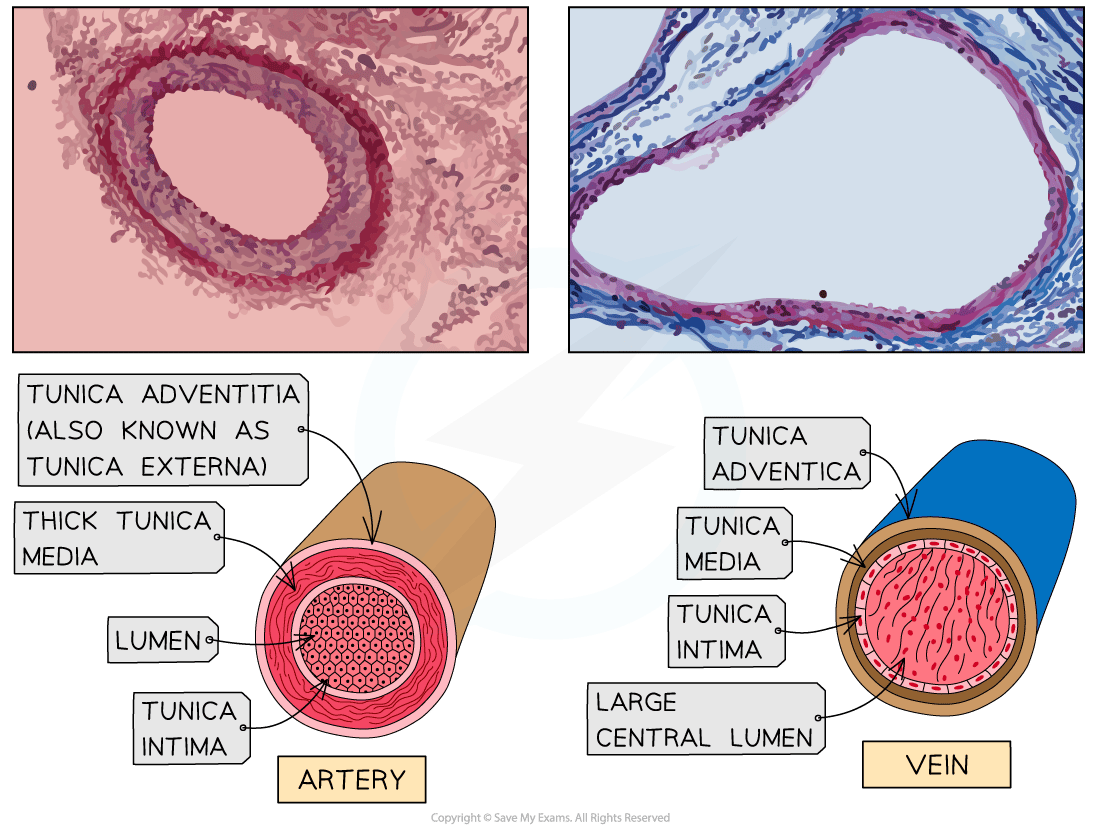
The walls of arteries and veins contain the same components; but in differing proportions and with different wall thicknesses
-
The walls of the capillaries are formed from a single layer of cells
-
Plan diagrams show the structures of arteries and veins; these can be drawn in transverse section (TS) and longitudinal section (LS)
Arteries
-
Arteries are blood vessels that carry blood at high pressures away from the heart
-
Arteries have relatively thick walls which allow them to withstand the high pressure of blood as it surges through with each ventricular contraction of the heart
-
The walls of arteries are composed of elastic and muscular tissue, as well as collagen fibres
-
Arteries closer to the heart contain a higher proportion of elastic fibres
-
The walls of these arteries must be able to stretch and recoil to accommodate blood surging through, preventing them from bursting or from the blood pressure dropping
-
These arteries are described as being elastic
-
-
Arteries further from the heart contain less elastic and more smooth muscle tissue
-
The diameter of these arteries can be adjusted to alter the blood flowing to different tissues
-
These arteries are described as being muscular and they branch into smaller arteries (arterioles)
-
The blood pressure in the arterioles is lower than that of the arteries
-
-
-
The lumen of the arteries is relatively narrow
-
This ensures that blood remains at relatively high pressure for efficient delivery to the tissues whilst also providing resistance to blood flow to allow gas exchange as blood passes through the tissues
-
Capillaries
-
Arterioles branch into the smallest blood vessel – the capillaries – which form networks throughout most tissues of the body (where they are described as capillary beds)
-
Blood flowing through the capillaries is brought close to the cells of the body to allow efficient exchange of materials (particularly the diffusion of oxygen)
-
The endothelial wall of the capillaries is only one-cell thick, which ensures that substances can diffuse easily between the capillary and neighbouring cells
-
The walls are also “leaky” – there are small gaps between individual squamous epithelial cells that form the wall to allow small substances to leak out of the blood into the fluid surrounding the cells of the body
-
Veins
-
Capillaries join together to form larger blood vessels called venules which join to form veins
-
The outer layer of the veins is relatively tough, composed largely of collagen fibres
-
Conversely, the middle layer of the veins is relatively thin in comparison and contains only a small amount of smooth muscle and elastic fibre
-
This is because the blood flowing through veins is under very low pressures so the walls of the veins do not have to stretch and recoil to accommodate blood flow
-
The lumen of veins is characteristically large
-
Skeletal muscle contraction helps raise blood pressure temporarily within the veins, and the presence of one-way valves keeps blood moving back towards the heart
-
Micrographs
-
A photomicrograph is a photograph taken of a specimen observed using a light microscope
-
An electron micrograph is a photograph taken of a specimen observed using an electron microscope