
Biology_A-level_Cie
-
1-1-the-microscope-in-cell-studies5 主题
-
1-2-cells-as-the-basic-units-of-living-organisms5 主题
-
2-1-testing-for-biological-molecules3 主题
-
2-2-carbohydrates-and-lipids8 主题
-
2-3-proteins6 主题
-
2-4-water2 主题
-
3-1-mode-of-action-of-enzymes5 主题
-
3-2-factors-that-affect-enzyme-action8 主题
-
4-1-fluid-mosaic-membranes4 主题
-
4-2-movement-into-and-out-of-cells12 主题
-
diffusion
-
osmosis
-
active-transport
-
endocytosis-and-exocytosis
-
investigating-transport-processes-in-plants
-
investigating-diffusion
-
surface-area-to-volume-ratios
-
investigating-surface-area
-
estimating-water-potential-in-plants
-
osmosis-in-plant-cells
-
osmosis-in-animals
-
comparing-osmosis-in-plants-and-animals
-
diffusion
-
5-1-replication-and-division-of-nuclei-and-cells6 主题
-
5-2-chromosome-behaviour-in-mitosis2 主题
-
6-1-structure-of-nucleic-acids-and-replication-of-dna4 主题
-
6-2-protein-synthesis5 主题
-
7-1-structure-of-transport-tissues4 主题
-
7-2-transport-mechanisms7 主题
-
8-1-the-circulatory-system7 主题
-
8-2-transport-of-oxygen-and-carbon-dioxide5 主题
-
8-3-the-heart4 主题
-
9-1-the-gas-exchange-system6 主题
-
10-1-infectious-diseases3 主题
-
10-2-antibiotics3 主题
-
11-1-the-immune-system4 主题
-
11-2-antibodies-and-vaccination6 主题
-
12-1-energy5 主题
-
12-2-respiration11 主题
-
aerobic-respiration-the-krebs-cycle
-
aerobic-respiration-role-of-nad-and-fad
-
aerobic-respiration-oxidative-phosphorylation
-
anaerobic-respiration
-
energy-yield-aerobic-and-anaerobic-respiration
-
anaerobic-adaptation-of-rice
-
aerobic-respiration-effect-of-temperature-and-substrate-concentration
-
structure-and-function-of-mitochondria
-
the-four-stages-in-aerobic-respiration
-
aerobic-respiration-glycolysis
-
aerobic-respiration-the-link-reaction
-
aerobic-respiration-the-krebs-cycle
-
13-1-photosynthesis-as-an-energy-transfer-process8 主题
-
13-2-investigation-of-limiting-factors2 主题
-
14-1-homeostasis-in-mammals8 主题
-
14-2-homeostasis-in-plants3 主题
-
15-1-control-and-coordination-in-mammals12 主题
-
the-endocrine-system
-
the-nervous-system
-
neurones
-
sensory-receptor-cells
-
sequence-of-events-resulting-in-an-action-potential
-
transmission-of-nerve-impulses
-
speed-of-conduction-of-impulses
-
the-refractory-period
-
cholinergic-synapses
-
stimulating-contraction-in-striated-muscle
-
ultrastructure-of-striated-muscle
-
sliding-filament-model-of-muscular-contraction
-
the-endocrine-system
-
15-2-control-and-coordination-in-plants3 主题
-
16-1-passage-of-information-from-parents-to-offspring5 主题
-
16-2-the-roles-of-genes-in-determining-the-phenotype7 主题
-
16-3-gene-control3 主题
-
17-1-variation4 主题
-
17-2-natural-and-artificial-selection7 主题
-
17-3-evolution2 主题
-
18-1-classification5 主题
-
18-2-biodiversity7 主题
-
18-3-conservation6 主题
-
19-1-principles-of-genetic-technology11 主题
-
19-2-genetic-technology-applied-to-medicine4 主题
-
19-3-genetically-modified-organisms-in-agriculture2 主题
-
1-1-the-microscope-in-cell-studies
-
1-2-cells-as-the-basic-units-of-living-organisms
-
2-1-testing-for-biological-molecules
-
2-2-carbohydrates-and-lipids
-
2-3-proteins
-
2-4-water
-
3-1-mode-of-action-of-enzymes
-
3-2-factors-that-affect-enzyme-action
-
4-1-fluid-mosaic-membranes
-
4-2-movement-into-and-out-of-cells
-
5-1-replication-and-division-of-nuclei-and-cells
-
5-2-chromosome-behaviour-in-mitosis
-
6-1-structure-of-nucleic-acids-and-replication-of-dna
-
6-2-protein-synthesis
-
7-1-structure-of-transport-tissues
-
7-2-transport-mechanisms
-
8-1-the-circulatory-system
-
8-2-transport-of-oxygen-and-carbon-dioxide
-
8-3-the-heart
-
9-1-the-gas-exchange-system
-
10-1-infectious-diseases
-
10-2-antibiotics
-
11-1-the-immune-system
-
11-2-antibodies-and-vaccination
circulatory-systems
Closed double circulatory system
The need for a circulatory system
-
The cells of all living organisms need a constant supply of reactants for metabolism, e.g. oxygen and glucose
-
Single celled organisms can gain oxygen and glucose directly from their surroundings
-
The molecules can diffuse to all parts of the cell quickly due to short diffusion distances
-
-
Larger organisms, however, are made up of many layers of cells
-
This means that the time taken for substances such as glucose and oxygen to diffuse to every cell in the body would be far too long
-
The diffusion distances involved are too great
-
-
-
To solve this problem their exchange surfaces are connected to a mass transport system, for example
-
The digestive system is connected to the circulatory system
-
The lungs are connected to the circulatory system
-
-
Mass transport is the bulk movement of gases or liquids in one direction, usually via a system of vessels and tubes
-
The circulatory system in mammals is a well-studied example of a mass transport system
-
The one-way flow of blood within the blood vessels carries essential nutrients and gases to all the cells of the body
-
Open and closed systems
-
Circulatory systems are either described as being open or closed
-
In a closed circulatory system, blood is pumped around the body and is always contained within a network of blood vessels
-
All vertebrates and many invertebrates have closed circulatory systems
-
-
In an open circulatory system, blood is not contained within blood vessels but is pumped directly into body cavities
-
Organisms such as arthropods and molluscs have open circulatory systems
-
-
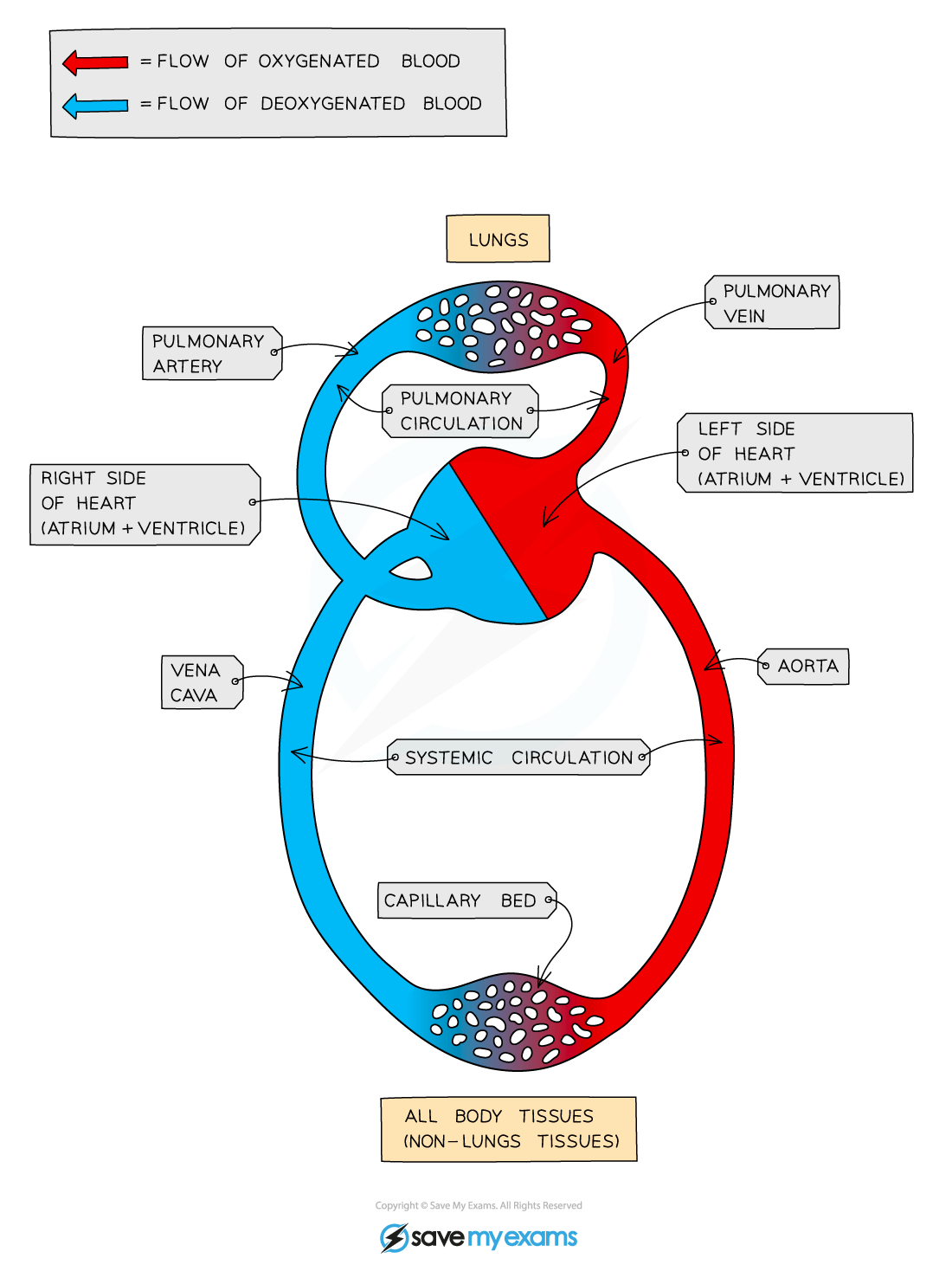
Humans have a closed double circulatory system:
-
In one complete circuit of the body blood passes through the heart (the pump) twice
-
-
The right side of the heart pumps deoxygenated blood to the lungs for gas exchange
-
This is the pulmonary circulatory system
-
-
Blood then returns to the left side of the heart, so that oxygenated blood can be pumped efficiently (at high pressure) around the body
-
This is the systemic circulatory system
-
|
Structure |
Function |
|---|---|
|
Heart |
A hollow, muscular organ located in the chest cavity which pumps blood. Cardiac muscle tissue is specialised for repeated involuntary contraction without rest. |
|
Arteries |
Blood vessels which carry blood away from the heart. The walls of the arteries contain lots of muscle and elastic tissue and a narrow lumen, to maintain high blood pressure. |
|
Arterioles |
Small arteries which branch from larger arteries and connect to capillaries. |
|
Capillaries |
Tiny blood vessels which connect arterioles and venules. Their size means they pass directly past cells and tissues and perform gas exchange and exchange of substances such as glucose. |
|
Venules |
Small veins which join capillaries to larger veins. |
|
Veins |
Blood vessels which carry blood back towards the heart. The walls of veins are thin in comparison to arteries, having less muscle and elastic tissue but a wider lumen. Valves help maintain blood flow back towards the heart. |
Examiner Tips and Tricks
Make sure you study any circulatory diagrams in the exam carefully to distinguish between single and double circulatory systems.