
Biology_A-level_Cie
-
1-1-the-microscope-in-cell-studies5 主题
-
1-2-cells-as-the-basic-units-of-living-organisms5 主题
-
2-1-testing-for-biological-molecules3 主题
-
2-2-carbohydrates-and-lipids8 主题
-
2-3-proteins6 主题
-
2-4-water2 主题
-
3-1-mode-of-action-of-enzymes5 主题
-
3-2-factors-that-affect-enzyme-action8 主题
-
4-1-fluid-mosaic-membranes4 主题
-
4-2-movement-into-and-out-of-cells12 主题
-
diffusion
-
osmosis
-
active-transport
-
endocytosis-and-exocytosis
-
investigating-transport-processes-in-plants
-
investigating-diffusion
-
surface-area-to-volume-ratios
-
investigating-surface-area
-
estimating-water-potential-in-plants
-
osmosis-in-plant-cells
-
osmosis-in-animals
-
comparing-osmosis-in-plants-and-animals
-
diffusion
-
5-1-replication-and-division-of-nuclei-and-cells6 主题
-
5-2-chromosome-behaviour-in-mitosis2 主题
-
6-1-structure-of-nucleic-acids-and-replication-of-dna4 主题
-
6-2-protein-synthesis5 主题
-
7-1-structure-of-transport-tissues4 主题
-
7-2-transport-mechanisms7 主题
-
8-1-the-circulatory-system7 主题
-
8-2-transport-of-oxygen-and-carbon-dioxide5 主题
-
8-3-the-heart4 主题
-
9-1-the-gas-exchange-system6 主题
-
10-1-infectious-diseases3 主题
-
10-2-antibiotics3 主题
-
11-1-the-immune-system4 主题
-
11-2-antibodies-and-vaccination6 主题
-
12-1-energy5 主题
-
12-2-respiration11 主题
-
aerobic-respiration-the-krebs-cycle
-
aerobic-respiration-role-of-nad-and-fad
-
aerobic-respiration-oxidative-phosphorylation
-
anaerobic-respiration
-
energy-yield-aerobic-and-anaerobic-respiration
-
anaerobic-adaptation-of-rice
-
aerobic-respiration-effect-of-temperature-and-substrate-concentration
-
structure-and-function-of-mitochondria
-
the-four-stages-in-aerobic-respiration
-
aerobic-respiration-glycolysis
-
aerobic-respiration-the-link-reaction
-
aerobic-respiration-the-krebs-cycle
-
13-1-photosynthesis-as-an-energy-transfer-process8 主题
-
13-2-investigation-of-limiting-factors2 主题
-
14-1-homeostasis-in-mammals8 主题
-
14-2-homeostasis-in-plants3 主题
-
15-1-control-and-coordination-in-mammals12 主题
-
the-endocrine-system
-
the-nervous-system
-
neurones
-
sensory-receptor-cells
-
sequence-of-events-resulting-in-an-action-potential
-
transmission-of-nerve-impulses
-
speed-of-conduction-of-impulses
-
the-refractory-period
-
cholinergic-synapses
-
stimulating-contraction-in-striated-muscle
-
ultrastructure-of-striated-muscle
-
sliding-filament-model-of-muscular-contraction
-
the-endocrine-system
-
15-2-control-and-coordination-in-plants3 主题
-
16-1-passage-of-information-from-parents-to-offspring5 主题
-
16-2-the-roles-of-genes-in-determining-the-phenotype7 主题
-
16-3-gene-control3 主题
-
17-1-variation4 主题
-
17-2-natural-and-artificial-selection7 主题
-
17-3-evolution2 主题
-
18-1-classification5 主题
-
18-2-biodiversity7 主题
-
18-3-conservation6 主题
-
19-1-principles-of-genetic-technology11 主题
-
19-2-genetic-technology-applied-to-medicine4 主题
-
19-3-genetically-modified-organisms-in-agriculture2 主题
-
1-1-the-microscope-in-cell-studies
-
1-2-cells-as-the-basic-units-of-living-organisms
-
2-1-testing-for-biological-molecules
-
2-2-carbohydrates-and-lipids
-
2-3-proteins
-
2-4-water
-
3-1-mode-of-action-of-enzymes
-
3-2-factors-that-affect-enzyme-action
-
4-1-fluid-mosaic-membranes
-
4-2-movement-into-and-out-of-cells
-
5-1-replication-and-division-of-nuclei-and-cells
-
5-2-chromosome-behaviour-in-mitosis
-
6-1-structure-of-nucleic-acids-and-replication-of-dna
-
6-2-protein-synthesis
-
7-1-structure-of-transport-tissues
-
7-2-transport-mechanisms
-
8-1-the-circulatory-system
-
8-2-transport-of-oxygen-and-carbon-dioxide
-
8-3-the-heart
-
9-1-the-gas-exchange-system
-
10-1-infectious-diseases
-
10-2-antibiotics
-
11-1-the-immune-system
-
11-2-antibodies-and-vaccination
the-stages-of-mitosis
Mitosis: the stages
-
Mitosis is the process of nuclear division by which two genetically identical daughter nuclei are produced that are also genetically identical to the parent cell nucleus (they have the same number of chromosomes as the parent cell)
-
Although mitosis is actually one continuous process, it can be divided into four main stages
-
These stages are:
-
Prophase
-
Metaphase
-
Anaphase
-
Telophase
-
-
Most organisms contain many chromosomes in the nuclei of their cells (e.g. humans have 46) but the diagrams below show mitosis of an animal cell with only four chromosomes, for the sake of simplicity
-
The different colours of the chromosomes are just to show that half are from the female parent and half from the male parent
Prophase
-
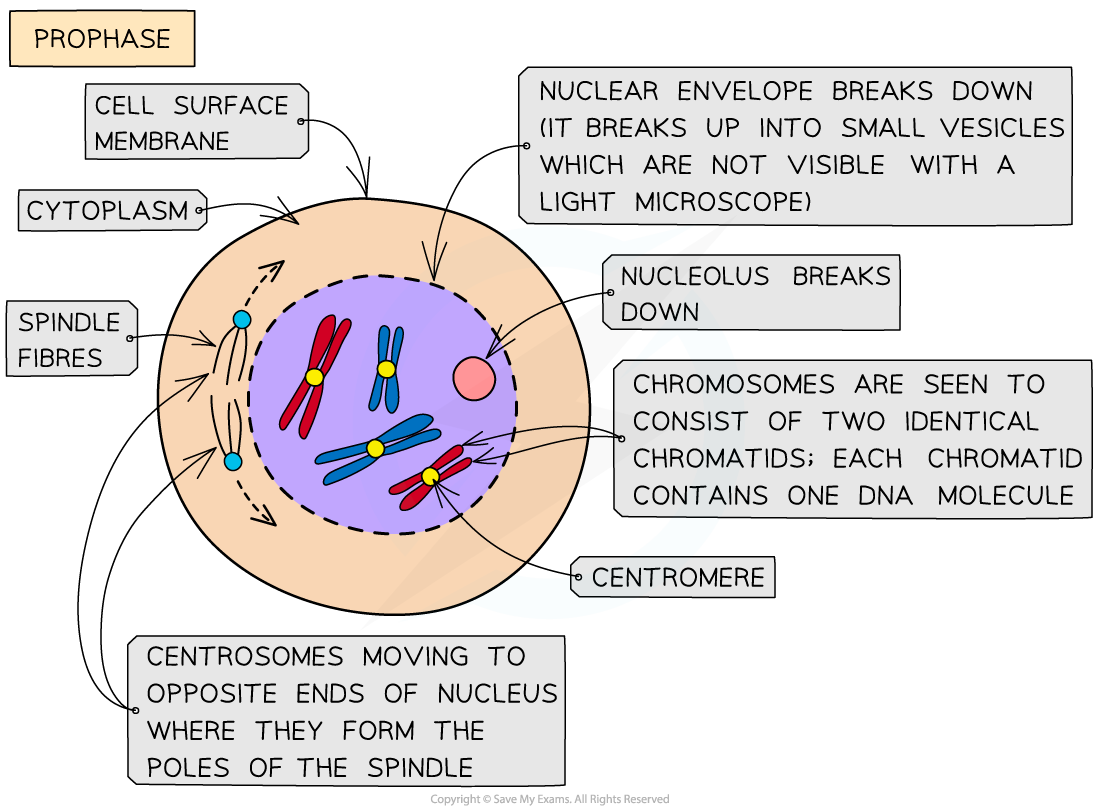
Chromosomes condense (and are now visible when stained)
-
The chromosomes consist of two identical chromatids called sister chromatids
-
Each sister chromatid contains one DNA molecule
-
They are joined together at the centromere
-
-
The two centrosomes (replicated in the G2 phase just before prophase) move towards opposite poles (opposite ends of the nucleus)
-
Spindle fibres (protein microtubules) begin to emerge from the centrosomes (consists of two centrioles in animal cells)
-
The nuclear envelope (nuclear membrane) breaks down into small vesicles
Metaphase
-
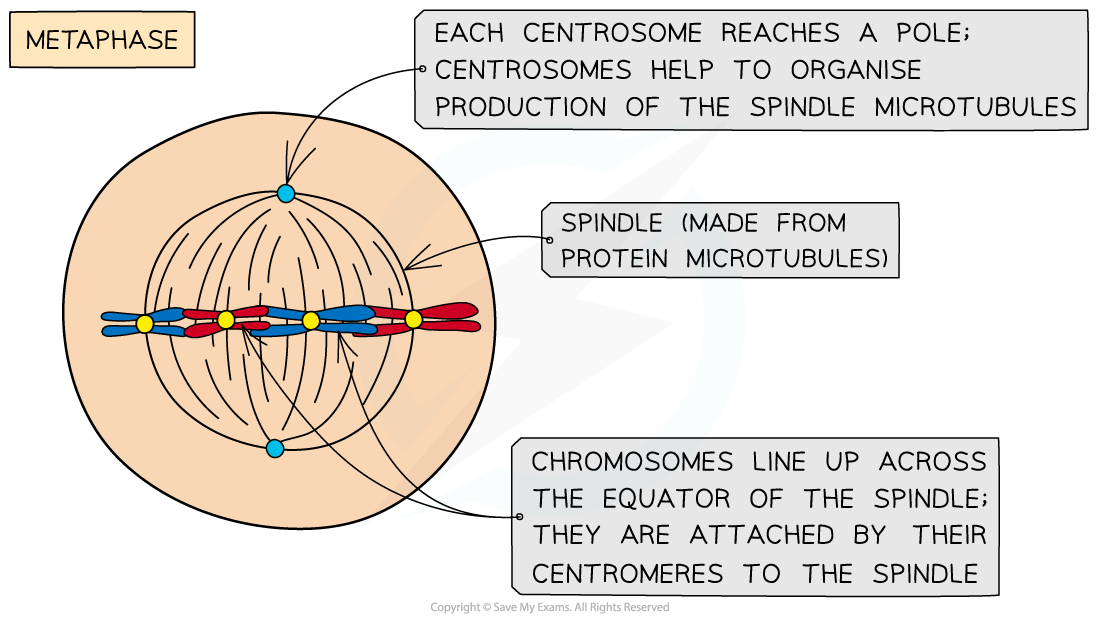
Centrosomes reach opposite poles
-
Spindle fibres (protein microtubules) continue to extend from centrosomes
-
Chromosomes line up at the equator of the spindle (also known as the metaphase plate) so they are equidistant to the two centrosome poles
-
Spindle fibres (protein microtubules) reach the chromosomes and attach to the centromeres
-
Each sister chromatid is attached to a spindle fibre originating from opposite poles
Anaphase
-
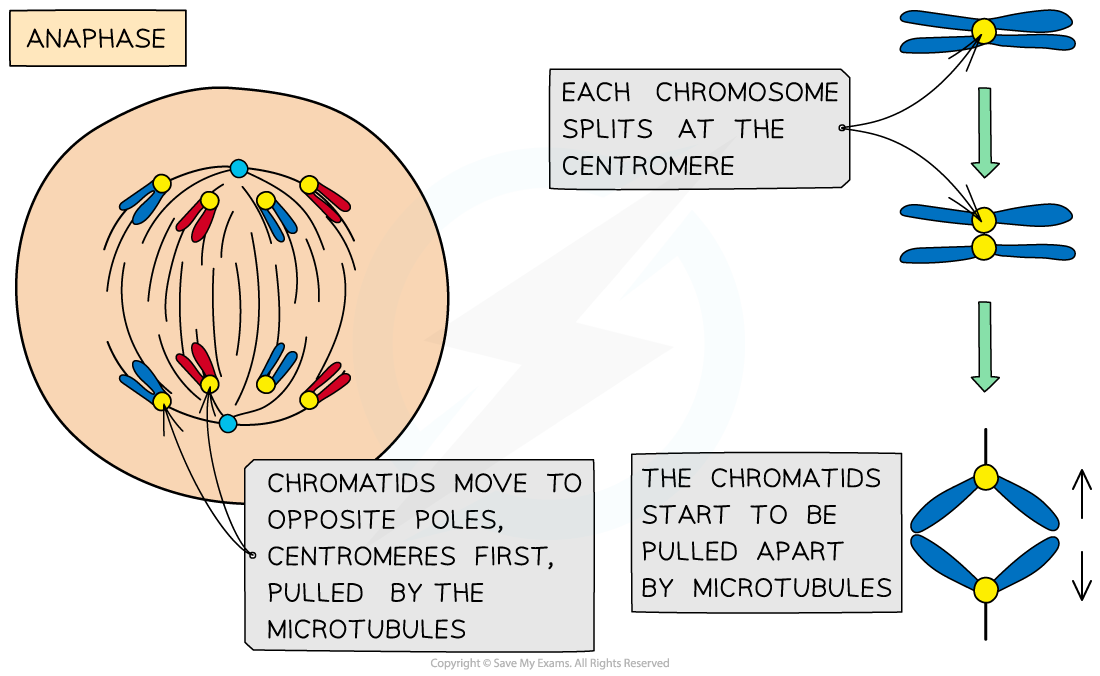
The sister chromatids separate at the centromere (the centromere divides in two)
-
Spindle fibres (protein microtubules) begin to shorten
-
The separated sister chromatids (now called chromosomes) are pulled to opposite poles by the spindle fibres (protein microtubules)
Telophase
-
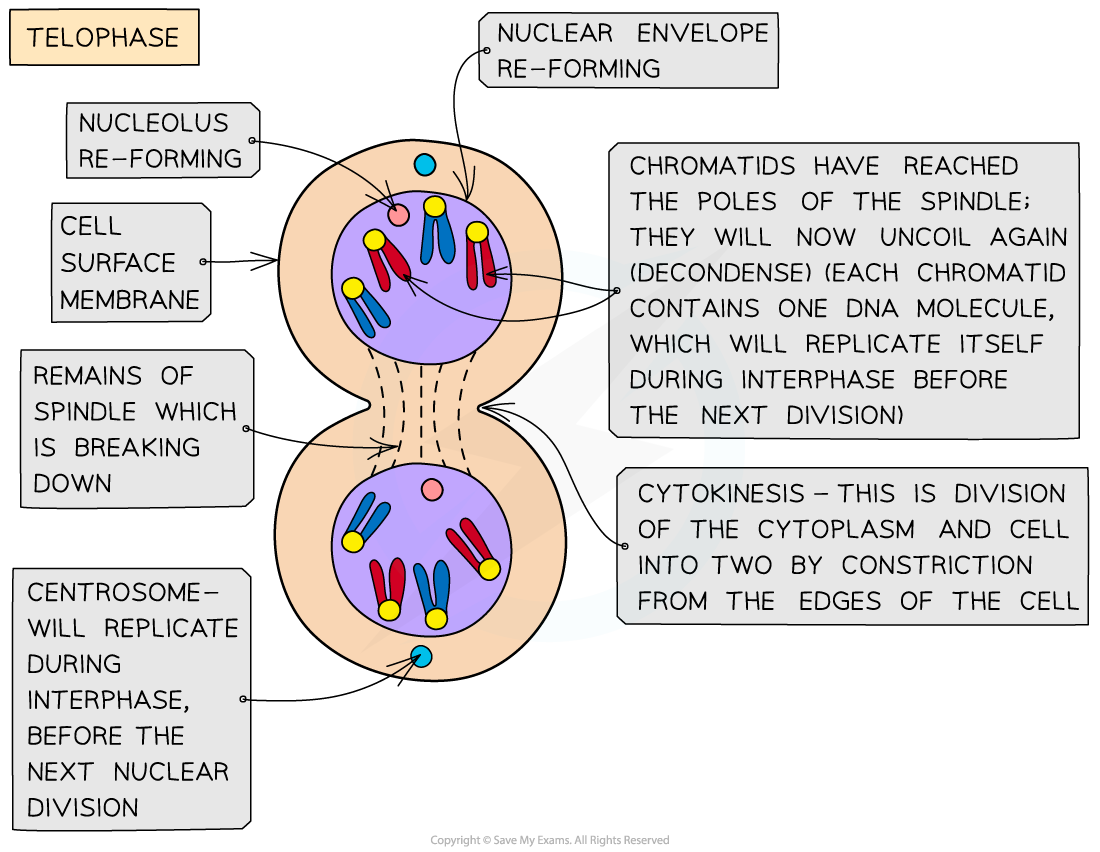
Chromosomes arrive at opposite poles and begin to decondense
-
Nuclear envelopes (nuclear membranes) begin to reform around each set of chromosomes
-
The spindle fibres break down
Examiner Tips and Tricks
Make sure you learn the four stages of mitosis and what is happening to the DNA molecules (one chromatid contains one DNA molecule) at each stage.
Learn ‘PMAT’ (prophase, metaphase, anaphase, telophase) to help you remember the order of the stages!
After interphase but before the parent cell undergoes mitosis, the human parent cell nucleus actually contains 92 DNA molecules! This is because during interphase (S phase), the 46 DNA molecules in the parent cell have replicated to form sister chromatids. As human cells have a diploid number of 46 this replication results in 92 molecules.
This ensures the two daughter cells will be diploid (have 46 chromosomes each) when mitosis occurs. Remember to read the questions carefully as only human diploid cells have 46 chromosomes so if the question refers to another organism, its diploid number will be different.