
Biology_A-level_Cie
-
1-1-the-microscope-in-cell-studies5 主题
-
1-2-cells-as-the-basic-units-of-living-organisms5 主题
-
2-1-testing-for-biological-molecules3 主题
-
2-2-carbohydrates-and-lipids8 主题
-
2-3-proteins6 主题
-
2-4-water2 主题
-
3-1-mode-of-action-of-enzymes5 主题
-
3-2-factors-that-affect-enzyme-action8 主题
-
4-1-fluid-mosaic-membranes4 主题
-
4-2-movement-into-and-out-of-cells12 主题
-
diffusion
-
osmosis
-
active-transport
-
endocytosis-and-exocytosis
-
investigating-transport-processes-in-plants
-
investigating-diffusion
-
surface-area-to-volume-ratios
-
investigating-surface-area
-
estimating-water-potential-in-plants
-
osmosis-in-plant-cells
-
osmosis-in-animals
-
comparing-osmosis-in-plants-and-animals
-
diffusion
-
5-1-replication-and-division-of-nuclei-and-cells6 主题
-
5-2-chromosome-behaviour-in-mitosis2 主题
-
6-1-structure-of-nucleic-acids-and-replication-of-dna4 主题
-
6-2-protein-synthesis5 主题
-
7-1-structure-of-transport-tissues4 主题
-
7-2-transport-mechanisms7 主题
-
8-1-the-circulatory-system7 主题
-
8-2-transport-of-oxygen-and-carbon-dioxide5 主题
-
8-3-the-heart4 主题
-
9-1-the-gas-exchange-system6 主题
-
10-1-infectious-diseases3 主题
-
10-2-antibiotics3 主题
-
11-1-the-immune-system4 主题
-
11-2-antibodies-and-vaccination6 主题
-
12-1-energy5 主题
-
12-2-respiration11 主题
-
aerobic-respiration-the-krebs-cycle
-
aerobic-respiration-role-of-nad-and-fad
-
aerobic-respiration-oxidative-phosphorylation
-
anaerobic-respiration
-
energy-yield-aerobic-and-anaerobic-respiration
-
anaerobic-adaptation-of-rice
-
aerobic-respiration-effect-of-temperature-and-substrate-concentration
-
structure-and-function-of-mitochondria
-
the-four-stages-in-aerobic-respiration
-
aerobic-respiration-glycolysis
-
aerobic-respiration-the-link-reaction
-
aerobic-respiration-the-krebs-cycle
-
13-1-photosynthesis-as-an-energy-transfer-process8 主题
-
13-2-investigation-of-limiting-factors2 主题
-
14-1-homeostasis-in-mammals8 主题
-
14-2-homeostasis-in-plants3 主题
-
15-1-control-and-coordination-in-mammals12 主题
-
the-endocrine-system
-
the-nervous-system
-
neurones
-
sensory-receptor-cells
-
sequence-of-events-resulting-in-an-action-potential
-
transmission-of-nerve-impulses
-
speed-of-conduction-of-impulses
-
the-refractory-period
-
cholinergic-synapses
-
stimulating-contraction-in-striated-muscle
-
ultrastructure-of-striated-muscle
-
sliding-filament-model-of-muscular-contraction
-
the-endocrine-system
-
15-2-control-and-coordination-in-plants3 主题
-
16-1-passage-of-information-from-parents-to-offspring5 主题
-
16-2-the-roles-of-genes-in-determining-the-phenotype7 主题
-
16-3-gene-control3 主题
-
17-1-variation4 主题
-
17-2-natural-and-artificial-selection7 主题
-
17-3-evolution2 主题
-
18-1-classification5 主题
-
18-2-biodiversity7 主题
-
18-3-conservation6 主题
-
19-1-principles-of-genetic-technology11 主题
-
19-2-genetic-technology-applied-to-medicine4 主题
-
19-3-genetically-modified-organisms-in-agriculture2 主题
-
1-1-the-microscope-in-cell-studies
-
1-2-cells-as-the-basic-units-of-living-organisms
-
2-1-testing-for-biological-molecules
-
2-2-carbohydrates-and-lipids
-
2-3-proteins
-
2-4-water
-
3-1-mode-of-action-of-enzymes
-
3-2-factors-that-affect-enzyme-action
-
4-1-fluid-mosaic-membranes
-
4-2-movement-into-and-out-of-cells
-
5-1-replication-and-division-of-nuclei-and-cells
-
5-2-chromosome-behaviour-in-mitosis
-
6-1-structure-of-nucleic-acids-and-replication-of-dna
-
6-2-protein-synthesis
-
7-1-structure-of-transport-tissues
-
7-2-transport-mechanisms
-
8-1-the-circulatory-system
-
8-2-transport-of-oxygen-and-carbon-dioxide
-
8-3-the-heart
-
9-1-the-gas-exchange-system
-
10-1-infectious-diseases
-
10-2-antibiotics
-
11-1-the-immune-system
-
11-2-antibodies-and-vaccination
the-role-of-water-in-living-organisms
Water molecules: in living organisms
-
Water has many essential roles in living organisms due to its properties:
-
The polarity of water molecules
-
The presence and number of hydrogen bonds between water molecules
-
Solvent
-
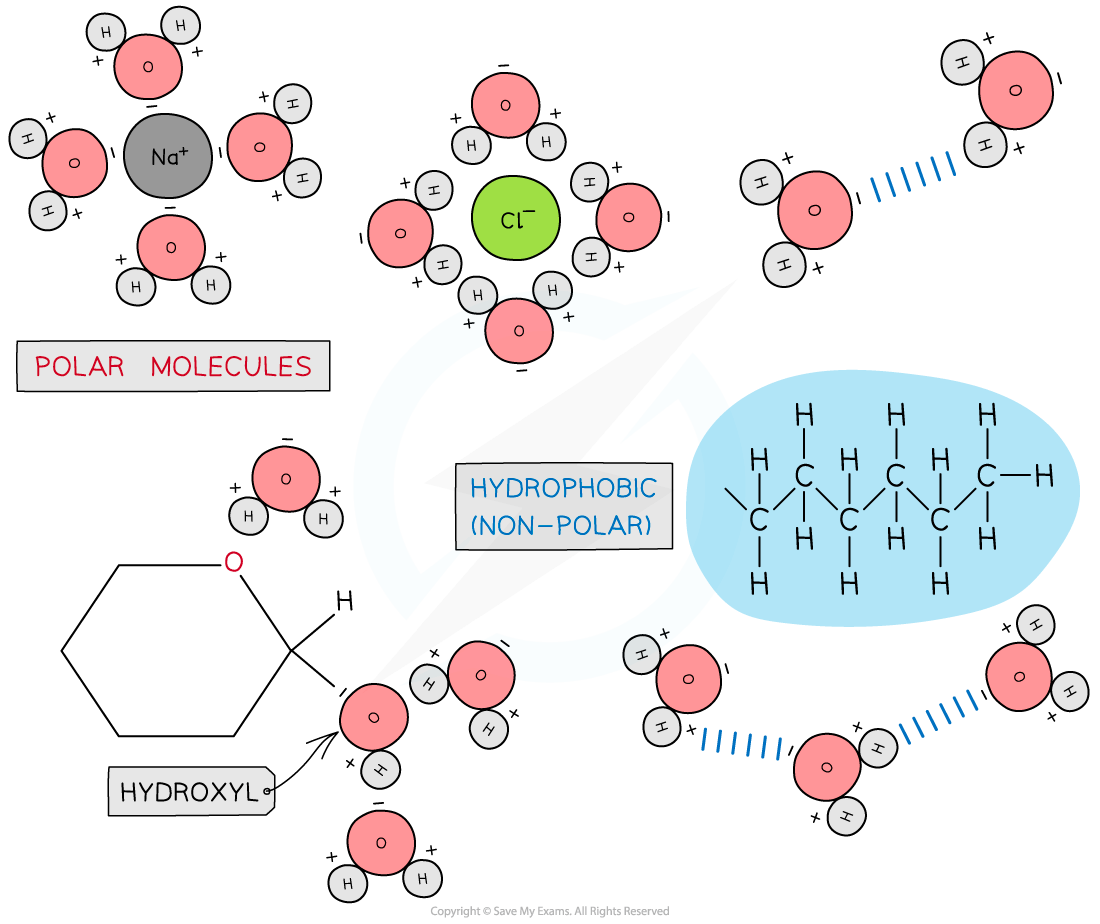
As water is a polar molecule many ionic compounds (e.g. sodium chloride) and covalently bonded polar substances (e.g. glucose) will dissolve in it
-
This allows chemical reactions to occur within cells (as the dissolved solutes are more chemically reactive when they are free to move about)
-
Metabolites can be transported efficiently (except non-polar molecules which are hydrophobic)
-
High specific heat capacity
-
The specific heat capacity of a substance is the amount of thermal energy required to raise the temperature of 1kg of that substance by 1°C. Water’s specific heat capacity is 4200 J/kg°C
-
The high specific heat capacity is due to the many hydrogen bonds present in water
-
It takes a lot of thermal energy to break these bonds and a lot of energy to create them, thus the temperature of water does not fluctuate greatly
-
-
The advantage for living organisms is that it:
-
Provides suitable habitats
-
Allows for constant temperatures within bodies and cells to be maintained (this ensures enzymes have the optimal temperatures)
-
This is because a large increase in energy is needed to increase the temperature of water
-
-
Latent heat of vaporisation
-
In order to change state (from liquid to gas) a large amount of thermal energy must be absorbed by water to break the hydrogen bonds and evaporate
-
This is an advantage for living organisms as only a little water is required to evaporate from the surface of the organism in order to lose a great amount of heat energy
-
This provides a cooling effect for living organisms, for example the transpiration from leaves or evaporation of water in sweat from the skin
|
Property |
Role in Living Organisms |
Reason |
|---|---|---|
|
Solvent |
Allows chemical reactions to occur Transport medium |
Polarity of water |
|
High specific heat capacity |
Allows water to be a suitable habitat Optimal temperature maintained within cells and bodies |
Presence of many hydrogen bonds |
|
High latent heat of vaporisation |
Coolant |
Presence of many hydrogen bonds |
Examiner Tips and Tricks
When discussing the role water has in living organisms remember to mention the ‘why’ in relation to its properties (i.e. it is an excellent solvent because of to the polar nature of water molecules).