
Biology_A-level_Cie
-
1-1-the-microscope-in-cell-studies5 主题
-
1-2-cells-as-the-basic-units-of-living-organisms5 主题
-
2-1-testing-for-biological-molecules3 主题
-
2-2-carbohydrates-and-lipids8 主题
-
2-3-proteins6 主题
-
2-4-water2 主题
-
3-1-mode-of-action-of-enzymes5 主题
-
3-2-factors-that-affect-enzyme-action8 主题
-
4-1-fluid-mosaic-membranes4 主题
-
4-2-movement-into-and-out-of-cells12 主题
-
diffusion
-
osmosis
-
active-transport
-
endocytosis-and-exocytosis
-
investigating-transport-processes-in-plants
-
investigating-diffusion
-
surface-area-to-volume-ratios
-
investigating-surface-area
-
estimating-water-potential-in-plants
-
osmosis-in-plant-cells
-
osmosis-in-animals
-
comparing-osmosis-in-plants-and-animals
-
diffusion
-
5-1-replication-and-division-of-nuclei-and-cells6 主题
-
5-2-chromosome-behaviour-in-mitosis2 主题
-
6-1-structure-of-nucleic-acids-and-replication-of-dna4 主题
-
6-2-protein-synthesis5 主题
-
7-1-structure-of-transport-tissues4 主题
-
7-2-transport-mechanisms7 主题
-
8-1-the-circulatory-system7 主题
-
8-2-transport-of-oxygen-and-carbon-dioxide5 主题
-
8-3-the-heart4 主题
-
9-1-the-gas-exchange-system6 主题
-
10-1-infectious-diseases3 主题
-
10-2-antibiotics3 主题
-
11-1-the-immune-system4 主题
-
11-2-antibodies-and-vaccination6 主题
-
12-1-energy5 主题
-
12-2-respiration11 主题
-
aerobic-respiration-the-krebs-cycle
-
aerobic-respiration-role-of-nad-and-fad
-
aerobic-respiration-oxidative-phosphorylation
-
anaerobic-respiration
-
energy-yield-aerobic-and-anaerobic-respiration
-
anaerobic-adaptation-of-rice
-
aerobic-respiration-effect-of-temperature-and-substrate-concentration
-
structure-and-function-of-mitochondria
-
the-four-stages-in-aerobic-respiration
-
aerobic-respiration-glycolysis
-
aerobic-respiration-the-link-reaction
-
aerobic-respiration-the-krebs-cycle
-
13-1-photosynthesis-as-an-energy-transfer-process8 主题
-
13-2-investigation-of-limiting-factors2 主题
-
14-1-homeostasis-in-mammals8 主题
-
14-2-homeostasis-in-plants3 主题
-
15-1-control-and-coordination-in-mammals12 主题
-
the-endocrine-system
-
the-nervous-system
-
neurones
-
sensory-receptor-cells
-
sequence-of-events-resulting-in-an-action-potential
-
transmission-of-nerve-impulses
-
speed-of-conduction-of-impulses
-
the-refractory-period
-
cholinergic-synapses
-
stimulating-contraction-in-striated-muscle
-
ultrastructure-of-striated-muscle
-
sliding-filament-model-of-muscular-contraction
-
the-endocrine-system
-
15-2-control-and-coordination-in-plants3 主题
-
16-1-passage-of-information-from-parents-to-offspring5 主题
-
16-2-the-roles-of-genes-in-determining-the-phenotype7 主题
-
16-3-gene-control3 主题
-
17-1-variation4 主题
-
17-2-natural-and-artificial-selection7 主题
-
17-3-evolution2 主题
-
18-1-classification5 主题
-
18-2-biodiversity7 主题
-
18-3-conservation6 主题
-
19-1-principles-of-genetic-technology11 主题
-
19-2-genetic-technology-applied-to-medicine4 主题
-
19-3-genetically-modified-organisms-in-agriculture2 主题
-
1-1-the-microscope-in-cell-studies
-
1-2-cells-as-the-basic-units-of-living-organisms
-
2-1-testing-for-biological-molecules
-
2-2-carbohydrates-and-lipids
-
2-3-proteins
-
2-4-water
-
3-1-mode-of-action-of-enzymes
-
3-2-factors-that-affect-enzyme-action
-
4-1-fluid-mosaic-membranes
-
4-2-movement-into-and-out-of-cells
-
5-1-replication-and-division-of-nuclei-and-cells
-
5-2-chromosome-behaviour-in-mitosis
-
6-1-structure-of-nucleic-acids-and-replication-of-dna
-
6-2-protein-synthesis
-
7-1-structure-of-transport-tissues
-
7-2-transport-mechanisms
-
8-1-the-circulatory-system
-
8-2-transport-of-oxygen-and-carbon-dioxide
-
8-3-the-heart
-
9-1-the-gas-exchange-system
-
10-1-infectious-diseases
-
10-2-antibiotics
-
11-1-the-immune-system
-
11-2-antibodies-and-vaccination
biological-molecules-key-terms
The two forms of glucose
-
The most well-known carbohydrate monomer is glucose
-
Glucose has the molecular formula C6H12O6
-
Glucose is the most common monosaccharide and is of central importance to most forms of life
-
There are different types of monosaccharide formed from molecules with varying numbers of carbon atom, for example:
-
Trioses (3C) e.g. glyceraldehyde
-
Pentoses (5C) e.g. ribose
-
Hexoses (6C) e.g. glucose
-
-
Glucose exists in two structurally different forms – alpha (α) glucose and beta (β) glucose and is therefore known as an isomer
-
This structural variety results in different functions between carbohydrates
-
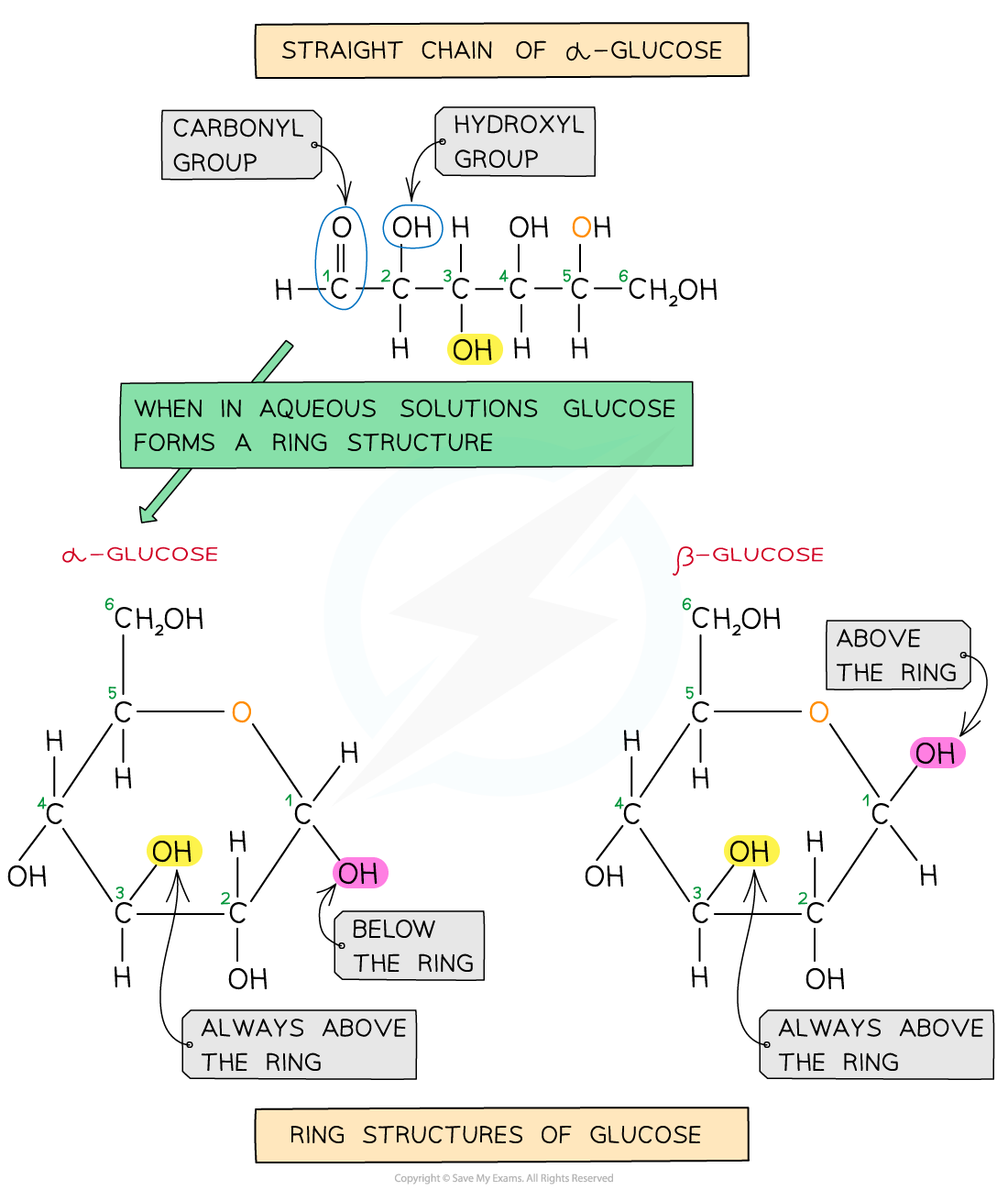
-
Different polysaccharides are formed from the two isomers of glucose
|
Polysaccharide |
Alpha Glucose |
Beta Glucose |
|---|---|---|
|
Starch |
✓ |
X |
|
Glycogen |
✓ |
X |
|
Cellulose |
X |
✓ |
Examiner Tips and Tricks
You must be able to recognise and draw the isomer rings of α and β glucose.
Biological molecules: key terms
-
The key molecules that are required to build structures that enable organisms to function are:
-
Carbohydrates
-
Proteins
-
Lipids
-
Nucleic Acids
-
Water
-
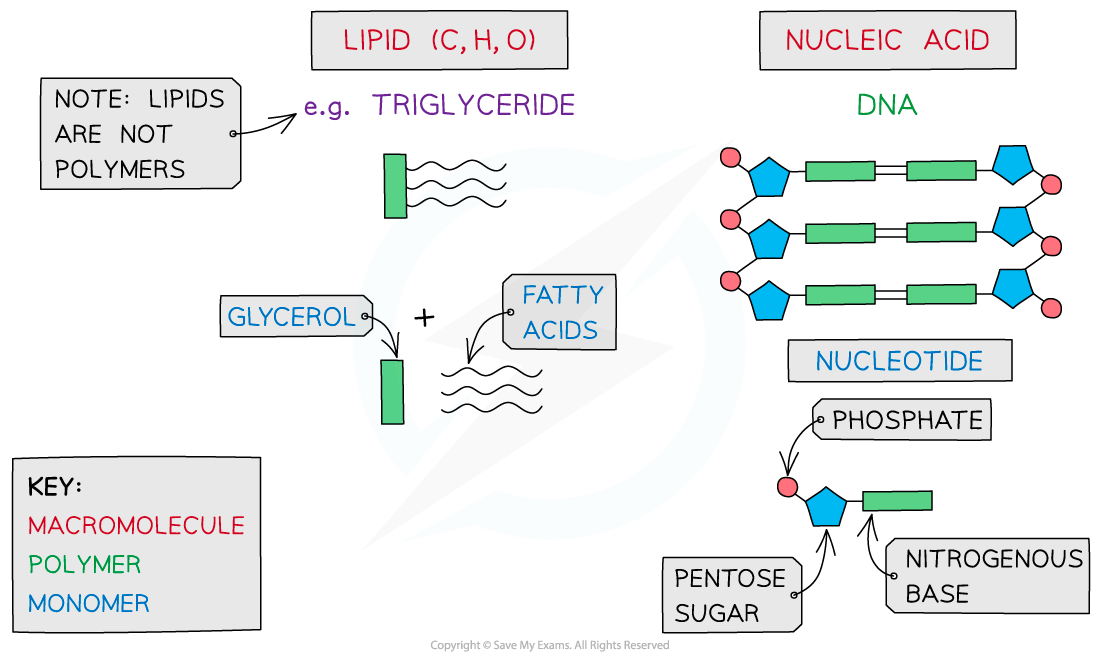
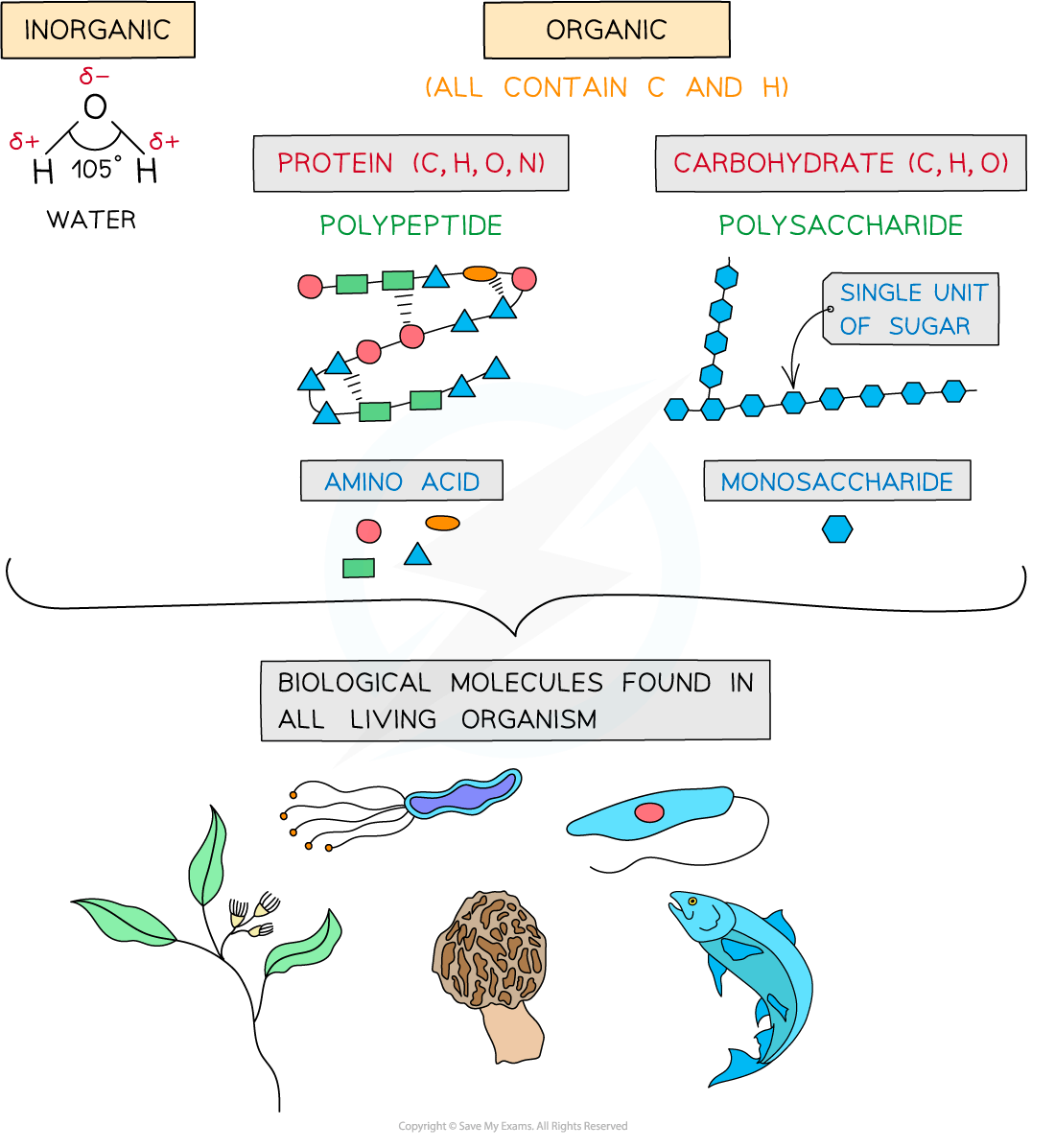
-
Carbohydrates, proteins, lipids and nucleic acids contain the elements carbon (C) and hydrogen (H) making them organic compounds
-
Carbon atoms are key to the organic compounds because:
-
Each carbon atom can form four covalent bonds – this makes the compounds very stable (as covalent bonds are so strong they require a large input of energy to break them)
-
Carbon atoms can form covalent bonds with oxygen, nitrogen and sulfur
-
Carbon atoms can bond to form straight chains, branched chains or rings
-
-
Carbon compounds can form small single subunits called monomers, that bond with many repeating subunits to form large molecules called polymers, by a process called polymerisation
-
Macromolecules are very large molecules
-
That contain 1000 or more atoms therefore having a high molecular mass
-
Polymers can be macromolecules, however not all macromolecules are polymers as the subunits of polymers have to be the same repeating units
-
Carbohydrates
-
Carbohydrates are one of the main carbon-based compounds in living organisms
-
All molecules in this group contain C, H and O
-
As H and O atoms are always present in the ratio of 2:1 (e.g. water H2O, which is where ‘hydrate’ comes from) they can be represented by the formula Cx (H2O)y
-
The three types of carbohydrates are monosaccharides, disaccharides and polysaccharides
Types of carbohydrate table
|
|
Monosaccharide |
Disaccharide |
Polysaccharide |
|---|---|---|---|
|
Definition |
A single sugar monomer, all of which are reducing sugars |
A sugar formed from two monosaccharides joined by a glycosidic bond in a condensation reaction |
A polymer formed by many monosaccharides joined by a glycosidic bond in a condensation reaction |
|
Examples |
Glyceraldehyde (3C) Ribose (5C) Glucose (6C) |
Maltose (α glucose + α glucose) Sucrose (α glucose + fructose) Lactose (α glucose + β galactose) |
Cellulose (monomer is β glucose) Starch (monomer is α glucose) Glycogen (monomer is α glucose) |
|
Function |
Energy in respiration Building blocks of polymers |
Sugar in germinating seeds (maltose) Mammal milk sugar (lactose) Sugar stored in cane sugar (sucrose) |
Energy storage (plants – starch; animals – glycogen) Structural cell wall (cellulose) |
Examiner Tips and Tricks
When discussing monomers and polymers, give the definition but also name specific examples e.g. nucleic acids – the monomer is a nucleotide.
You need to be able to define the terms monomer, polymer, macromolecule, monosaccharide, disaccharide and polysaccharide.