
Biology_A-level_Cie
-
1-1-the-microscope-in-cell-studies5 主题
-
1-2-cells-as-the-basic-units-of-living-organisms5 主题
-
2-1-testing-for-biological-molecules3 主题
-
2-2-carbohydrates-and-lipids8 主题
-
2-3-proteins6 主题
-
2-4-water2 主题
-
3-1-mode-of-action-of-enzymes5 主题
-
3-2-factors-that-affect-enzyme-action8 主题
-
4-1-fluid-mosaic-membranes4 主题
-
4-2-movement-into-and-out-of-cells12 主题
-
diffusion
-
osmosis
-
active-transport
-
endocytosis-and-exocytosis
-
investigating-transport-processes-in-plants
-
investigating-diffusion
-
surface-area-to-volume-ratios
-
investigating-surface-area
-
estimating-water-potential-in-plants
-
osmosis-in-plant-cells
-
osmosis-in-animals
-
comparing-osmosis-in-plants-and-animals
-
diffusion
-
5-1-replication-and-division-of-nuclei-and-cells6 主题
-
5-2-chromosome-behaviour-in-mitosis2 主题
-
6-1-structure-of-nucleic-acids-and-replication-of-dna4 主题
-
6-2-protein-synthesis5 主题
-
7-1-structure-of-transport-tissues4 主题
-
7-2-transport-mechanisms7 主题
-
8-1-the-circulatory-system7 主题
-
8-2-transport-of-oxygen-and-carbon-dioxide5 主题
-
8-3-the-heart4 主题
-
9-1-the-gas-exchange-system6 主题
-
10-1-infectious-diseases3 主题
-
10-2-antibiotics3 主题
-
11-1-the-immune-system4 主题
-
11-2-antibodies-and-vaccination6 主题
-
12-1-energy5 主题
-
12-2-respiration11 主题
-
aerobic-respiration-the-krebs-cycle
-
aerobic-respiration-role-of-nad-and-fad
-
aerobic-respiration-oxidative-phosphorylation
-
anaerobic-respiration
-
energy-yield-aerobic-and-anaerobic-respiration
-
anaerobic-adaptation-of-rice
-
aerobic-respiration-effect-of-temperature-and-substrate-concentration
-
structure-and-function-of-mitochondria
-
the-four-stages-in-aerobic-respiration
-
aerobic-respiration-glycolysis
-
aerobic-respiration-the-link-reaction
-
aerobic-respiration-the-krebs-cycle
-
13-1-photosynthesis-as-an-energy-transfer-process8 主题
-
13-2-investigation-of-limiting-factors2 主题
-
14-1-homeostasis-in-mammals8 主题
-
14-2-homeostasis-in-plants3 主题
-
15-1-control-and-coordination-in-mammals12 主题
-
the-endocrine-system
-
the-nervous-system
-
neurones
-
sensory-receptor-cells
-
sequence-of-events-resulting-in-an-action-potential
-
transmission-of-nerve-impulses
-
speed-of-conduction-of-impulses
-
the-refractory-period
-
cholinergic-synapses
-
stimulating-contraction-in-striated-muscle
-
ultrastructure-of-striated-muscle
-
sliding-filament-model-of-muscular-contraction
-
the-endocrine-system
-
15-2-control-and-coordination-in-plants3 主题
-
16-1-passage-of-information-from-parents-to-offspring5 主题
-
16-2-the-roles-of-genes-in-determining-the-phenotype7 主题
-
16-3-gene-control3 主题
-
17-1-variation4 主题
-
17-2-natural-and-artificial-selection7 主题
-
17-3-evolution2 主题
-
18-1-classification5 主题
-
18-2-biodiversity7 主题
-
18-3-conservation6 主题
-
19-1-principles-of-genetic-technology11 主题
-
19-2-genetic-technology-applied-to-medicine4 主题
-
19-3-genetically-modified-organisms-in-agriculture2 主题
-
1-1-the-microscope-in-cell-studies
-
1-2-cells-as-the-basic-units-of-living-organisms
-
2-1-testing-for-biological-molecules
-
2-2-carbohydrates-and-lipids
-
2-3-proteins
-
2-4-water
-
3-1-mode-of-action-of-enzymes
-
3-2-factors-that-affect-enzyme-action
-
4-1-fluid-mosaic-membranes
-
4-2-movement-into-and-out-of-cells
-
5-1-replication-and-division-of-nuclei-and-cells
-
5-2-chromosome-behaviour-in-mitosis
-
6-1-structure-of-nucleic-acids-and-replication-of-dna
-
6-2-protein-synthesis
-
7-1-structure-of-transport-tissues
-
7-2-transport-mechanisms
-
8-1-the-circulatory-system
-
8-2-transport-of-oxygen-and-carbon-dioxide
-
8-3-the-heart
-
9-1-the-gas-exchange-system
-
10-1-infectious-diseases
-
10-2-antibiotics
-
11-1-the-immune-system
-
11-2-antibodies-and-vaccination
gel-electrophoresis
Gel electrophoresis
-
Gel electrophoresis is widely used to analyse DNA, RNA and proteins
-
During electrophoresis, the molecules are separated according to their size/mass and their net (overall) charge
-
The separation occurs because:
-
Of the electrical charge that molecules carry – positively charged molecules will move towards the cathode (negative pole), whereas negatively charged molecules will move towards the anode (positive pole)
-
DNA is negatively charged due to the phosphate groups and thus when placed in an electric field the molecules move towards the anode
-
Different-sized molecules move through the gel (agarose for DNA and polyacrylamide – PAG for proteins) at different rates
-
The tiny pores in the gel result in smaller molecules moving quickly, whereas larger molecules move slowly
-
Different types of gel have different-sized pores
-
The pore size affects the speed at which molecules can move through them
-
DNA separation
-
DNA can be collected from almost any body tissue, e.g. the root of a hair or saliva from a cup.
-
After collection, DNA must be prepared for gel electrophoresis so that the DNA can be sequenced or analysed for genetic profiling (fingerprinting)
-
To prepare the fragments, scientists must first increase (amplify) the number of DNA molecules by the polymerase chain reaction (PCR)
-
Then, restriction endonucleases (enzymes) are used to cut the DNA into fragments
-
Different restriction enzymes cut the DNA at different base sequences
-
Therefore scientists use enzymes that will cut close to the variable number tandem repeat (VNTR) regions
-
Variable number tandem repeats (VNTRs) are regions found in the non-coding part of DNA
-
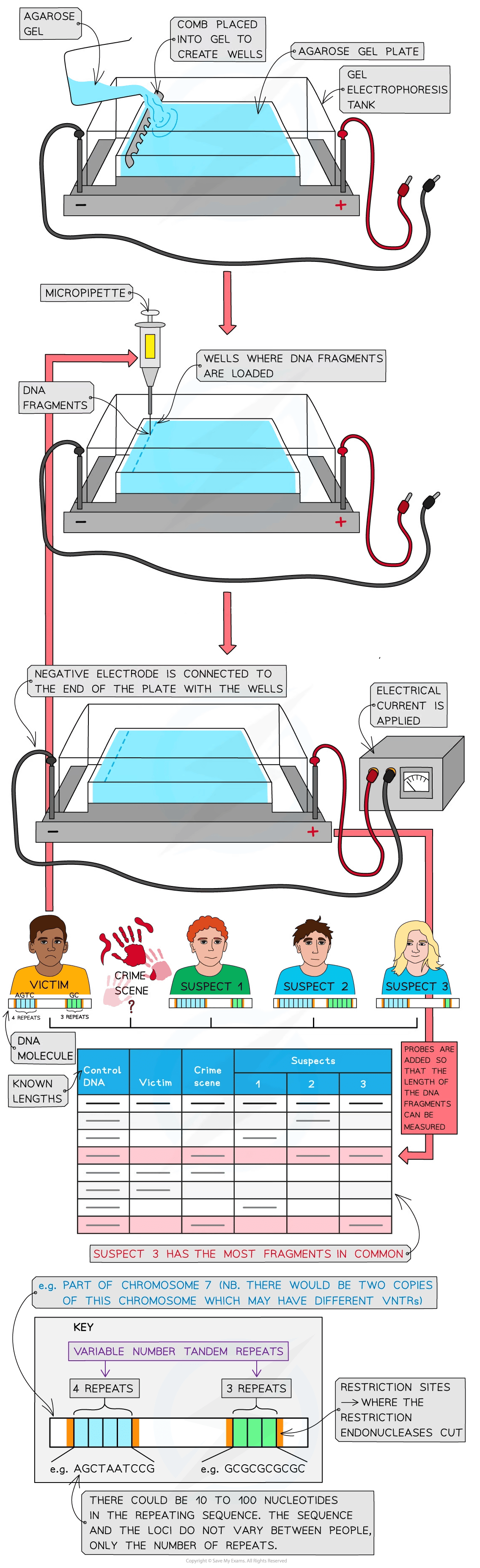
VNTRs contain variable numbers of repeated DNA sequences and are known to vary between different people (except for identical twins)
-
These VNTRs may be referred to as ‘satellite’ or ‘microsatellite’ DNA
How scientists separate DNA fragments in gel electrophoresis
-
Create an agarose gel plate in a tank by pouring liquid agarose and waiting for it to set as a gel
-
Mould wells (a series of grooves) into the gel at one end, using a comb that creates wells as the agarose gel solidifies
-
Submerge the gel in an electrolyte solution (a salt solution that conducts electricity) in the tank
-
Load (insert) the fragments into the wells using a micropipette
-
Apply an electrical current to the tank
-
The negative electrode must be connected to the end of the plate with the wells as the DNA fragments will then move towards the anode (positive pole) due to the attraction between the negatively charged phosphates of DNA and the anode
-
The smaller mass / shorter pieces of DNA fragments will move faster and further from the wells than the larger fragments
-
The fragments are not visible so must be transferred onto absorbent paper or nitrocellulose, which is then heated to separate the two DNA strands
-
Probes are then added, after which an X-ray image is taken or UV light is shone onto the paper, producing a pattern of bands which is generally compared to a control fragment of DNA
-
Probes are single-stranded DNA sequences that are complementary to the VNTR regions sought by the scientists
-
The probes also contain a means by which to be identified. This can either be:
-
A radioactive label (eg. a phosphorus isotope) which causes the probes to emit radiation that makes the X-ray film go dark, creating a pattern of dark bands
-
A fluorescent stain/dye (e.g. ethidium bromide) which fluoresces (shines) when exposed to ultraviolet (UV) light, creating a pattern of coloured bands
-
Protein separation
-
The amino acid composition of a protein determines the charge on each protein
-
Because each individual amino acid’s R group is charged differently
-
-
The charge of the R groups depends on the pH so buffer solutions are used during the separation of proteins to keep the pH constant
-
Gel electrophoresis is used to separate polypeptide chains produced by different alleles e.g. the haemoglobin variants (α-globin, β-globin and the sickle cell anaemia variant of β-globin)
Examiner Tips and Tricks
Remember gel electrophoresis is the separation of molecules according to their size and charge (negatively charged DNA molecules move to the positive pole). Examiners like to ask questions about gel electrophoresis.