
Biology_A-level_Cie
-
1-1-the-microscope-in-cell-studies5 主题
-
1-2-cells-as-the-basic-units-of-living-organisms5 主题
-
2-1-testing-for-biological-molecules3 主题
-
2-2-carbohydrates-and-lipids8 主题
-
2-3-proteins6 主题
-
2-4-water2 主题
-
3-1-mode-of-action-of-enzymes5 主题
-
3-2-factors-that-affect-enzyme-action8 主题
-
4-1-fluid-mosaic-membranes4 主题
-
4-2-movement-into-and-out-of-cells12 主题
-
diffusion
-
osmosis
-
active-transport
-
endocytosis-and-exocytosis
-
investigating-transport-processes-in-plants
-
investigating-diffusion
-
surface-area-to-volume-ratios
-
investigating-surface-area
-
estimating-water-potential-in-plants
-
osmosis-in-plant-cells
-
osmosis-in-animals
-
comparing-osmosis-in-plants-and-animals
-
diffusion
-
5-1-replication-and-division-of-nuclei-and-cells6 主题
-
5-2-chromosome-behaviour-in-mitosis2 主题
-
6-1-structure-of-nucleic-acids-and-replication-of-dna4 主题
-
6-2-protein-synthesis5 主题
-
7-1-structure-of-transport-tissues4 主题
-
7-2-transport-mechanisms7 主题
-
8-1-the-circulatory-system7 主题
-
8-2-transport-of-oxygen-and-carbon-dioxide5 主题
-
8-3-the-heart4 主题
-
9-1-the-gas-exchange-system6 主题
-
10-1-infectious-diseases3 主题
-
10-2-antibiotics3 主题
-
11-1-the-immune-system4 主题
-
11-2-antibodies-and-vaccination6 主题
-
12-1-energy5 主题
-
12-2-respiration11 主题
-
aerobic-respiration-the-krebs-cycle
-
aerobic-respiration-role-of-nad-and-fad
-
aerobic-respiration-oxidative-phosphorylation
-
anaerobic-respiration
-
energy-yield-aerobic-and-anaerobic-respiration
-
anaerobic-adaptation-of-rice
-
aerobic-respiration-effect-of-temperature-and-substrate-concentration
-
structure-and-function-of-mitochondria
-
the-four-stages-in-aerobic-respiration
-
aerobic-respiration-glycolysis
-
aerobic-respiration-the-link-reaction
-
aerobic-respiration-the-krebs-cycle
-
13-1-photosynthesis-as-an-energy-transfer-process8 主题
-
13-2-investigation-of-limiting-factors2 主题
-
14-1-homeostasis-in-mammals8 主题
-
14-2-homeostasis-in-plants3 主题
-
15-1-control-and-coordination-in-mammals12 主题
-
the-endocrine-system
-
the-nervous-system
-
neurones
-
sensory-receptor-cells
-
sequence-of-events-resulting-in-an-action-potential
-
transmission-of-nerve-impulses
-
speed-of-conduction-of-impulses
-
the-refractory-period
-
cholinergic-synapses
-
stimulating-contraction-in-striated-muscle
-
ultrastructure-of-striated-muscle
-
sliding-filament-model-of-muscular-contraction
-
the-endocrine-system
-
15-2-control-and-coordination-in-plants3 主题
-
16-1-passage-of-information-from-parents-to-offspring5 主题
-
16-2-the-roles-of-genes-in-determining-the-phenotype7 主题
-
16-3-gene-control3 主题
-
17-1-variation4 主题
-
17-2-natural-and-artificial-selection7 主题
-
17-3-evolution2 主题
-
18-1-classification5 主题
-
18-2-biodiversity7 主题
-
18-3-conservation6 主题
-
19-1-principles-of-genetic-technology11 主题
-
19-2-genetic-technology-applied-to-medicine4 主题
-
19-3-genetically-modified-organisms-in-agriculture2 主题
-
1-1-the-microscope-in-cell-studies
-
1-2-cells-as-the-basic-units-of-living-organisms
-
2-1-testing-for-biological-molecules
-
2-2-carbohydrates-and-lipids
-
2-3-proteins
-
2-4-water
-
3-1-mode-of-action-of-enzymes
-
3-2-factors-that-affect-enzyme-action
-
4-1-fluid-mosaic-membranes
-
4-2-movement-into-and-out-of-cells
-
5-1-replication-and-division-of-nuclei-and-cells
-
5-2-chromosome-behaviour-in-mitosis
-
6-1-structure-of-nucleic-acids-and-replication-of-dna
-
6-2-protein-synthesis
-
7-1-structure-of-transport-tissues
-
7-2-transport-mechanisms
-
8-1-the-circulatory-system
-
8-2-transport-of-oxygen-and-carbon-dioxide
-
8-3-the-heart
-
9-1-the-gas-exchange-system
-
10-1-infectious-diseases
-
10-2-antibiotics
-
11-1-the-immune-system
-
11-2-antibodies-and-vaccination
gene-control-lac-operon
Gene control: lac operon
-
Regulatory genes control structural genes and their levels of protein production
-
Regulatory genes sometimes have control over several structural genes at once
-
Structural genes in prokaryotes can form an operon: a group or a cluster of genes that are controlled by the same promoter
-
The lac operon found in some bacteria is one of the most well-known of these
-
The lac operon controls the production of the enzyme lactase (also called β-galactosidase) and two other structural proteins
-
Lactase breaks down the substrate lactose so that it can be used as an energy source in the bacterial cell
-
It is an inducible enzyme that is only synthesised when lactose is present
-
This helps prevent the bacteria from wasting energy and materials
Structure of the lac operon
-
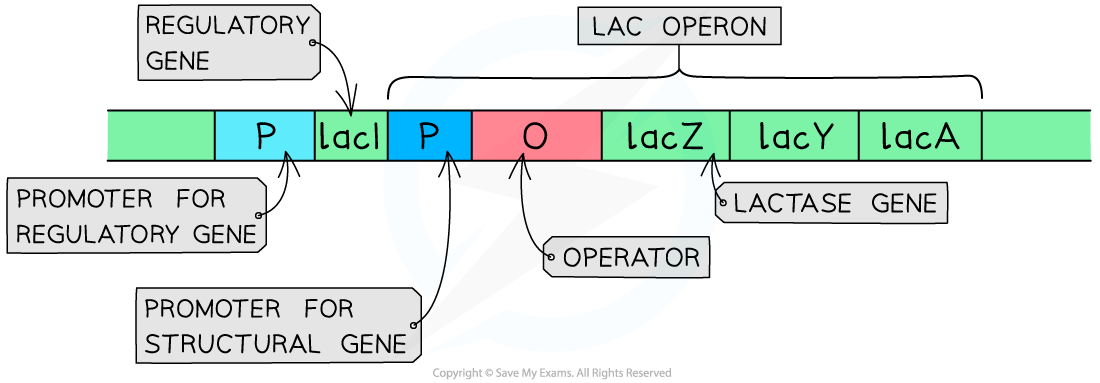
The components of the lac operon are found in the following order:
-
Promoter for structural genes
-
Operator
-
Structural gene lacZ that codes for lactase
-
Structural gene lacY that codes for permease (allows lactose into the cell)
-
Structural gene lacA that codes for transacetylase
-
-
Located to the left (upstream) of the lac operon on the bacterium’s DNA there is also the:
-
Promoter for regulatory gene
-
Regulatory gene lacI that codes for the lac repressor protein
-
-
The lac repressor protein has two binding sites that allow it to bind to the operator in the lac operon and also to lactose (the effector molecule)
-
When it binds to the operator it prevents the transcription of the structural genes as RNA polymerase cannot attach to the promoter
-
When it binds to lactose the shape of the repressor protein distorts and it can no longer bind to the operator
-
When lactose is absent
-
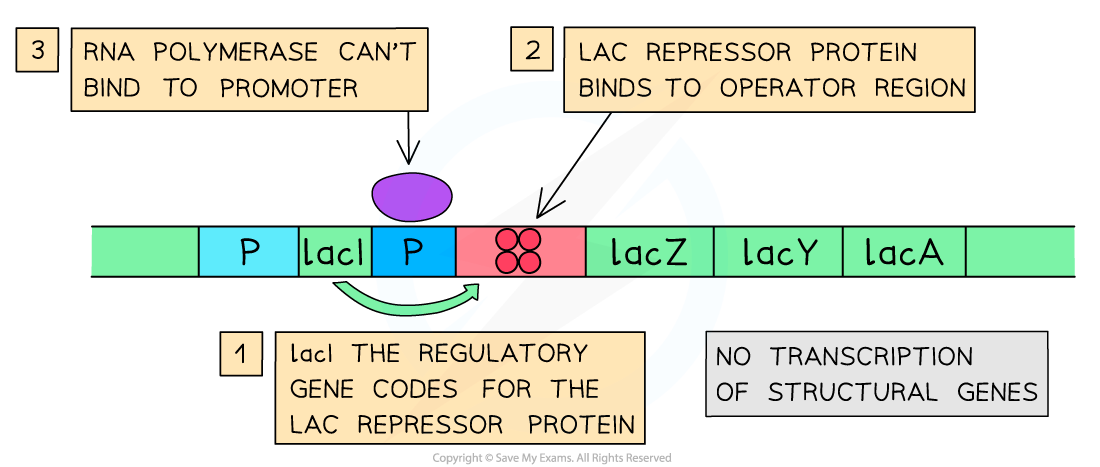
The following processes take place when lactose is absent in the medium that the bacterium is growing in:
-
The regulatory gene is transcribed and translated to produce lac repressor protein
-
The lac repressor protein binds to the operator region upstream of lacZ
-
Due to the presence of the repressor protein RNA polymerase is unable to bind to the promoter region
-
Transcription of the structural genes does not take place
-
No lactase enzyme is synthesized
-
When lactose is present
-
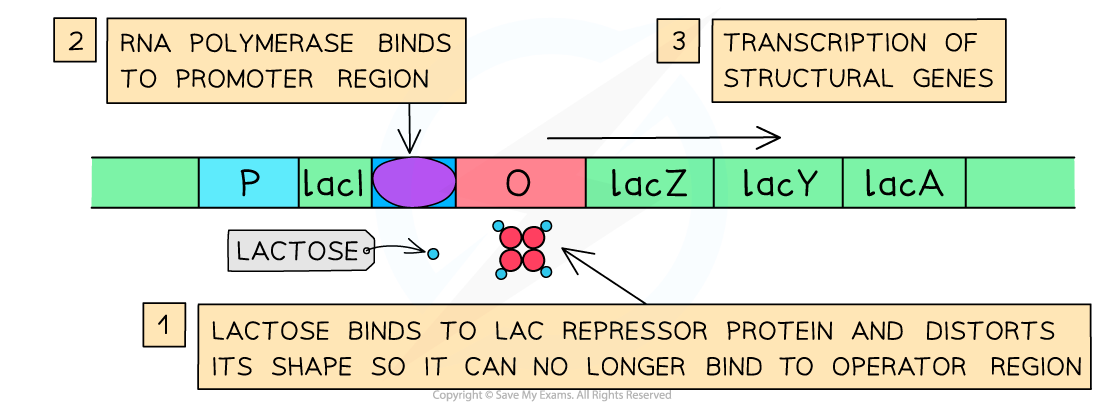
The following processes take place when lactose is present in the medium that the bacterium is growing in:
-
There is an uptake of lactose by the bacterium
-
The lactose binds to the second binding site on the repressor protein, distorting its shape so that it cannot bind to the operator site
-
RNA polymerase is then able to bind to the promoter region and transcription takes place
-
The mRNA from all three structural genes is translated
-
Enzyme lactase is produced and lactose can be broken down and used for energy by the bacterium
-
Examiner Tips and Tricks
The example above explains how the genetic control of an inducible enzyme works. You could get some questions on the genetic control of repressible enzymes.
In this mechanism an effector molecule also binds to a repressor protein produced by a regulatory gene. However this binding actually helps the repressor bind to the operator region and prevent transcription of the structural genes. So it’s the opposite of the lac operon: when there is less of the effector molecule, the repressor protein cannot bind to the operator region and transcription of the structural genes goes ahead, meaning the enzyme is produced.