
Biology_A-level_Cie
-
1-1-the-microscope-in-cell-studies5 主题
-
1-2-cells-as-the-basic-units-of-living-organisms5 主题
-
2-1-testing-for-biological-molecules3 主题
-
2-2-carbohydrates-and-lipids8 主题
-
2-3-proteins6 主题
-
2-4-water2 主题
-
3-1-mode-of-action-of-enzymes5 主题
-
3-2-factors-that-affect-enzyme-action8 主题
-
4-1-fluid-mosaic-membranes4 主题
-
4-2-movement-into-and-out-of-cells12 主题
-
diffusion
-
osmosis
-
active-transport
-
endocytosis-and-exocytosis
-
investigating-transport-processes-in-plants
-
investigating-diffusion
-
surface-area-to-volume-ratios
-
investigating-surface-area
-
estimating-water-potential-in-plants
-
osmosis-in-plant-cells
-
osmosis-in-animals
-
comparing-osmosis-in-plants-and-animals
-
diffusion
-
5-1-replication-and-division-of-nuclei-and-cells6 主题
-
5-2-chromosome-behaviour-in-mitosis2 主题
-
6-1-structure-of-nucleic-acids-and-replication-of-dna4 主题
-
6-2-protein-synthesis5 主题
-
7-1-structure-of-transport-tissues4 主题
-
7-2-transport-mechanisms7 主题
-
8-1-the-circulatory-system7 主题
-
8-2-transport-of-oxygen-and-carbon-dioxide5 主题
-
8-3-the-heart4 主题
-
9-1-the-gas-exchange-system6 主题
-
10-1-infectious-diseases3 主题
-
10-2-antibiotics3 主题
-
11-1-the-immune-system4 主题
-
11-2-antibodies-and-vaccination6 主题
-
12-1-energy5 主题
-
12-2-respiration11 主题
-
aerobic-respiration-the-krebs-cycle
-
aerobic-respiration-role-of-nad-and-fad
-
aerobic-respiration-oxidative-phosphorylation
-
anaerobic-respiration
-
energy-yield-aerobic-and-anaerobic-respiration
-
anaerobic-adaptation-of-rice
-
aerobic-respiration-effect-of-temperature-and-substrate-concentration
-
structure-and-function-of-mitochondria
-
the-four-stages-in-aerobic-respiration
-
aerobic-respiration-glycolysis
-
aerobic-respiration-the-link-reaction
-
aerobic-respiration-the-krebs-cycle
-
13-1-photosynthesis-as-an-energy-transfer-process8 主题
-
13-2-investigation-of-limiting-factors2 主题
-
14-1-homeostasis-in-mammals8 主题
-
14-2-homeostasis-in-plants3 主题
-
15-1-control-and-coordination-in-mammals12 主题
-
the-endocrine-system
-
the-nervous-system
-
neurones
-
sensory-receptor-cells
-
sequence-of-events-resulting-in-an-action-potential
-
transmission-of-nerve-impulses
-
speed-of-conduction-of-impulses
-
the-refractory-period
-
cholinergic-synapses
-
stimulating-contraction-in-striated-muscle
-
ultrastructure-of-striated-muscle
-
sliding-filament-model-of-muscular-contraction
-
the-endocrine-system
-
15-2-control-and-coordination-in-plants3 主题
-
16-1-passage-of-information-from-parents-to-offspring5 主题
-
16-2-the-roles-of-genes-in-determining-the-phenotype7 主题
-
16-3-gene-control3 主题
-
17-1-variation4 主题
-
17-2-natural-and-artificial-selection7 主题
-
17-3-evolution2 主题
-
18-1-classification5 主题
-
18-2-biodiversity7 主题
-
18-3-conservation6 主题
-
19-1-principles-of-genetic-technology11 主题
-
19-2-genetic-technology-applied-to-medicine4 主题
-
19-3-genetically-modified-organisms-in-agriculture2 主题
-
1-1-the-microscope-in-cell-studies
-
1-2-cells-as-the-basic-units-of-living-organisms
-
2-1-testing-for-biological-molecules
-
2-2-carbohydrates-and-lipids
-
2-3-proteins
-
2-4-water
-
3-1-mode-of-action-of-enzymes
-
3-2-factors-that-affect-enzyme-action
-
4-1-fluid-mosaic-membranes
-
4-2-movement-into-and-out-of-cells
-
5-1-replication-and-division-of-nuclei-and-cells
-
5-2-chromosome-behaviour-in-mitosis
-
6-1-structure-of-nucleic-acids-and-replication-of-dna
-
6-2-protein-synthesis
-
7-1-structure-of-transport-tissues
-
7-2-transport-mechanisms
-
8-1-the-circulatory-system
-
8-2-transport-of-oxygen-and-carbon-dioxide
-
8-3-the-heart
-
9-1-the-gas-exchange-system
-
10-1-infectious-diseases
-
10-2-antibiotics
-
11-1-the-immune-system
-
11-2-antibodies-and-vaccination
sliding-filament-model-of-muscular-contraction
Sliding filament model of muscular contraction
Structure of thick and thin filaments in a myofibril
-
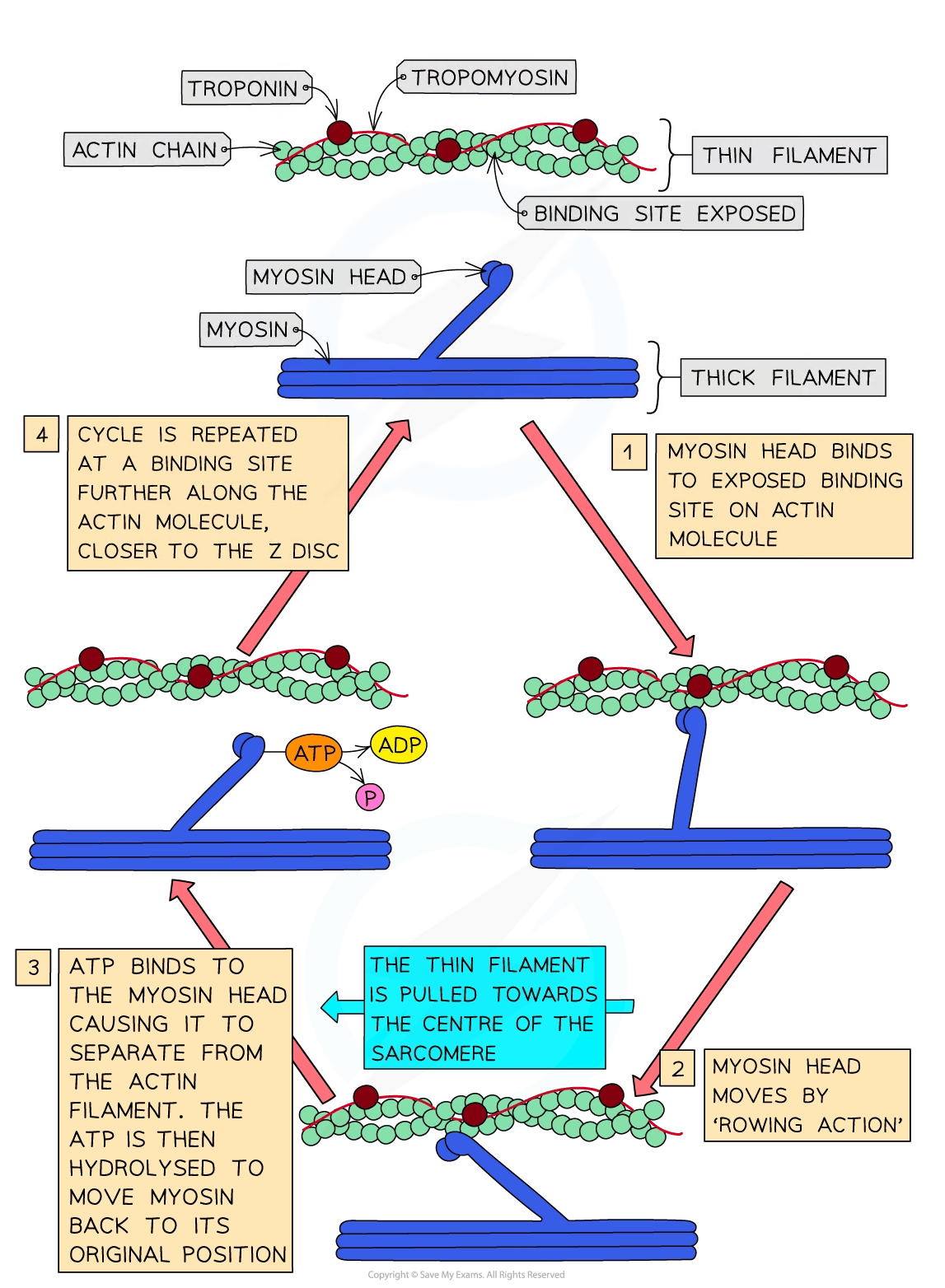
The thick filaments within a myofibril are made up of myosin molecules
-
These are fibrous protein molecules with a globular head
-
The fibrous part of the myosin molecule anchors the molecule into the thick filament
-
In the thick filament, many myosin molecules lie next to each other with their globular heads all pointing away from the M line
-
-
The thin filaments within a myofibril are made up of actin molecules
-
These are globular protein molecules
-
Many actin molecules link together to form a chain
-
Two actin chains twist together to form one thin filament
-
A fibrous protein known as tropomyosin is twisted around the two actin chains
-
Another protein known as troponin is attached to the actin chains at regular intervals
-
How muscles contract—the sliding filament model
-
Muscles cause movement by contracting
-
During muscle contraction, sarcomeres within myofibrils shorten as the Z discs are pulled closer together
-
This is known as the sliding filament model of muscle contraction and occurs via the following process:
-
An action potential arrives at the neuromuscular junction
-
Calcium ions are released from the sarcoplasmic reticulum (SR)
-
Calcium ions bind to troponin molecules, stimulating them to change shape
-
This causes troponin and tropomyosin proteins to change position on the actin (thin) filaments
-
Myosin binding sites are exposed on the actin molecules
-
The globular heads of the myosin molecules bind with these sites, forming cross-bridges between the two types of filament
-
The myosin heads move and pull the actin filaments towards the centre of the sarcomere, causing the muscle to contract a very small distance
-
ATP hydrolysis occurs at the myosin heads, providing the energy required for the myosin heads to release the actin filaments
-
The myosin heads move back to their original positions and bind to new binding sites on the actin filaments, closer to the Z disc
-
The myosin heads move again, pulling the actin filaments even closer to the centre of the sarcomere, causing the sarcomere to shorten once more and pulling the Z discs closer together
-
The myosin heads hydrolyse ATP once more in order to detach again
-
As long as troponin and tropomyosin are not blocking the myosin-binding sites and the muscle has a supply of ATP, this process repeats until the muscle is fully contracted
-
Examiner Tips and Tricks
The sliding filament model can be difficult to visualise fully with diagrams. To help you more clearly understand the steps involved, try to find some animations or videos of the sliding filament model online to see the movement of the myosin heads and thin (actin) filaments during muscle contraction!