
Biology_A-level_Cie
-
1-1-the-microscope-in-cell-studies5 主题
-
1-2-cells-as-the-basic-units-of-living-organisms5 主题
-
2-1-testing-for-biological-molecules3 主题
-
2-2-carbohydrates-and-lipids8 主题
-
2-3-proteins6 主题
-
2-4-water2 主题
-
3-1-mode-of-action-of-enzymes5 主题
-
3-2-factors-that-affect-enzyme-action8 主题
-
4-1-fluid-mosaic-membranes4 主题
-
4-2-movement-into-and-out-of-cells12 主题
-
diffusion
-
osmosis
-
active-transport
-
endocytosis-and-exocytosis
-
investigating-transport-processes-in-plants
-
investigating-diffusion
-
surface-area-to-volume-ratios
-
investigating-surface-area
-
estimating-water-potential-in-plants
-
osmosis-in-plant-cells
-
osmosis-in-animals
-
comparing-osmosis-in-plants-and-animals
-
diffusion
-
5-1-replication-and-division-of-nuclei-and-cells6 主题
-
5-2-chromosome-behaviour-in-mitosis2 主题
-
6-1-structure-of-nucleic-acids-and-replication-of-dna4 主题
-
6-2-protein-synthesis5 主题
-
7-1-structure-of-transport-tissues4 主题
-
7-2-transport-mechanisms7 主题
-
8-1-the-circulatory-system7 主题
-
8-2-transport-of-oxygen-and-carbon-dioxide5 主题
-
8-3-the-heart4 主题
-
9-1-the-gas-exchange-system6 主题
-
10-1-infectious-diseases3 主题
-
10-2-antibiotics3 主题
-
11-1-the-immune-system4 主题
-
11-2-antibodies-and-vaccination6 主题
-
12-1-energy5 主题
-
12-2-respiration11 主题
-
aerobic-respiration-the-krebs-cycle
-
aerobic-respiration-role-of-nad-and-fad
-
aerobic-respiration-oxidative-phosphorylation
-
anaerobic-respiration
-
energy-yield-aerobic-and-anaerobic-respiration
-
anaerobic-adaptation-of-rice
-
aerobic-respiration-effect-of-temperature-and-substrate-concentration
-
structure-and-function-of-mitochondria
-
the-four-stages-in-aerobic-respiration
-
aerobic-respiration-glycolysis
-
aerobic-respiration-the-link-reaction
-
aerobic-respiration-the-krebs-cycle
-
13-1-photosynthesis-as-an-energy-transfer-process8 主题
-
13-2-investigation-of-limiting-factors2 主题
-
14-1-homeostasis-in-mammals8 主题
-
14-2-homeostasis-in-plants3 主题
-
15-1-control-and-coordination-in-mammals12 主题
-
the-endocrine-system
-
the-nervous-system
-
neurones
-
sensory-receptor-cells
-
sequence-of-events-resulting-in-an-action-potential
-
transmission-of-nerve-impulses
-
speed-of-conduction-of-impulses
-
the-refractory-period
-
cholinergic-synapses
-
stimulating-contraction-in-striated-muscle
-
ultrastructure-of-striated-muscle
-
sliding-filament-model-of-muscular-contraction
-
the-endocrine-system
-
15-2-control-and-coordination-in-plants3 主题
-
16-1-passage-of-information-from-parents-to-offspring5 主题
-
16-2-the-roles-of-genes-in-determining-the-phenotype7 主题
-
16-3-gene-control3 主题
-
17-1-variation4 主题
-
17-2-natural-and-artificial-selection7 主题
-
17-3-evolution2 主题
-
18-1-classification5 主题
-
18-2-biodiversity7 主题
-
18-3-conservation6 主题
-
19-1-principles-of-genetic-technology11 主题
-
19-2-genetic-technology-applied-to-medicine4 主题
-
19-3-genetically-modified-organisms-in-agriculture2 主题
-
1-1-the-microscope-in-cell-studies
-
1-2-cells-as-the-basic-units-of-living-organisms
-
2-1-testing-for-biological-molecules
-
2-2-carbohydrates-and-lipids
-
2-3-proteins
-
2-4-water
-
3-1-mode-of-action-of-enzymes
-
3-2-factors-that-affect-enzyme-action
-
4-1-fluid-mosaic-membranes
-
4-2-movement-into-and-out-of-cells
-
5-1-replication-and-division-of-nuclei-and-cells
-
5-2-chromosome-behaviour-in-mitosis
-
6-1-structure-of-nucleic-acids-and-replication-of-dna
-
6-2-protein-synthesis
-
7-1-structure-of-transport-tissues
-
7-2-transport-mechanisms
-
8-1-the-circulatory-system
-
8-2-transport-of-oxygen-and-carbon-dioxide
-
8-3-the-heart
-
9-1-the-gas-exchange-system
-
10-1-infectious-diseases
-
10-2-antibiotics
-
11-1-the-immune-system
-
11-2-antibodies-and-vaccination
guard-cells
Guard cells
Structure of guard cells
-
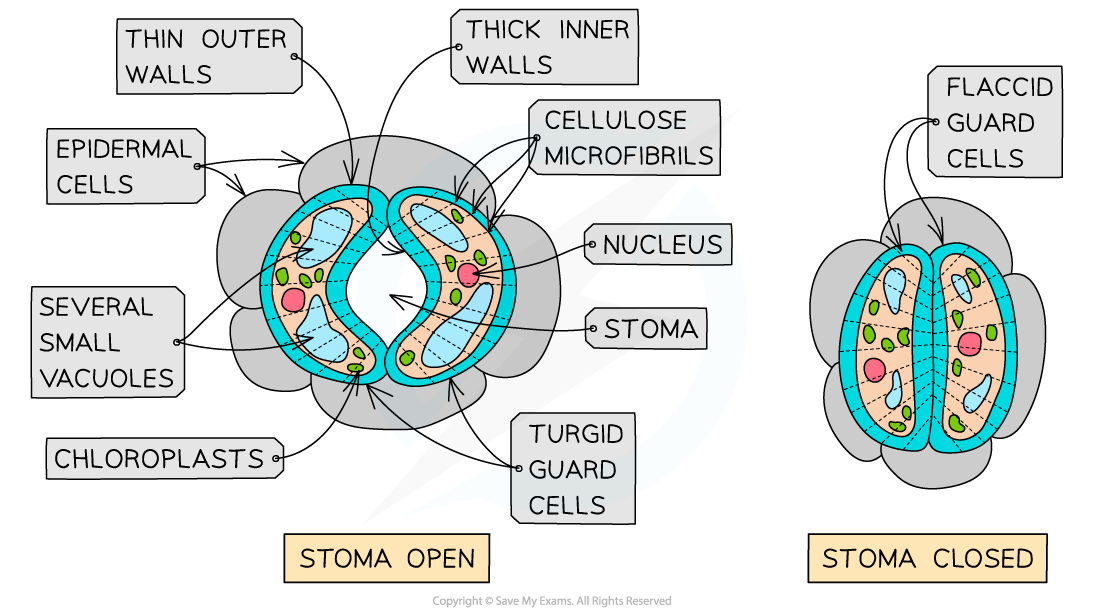
Each stoma is surrounded by two guard cells
-
Guard cells have the following features:
-
Thick cell walls facing the air outside the leaf and the stoma
-
Thin cell walls facing adjacent epidermal cells
-
Cellulose microfibrils arranged in bands around the cell
-
Cell walls have no plasmodesmata
-
Cell surface membrane is often folded and contains many channel and carrier proteins
-
Cytoplasm has a high density of chloroplasts and mitochondria
-
Chloroplasts have thylakoids but with few grana (unlike those in mesophyll cell chloroplasts)
-
Mitochondria have many cristae
-
Several small vacuoles rather than one large vacuole
-
Mechanism to open stomata
-
Guard cells open when they gain water and become turgid
-
Guard cells gain water by osmosis
-
A decrease in water potential in the guard cells is required for water to enter the cells by osmosis
-
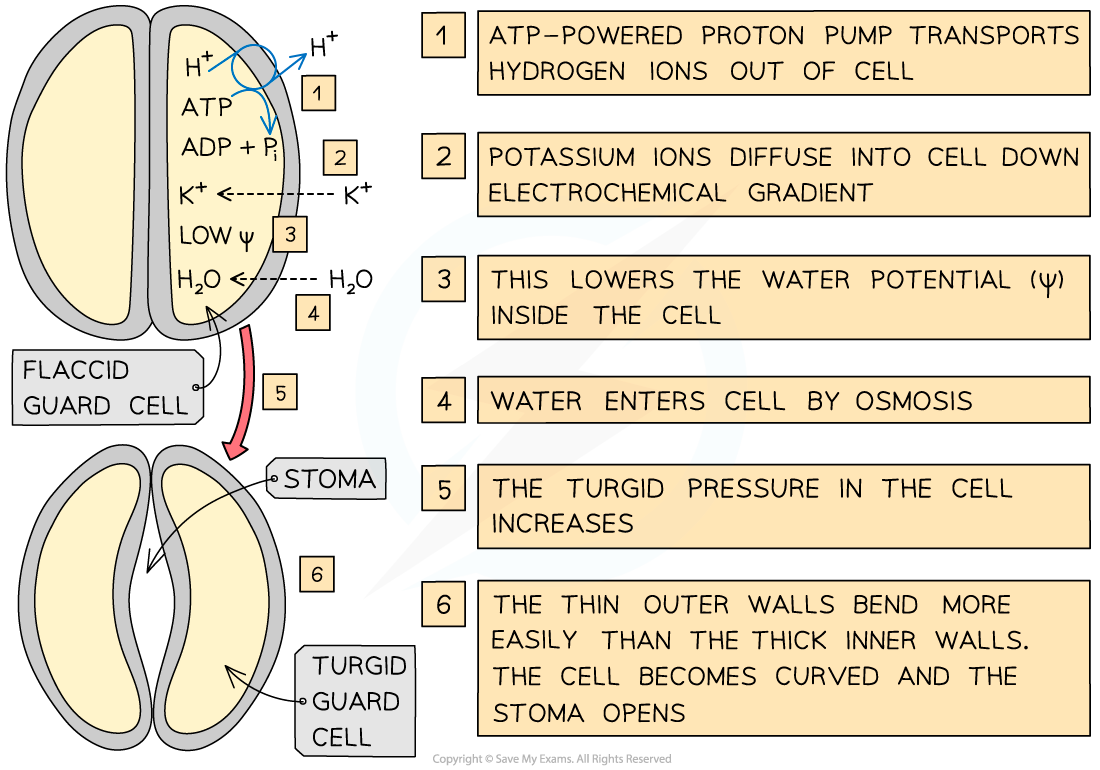
In response to light, ATP-powered proton pumps in the guard cell surface membranes actively transport hydrogen (H+) ions out of the guard cell
-
This leaves the inside of the guard cells negatively charged compared to the outside
-
This causes channel proteins in the guard cell surface membranes to open, allowing potassium (K+) ions to move down the electrical gradient and enter the guard cells
-
The potassium (K+) ions also diffuse into the guard cells down a concentration gradient
-
The combination of the electrical gradient and concentration gradient is known as an electrochemical gradient
-
-
The influx of potassium (K+) ions increases the solute concentration inside the guard cells, lowering the water potential inside the cells
-
Water now enters the guard cells by osmosis through aquaporins in the guard cell surface membranes
-
Most of the water enters the vacuoles, causing them to increase in size
-
-
This increases the turgor pressure of the guard cells, causing the stoma to open
-
The bands of cellulose microfibrils only allow the guard cells to increase in length (not diameter)
-
The thin outer walls of the guard cells bend more easily than thick inner walls
-
This causes the guard cells to become curved, opening up the stoma
-
Mechanism to close stomata
-
When certain environmental stimuli are detected (that lead to the closing of the stomata), the proton pumps in the guard cell surface membranes stop actively transporting hydrogen (H+) ions out of the guard cell
-
The potassium (K+) ions leave the guard cells
-
The water potential gradient is now reversed and water leaves the guard cells by osmosis
-
This causes the guard cells to become flaccid, closing the stoma