
Biology_A-level_Cie
-
1-1-the-microscope-in-cell-studies5 主题
-
1-2-cells-as-the-basic-units-of-living-organisms5 主题
-
2-1-testing-for-biological-molecules3 主题
-
2-2-carbohydrates-and-lipids8 主题
-
2-3-proteins6 主题
-
2-4-water2 主题
-
3-1-mode-of-action-of-enzymes5 主题
-
3-2-factors-that-affect-enzyme-action8 主题
-
4-1-fluid-mosaic-membranes4 主题
-
4-2-movement-into-and-out-of-cells12 主题
-
diffusion
-
osmosis
-
active-transport
-
endocytosis-and-exocytosis
-
investigating-transport-processes-in-plants
-
investigating-diffusion
-
surface-area-to-volume-ratios
-
investigating-surface-area
-
estimating-water-potential-in-plants
-
osmosis-in-plant-cells
-
osmosis-in-animals
-
comparing-osmosis-in-plants-and-animals
-
diffusion
-
5-1-replication-and-division-of-nuclei-and-cells6 主题
-
5-2-chromosome-behaviour-in-mitosis2 主题
-
6-1-structure-of-nucleic-acids-and-replication-of-dna4 主题
-
6-2-protein-synthesis5 主题
-
7-1-structure-of-transport-tissues4 主题
-
7-2-transport-mechanisms7 主题
-
8-1-the-circulatory-system7 主题
-
8-2-transport-of-oxygen-and-carbon-dioxide5 主题
-
8-3-the-heart4 主题
-
9-1-the-gas-exchange-system6 主题
-
10-1-infectious-diseases3 主题
-
10-2-antibiotics3 主题
-
11-1-the-immune-system4 主题
-
11-2-antibodies-and-vaccination6 主题
-
12-1-energy5 主题
-
12-2-respiration11 主题
-
aerobic-respiration-the-krebs-cycle
-
aerobic-respiration-role-of-nad-and-fad
-
aerobic-respiration-oxidative-phosphorylation
-
anaerobic-respiration
-
energy-yield-aerobic-and-anaerobic-respiration
-
anaerobic-adaptation-of-rice
-
aerobic-respiration-effect-of-temperature-and-substrate-concentration
-
structure-and-function-of-mitochondria
-
the-four-stages-in-aerobic-respiration
-
aerobic-respiration-glycolysis
-
aerobic-respiration-the-link-reaction
-
aerobic-respiration-the-krebs-cycle
-
13-1-photosynthesis-as-an-energy-transfer-process8 主题
-
13-2-investigation-of-limiting-factors2 主题
-
14-1-homeostasis-in-mammals8 主题
-
14-2-homeostasis-in-plants3 主题
-
15-1-control-and-coordination-in-mammals12 主题
-
the-endocrine-system
-
the-nervous-system
-
neurones
-
sensory-receptor-cells
-
sequence-of-events-resulting-in-an-action-potential
-
transmission-of-nerve-impulses
-
speed-of-conduction-of-impulses
-
the-refractory-period
-
cholinergic-synapses
-
stimulating-contraction-in-striated-muscle
-
ultrastructure-of-striated-muscle
-
sliding-filament-model-of-muscular-contraction
-
the-endocrine-system
-
15-2-control-and-coordination-in-plants3 主题
-
16-1-passage-of-information-from-parents-to-offspring5 主题
-
16-2-the-roles-of-genes-in-determining-the-phenotype7 主题
-
16-3-gene-control3 主题
-
17-1-variation4 主题
-
17-2-natural-and-artificial-selection7 主题
-
17-3-evolution2 主题
-
18-1-classification5 主题
-
18-2-biodiversity7 主题
-
18-3-conservation6 主题
-
19-1-principles-of-genetic-technology11 主题
-
19-2-genetic-technology-applied-to-medicine4 主题
-
19-3-genetically-modified-organisms-in-agriculture2 主题
-
1-1-the-microscope-in-cell-studies
-
1-2-cells-as-the-basic-units-of-living-organisms
-
2-1-testing-for-biological-molecules
-
2-2-carbohydrates-and-lipids
-
2-3-proteins
-
2-4-water
-
3-1-mode-of-action-of-enzymes
-
3-2-factors-that-affect-enzyme-action
-
4-1-fluid-mosaic-membranes
-
4-2-movement-into-and-out-of-cells
-
5-1-replication-and-division-of-nuclei-and-cells
-
5-2-chromosome-behaviour-in-mitosis
-
6-1-structure-of-nucleic-acids-and-replication-of-dna
-
6-2-protein-synthesis
-
7-1-structure-of-transport-tissues
-
7-2-transport-mechanisms
-
8-1-the-circulatory-system
-
8-2-transport-of-oxygen-and-carbon-dioxide
-
8-3-the-heart
-
9-1-the-gas-exchange-system
-
10-1-infectious-diseases
-
10-2-antibiotics
-
11-1-the-immune-system
-
11-2-antibodies-and-vaccination
homeostasis
Homeostasis
-
In order to function properly and efficiently, organisms have different control systems that ensure their internal conditions are kept relatively constant
-
The process of maintaining constant internal body conditions is known as homeostasis
-
-
Homeostasis is critically important for organisms as it ensures the maintenance of optimal conditions for enzyme action and cell function
-
Examples of physiological factors that are controlled by homeostasis in mammals include:
-
Core body temperature
-
Metabolic waste (e.g. carbon dioxide and urea)
-
Blood pH
-
Concentration of glucose in the blood
-
Water potential of the blood
-
Concentration of the respiratory gases (carbon dioxide and oxygen) in the blood
-
Examiner Tips and Tricks
Learn the following definition for homeostasis: Homeostasis is the regulation of the internal conditions of a cell or organism to maintain optimum conditions for function, in response to internal and external changes.
Principles of homeostasis
-
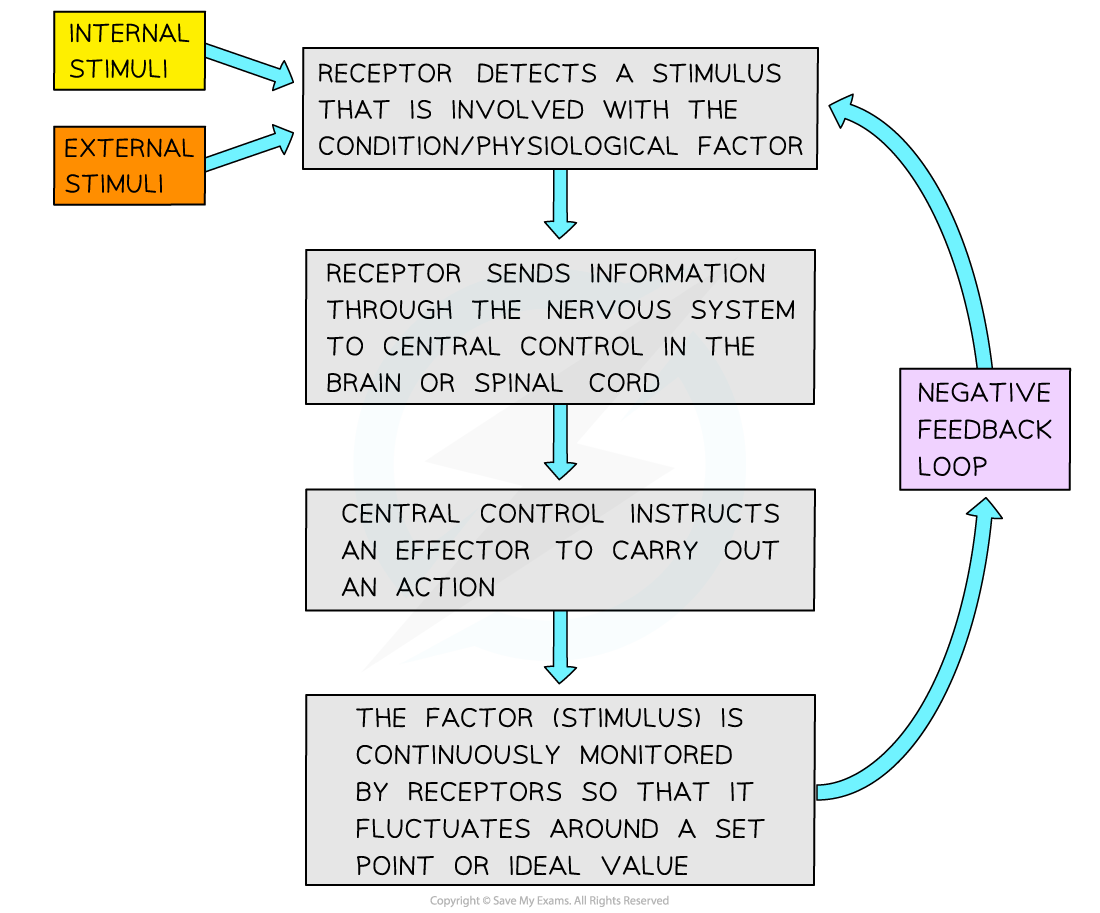
The majority of homeostatic control mechanisms in organisms use negative feedback to maintain homeostatic balance
-
This means keeping certain physiological factors, such as blood glucose concentration, within certain limits
-
-
Negative feedback control loops involve:
-
A receptor (or sensor)—to detect a stimulus that is involved with a condition or physiological factor
-
A coordination system (nervous system and endocrine system)—to transfer information between different parts of the body
-
An effector (muscles and glands)—to carry out a response
-
-
Outcome of a negative feedback loop:
-
The factor / stimulus is continuously monitored
-
If there is an increase in the factor, the body responds to make the factor decrease
-
If there is a decrease in the factor, the body responds to make the factor increase
-
-
Homeostasis in mammals relies on two different coordination systems to transfer information between different parts of the body:
-
Nervous system—information is transmitted as electrical impulses that travel along neurones
-
Endocrine system—information is transmitted as chemical messengers called hormones that travel in the blood
-
Examiner Tips and Tricks
Although the nervous and endocrine systems are both important in homeostasis and the regulation of certain physiological factors, there are some fundamental differences between them.
Information is transmitted through these two systems in different ways (electrical impulses vs. hormones).
Also, the nervous system is usually required for fast, but short-lived responses, whereas the endocrine system is usually involved in slower, but longer-lasting responses (although this is not always the case and some hormones can act very quickly)!