
Biology_A-level_Cie
-
1-1-the-microscope-in-cell-studies5 主题
-
1-2-cells-as-the-basic-units-of-living-organisms5 主题
-
2-1-testing-for-biological-molecules3 主题
-
2-2-carbohydrates-and-lipids8 主题
-
2-3-proteins6 主题
-
2-4-water2 主题
-
3-1-mode-of-action-of-enzymes5 主题
-
3-2-factors-that-affect-enzyme-action8 主题
-
4-1-fluid-mosaic-membranes4 主题
-
4-2-movement-into-and-out-of-cells12 主题
-
diffusion
-
osmosis
-
active-transport
-
endocytosis-and-exocytosis
-
investigating-transport-processes-in-plants
-
investigating-diffusion
-
surface-area-to-volume-ratios
-
investigating-surface-area
-
estimating-water-potential-in-plants
-
osmosis-in-plant-cells
-
osmosis-in-animals
-
comparing-osmosis-in-plants-and-animals
-
diffusion
-
5-1-replication-and-division-of-nuclei-and-cells6 主题
-
5-2-chromosome-behaviour-in-mitosis2 主题
-
6-1-structure-of-nucleic-acids-and-replication-of-dna4 主题
-
6-2-protein-synthesis5 主题
-
7-1-structure-of-transport-tissues4 主题
-
7-2-transport-mechanisms7 主题
-
8-1-the-circulatory-system7 主题
-
8-2-transport-of-oxygen-and-carbon-dioxide5 主题
-
8-3-the-heart4 主题
-
9-1-the-gas-exchange-system6 主题
-
10-1-infectious-diseases3 主题
-
10-2-antibiotics3 主题
-
11-1-the-immune-system4 主题
-
11-2-antibodies-and-vaccination6 主题
-
12-1-energy5 主题
-
12-2-respiration11 主题
-
aerobic-respiration-the-krebs-cycle
-
aerobic-respiration-role-of-nad-and-fad
-
aerobic-respiration-oxidative-phosphorylation
-
anaerobic-respiration
-
energy-yield-aerobic-and-anaerobic-respiration
-
anaerobic-adaptation-of-rice
-
aerobic-respiration-effect-of-temperature-and-substrate-concentration
-
structure-and-function-of-mitochondria
-
the-four-stages-in-aerobic-respiration
-
aerobic-respiration-glycolysis
-
aerobic-respiration-the-link-reaction
-
aerobic-respiration-the-krebs-cycle
-
13-1-photosynthesis-as-an-energy-transfer-process8 主题
-
13-2-investigation-of-limiting-factors2 主题
-
14-1-homeostasis-in-mammals8 主题
-
14-2-homeostasis-in-plants3 主题
-
15-1-control-and-coordination-in-mammals12 主题
-
the-endocrine-system
-
the-nervous-system
-
neurones
-
sensory-receptor-cells
-
sequence-of-events-resulting-in-an-action-potential
-
transmission-of-nerve-impulses
-
speed-of-conduction-of-impulses
-
the-refractory-period
-
cholinergic-synapses
-
stimulating-contraction-in-striated-muscle
-
ultrastructure-of-striated-muscle
-
sliding-filament-model-of-muscular-contraction
-
the-endocrine-system
-
15-2-control-and-coordination-in-plants3 主题
-
16-1-passage-of-information-from-parents-to-offspring5 主题
-
16-2-the-roles-of-genes-in-determining-the-phenotype7 主题
-
16-3-gene-control3 主题
-
17-1-variation4 主题
-
17-2-natural-and-artificial-selection7 主题
-
17-3-evolution2 主题
-
18-1-classification5 主题
-
18-2-biodiversity7 主题
-
18-3-conservation6 主题
-
19-1-principles-of-genetic-technology11 主题
-
19-2-genetic-technology-applied-to-medicine4 主题
-
19-3-genetically-modified-organisms-in-agriculture2 主题
-
1-1-the-microscope-in-cell-studies
-
1-2-cells-as-the-basic-units-of-living-organisms
-
2-1-testing-for-biological-molecules
-
2-2-carbohydrates-and-lipids
-
2-3-proteins
-
2-4-water
-
3-1-mode-of-action-of-enzymes
-
3-2-factors-that-affect-enzyme-action
-
4-1-fluid-mosaic-membranes
-
4-2-movement-into-and-out-of-cells
-
5-1-replication-and-division-of-nuclei-and-cells
-
5-2-chromosome-behaviour-in-mitosis
-
6-1-structure-of-nucleic-acids-and-replication-of-dna
-
6-2-protein-synthesis
-
7-1-structure-of-transport-tissues
-
7-2-transport-mechanisms
-
8-1-the-circulatory-system
-
8-2-transport-of-oxygen-and-carbon-dioxide
-
8-3-the-heart
-
9-1-the-gas-exchange-system
-
10-1-infectious-diseases
-
10-2-antibiotics
-
11-1-the-immune-system
-
11-2-antibodies-and-vaccination
investigating-the-rate-of-photosynthesis
Investigating the rate of photosynthesis: redox indicators
-
The light-dependent reactions of photosynthesis take place in the thylakoid membrane and involve the release of high-energy electrons from chlorophyll a molecules
-
These electrons are picked up by electron acceptors and then passed down the electron transport chain
-
However, if a redox indicator (such as DCPIP or methylene blue) is present, the indicator takes up the electrons instead
-
This causes the indicator to change colour
-
DCPIP: oxidised (blue) → accepts electrons → reduced (colourless)
-
Methylene blue: oxidised (blue) → accepts electrons → reduced (colourless)
-
The colour of the reduced solution may appear green because the chlorophyll has a green colour
-
-
The rate at which the redox indicator changes colour from its oxidised state to its reduced state can be used as a measure of the rate of photosynthesis
-
When light is at a higher intensity, or at more preferable light wavelengths, the rate of photoactivation of electrons is faster, therefore the rate of reduction of the indicator is faster
-
Method
-
Leaves are crushed in a liquid known as an isolation medium
-
This produces a concentrated leaf extract that contains a suspension of intact and functional chloroplasts
-
The medium must have the same water potential as the leaf cells (so the chloroplasts don’t shrivel or burst) and contain a buffer (to keep the pH constant)
-
It should also be ice cold (to avoid damaging the chloroplasts and to maintain membrane structure)
-
-
Small tubes are set up with different intensities, or different colours (wavelengths) of light shining on them
-
If different intensities of light are used, they must all be of the same wavelength (same colour of light)
-
If different wavelengths of light are used, they must all be of the same light intensity
-
-
DCPIP of methylene blue indicator is added to each tube, as well as a small volume of the leaf extract
-
The time taken for the redox indicator to go colourless is recorded
-
This is a measure of the rate of photosynthesis
-
Examiner Tips and Tricks
In chemistry, the acronym ‘OIL RIG’ is used to remember if something is being oxidised or reduced.
-
Oxidation Is Loss (of electrons)
-
Reduction Is Gain (of electrons)
Therefore DCPIP in its oxidised state has not accepted electrons and in its reduced state has accepted electrons.
Investigating the rate of photosynthesis: aquatic plants
-
Investigations to determine the effects of light intensity, carbon dioxide concentration and temperature on the rate of photosynthesis can be carried out using aquatic plants, such as Elodea or Cabomba (types of pondweed)
-
The effect of these limiting factors on the rate of photosynthesis can be investigated in the following ways:
-
Light intensity—change the distance (d) of a light source from the plant (light intensity is proportional to 1/d2)
-
Carbon dioxide concentration—add different quantities of sodium hydrogencarbonate (NaHCO3) to the water surrounding the plant, this dissolves to produce CO2
-
Temperature (of the solution surrounding the plant)—place the boiling tube containing the submerged plant in water baths of different temperatures
-
-
Whilst changing one of these factors during the investigation (as described below), ensure the other two remain constant
-
For example, when investigating the effect of light intensity on the rate of photosynthesis, a glass tank should be placed in between the lamp and the boiling tube containing the pondweed to absorb heat from the lamp – this prevents the solution surrounding the plant from changing temperature
-
Method
-
Ensure that the water is well aerated before use by bubbling air through it
-
This will ensure that oxygen gas given off by the plant during the investigation forms bubbles and does not dissolve in the water
-
-
Ensure that the plant has been well illuminated before starting the experiment
-
This will ensure that the plant contains all the enzymes required for photosynthesis and that any changes in rate are due to the independent variable rather than an increase in enzyme activity
-
-
Cut the stem of the pondweed cleanly just before placing it into the boiling tube
-
Cutting the stem at an angle provides a larger surface area from which bubbles can form
-
-
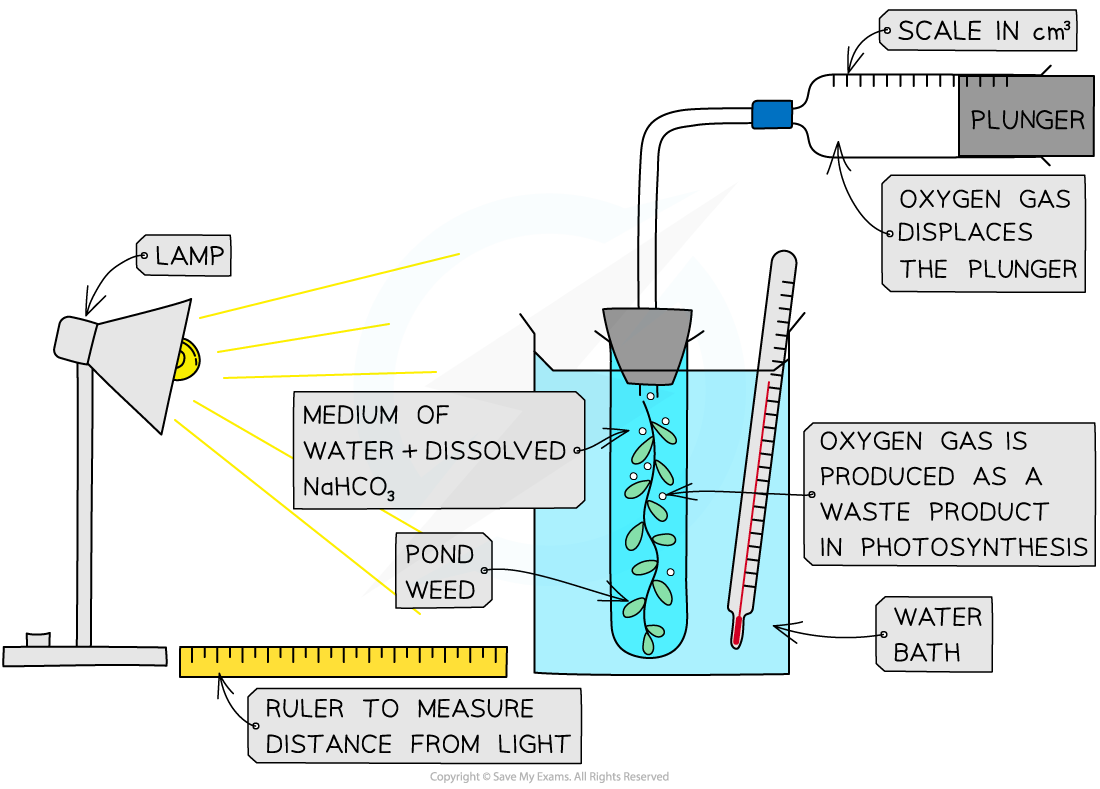
Set up the apparatus (as shown below) in a darkened room
-
This ensures that the lamp is the only light source and so allows light intensity to be controlled
-
Ensure that the pondweed is fully submerged in sodium hydrogencarbonate solution (1%); this ensures that the pondweed has a controlled supply of carbon dioxide for photosynthesis
-
-
Measure the volume of gas collected in the gas syringe in a set period of time, e.g. 5 minutes
-
Repeat step 5 at least twice more
-
Change the independent variable and repeat step 5 again
-
The independent variable could be the light intensity, carbon dioxide concentration or temperature depending on which limiting factor you are investigating
-
-
Record the results in a table and plot a graph of the volume of oxygen produced per minute against the independent variable
Examiner Tips and Tricks
Learn the 3 limiting factors and how each one can be altered in a laboratory environment:
-
Light intensity – the distance of the light source from the plant (intensity ∝ 1/d2)
-
Temperature – changing the temperature of the water bath the test tube sits in
-
Carbon dioxide – the concentration of NaHCO3 dissolved in the water the pondweed is in
Also, remember that the variables not being tested (the control variables) must be kept constant.