
Biology_A-level_Aqa
-
1-biological-molecules
1-1-biological-molecules-carbohydrates11 主题-
1-1-1-biological-molecules-key-terms
-
1-1-2-biological-molecules-reactions
-
1-1-3-monosaccharides
-
1-1-4-glucose
-
1-1-5-the-glycosidic-bond
-
1-1-6-chromatography-monosaccharides
-
1-1-7-disaccharides
-
1-1-8-starch-and-glycogen
-
1-1-9-cellulose
-
1-1-10-biochemical-tests-sugars-and-starch
-
1-1-11-finding-the-concentration-of-glucose
-
1-1-1-biological-molecules-key-terms
-
1-2-biological-molecules-lipids3 主题
-
1-3-biological-molecules-proteins5 主题
-
1-4-proteins-enzymes12 主题
-
1-4-1-many-proteins-are-enzymes
-
1-4-2-enzyme-specificity
-
1-4-3-how-enzymes-work
-
1-4-4-required-practical-measuring-enzyme-activity
-
1-4-5-drawing-a-graph-for-enzyme-rate-experiments
-
1-4-6-using-a-tangent-to-find-initial-rate-of-reaction
-
1-4-7-limiting-factors-affecting-enzymes-temperature
-
1-4-8-limiting-factors-affecting-enzymes-ph
-
1-4-10-limiting-factors-affecting-enzymes-enzyme-concentration
-
1-4-11-limiting-factors-affecting-enzymes-substrate-concentration
-
1-4-12-limiting-factors-affecting-enzymes-inhibitors
-
1-4-14-control-of-variables-and-uncertainty
-
1-4-1-many-proteins-are-enzymes
-
1-5-nucleic-acids-structure-and-dna-replication8 主题
-
1-5-2-nucleotide-structure-and-the-phosphodiester-bond
-
1-5-3-dna-structure-and-function
-
1-5-4-rna-structure-and-function
-
1-5-5-ribosomes
-
1-5-6-the-origins-of-research-on-the-genetic-code
-
1-5-8-the-process-of-semi-conservative-replication
-
1-5-9-calculating-the-frequency-of-nucleotide-bases
-
1-5-10-the-watson-crick-model
-
1-5-2-nucleotide-structure-and-the-phosphodiester-bond
-
1-6-atp-water-and-inorganic-ions4 主题
-
2-cell-structure2-1-cell-structure7 主题
-
2-2-the-microscope-in-cell-studies4 主题
-
2-3-cell-division-in-eukaryotic-and-prokaryotic-cells8 主题
-
2-4-cell-membranes-and-transport7 主题
-
2-5-cell-recognition-and-the-immune-system7 主题
-
2-6-vaccines-disease-and-monoclonal-antibodies6 主题
-
3-exchange-and-transport3-1-adaptations-for-gas-exchange6 主题
-
3-2-human-gas-exchange10 主题
-
3-2-1-the-human-gas-exchange-system
-
3-2-2-dissecting-the-gas-exchange-system
-
3-2-3-microscopy-and-gas-exchange-surfaces
-
3-2-4-investigating-gas-exchange
-
3-2-5-the-alveolar-epithelium
-
3-2-6-ventilation-and-gas-exchange
-
3-2-8-the-effects-of-lung-disease
-
3-2-9-pollution-and-smoking-data
-
3-2-10-risk-factor-data
-
3-2-11-correlations-and-causal-relationships
-
3-2-1-the-human-gas-exchange-system
-
3-3-digestion-and-absorption5 主题
-
3-4-mass-transport-in-animals6 主题
-
3-5-the-circulatory-system-in-animals8 主题
-
3-6-mass-transport-in-plants6 主题
-
4-genetics-variation-and-interdependence4-1-dna-genes-and-chromosomes7 主题
-
4-2-dna-and-protein-synthesis6 主题
-
4-3-genetic-diversity-mutations-and-meiosis7 主题
-
4-4-genetic-diversity-and-adaptation6 主题
-
4-5-species-and-taxonomy4 主题
-
4-6-biodiversity9 主题
-
5-energy-transfers-in-and-between-organisms-a-level-only5-1-photosynthesis-a-level-only5 主题
-
5-2-respiration-a-level-only7 主题
-
5-3-energy-and-ecosystems-a-level-only9 主题
-
5-4-nutrient-cycles-a-level-only4 主题
-
6-organisms-respond-to-changes-in-their-environments-a-level-only6-1-response-to-stimuli-a-level-only12 主题
-
6-1-1-survival-and-response
-
6-1-2-growth-factors-in-flowering-plants
-
6-1-3-indoleacetic-acid-iaa
-
6-1-4-taxes-and-kinesis
-
6-1-5-reflex-arcs
-
6-1-6-required-practical-investigating-animal-movement
-
6-1-7-the-pacinian-corpuscle
-
6-1-8-pacinian-corpuscles-generator-potential
-
6-1-9-investigating-touch-and-temperature-receptors
-
6-1-10-the-human-retina
-
6-1-11-myogenic-stimulation-of-the-heart
-
6-1-13-heart-rate
-
6-1-1-survival-and-response
-
6-2-nervous-coordination-a-level-only10 主题
-
6-3-skeletal-muscles-a-level-only6 主题
-
6-4-homeostasis-a-level-only11 主题
-
6-4-1-principles-of-homeostasis
-
6-4-2-negative-feedback
-
6-4-3-glucose-concentration-and-insulin
-
6-4-4-glucose-regulation-glucagon
-
6-4-5-glucose-regulation-adrenaline
-
6-4-6-glucose-regulation-the-liver
-
6-4-7-diabetes
-
6-4-8-required-practical-determining-the-concentration-of-glucose-in-urine
-
6-4-9-nephron-structure
-
6-4-10-nephron-function
-
6-4-11-control-of-blood-water-potential
-
6-4-1-principles-of-homeostasis
-
7-genetics-populations-evolution-and-ecosystems-a-level-only7-1-inheritance-a-level-only6 主题
-
7-2-populations-a-level-only3 主题
-
7-3-evolution-a-level-only5 主题
-
7-4-populations-in-ecosystems-a-level-only7 主题
-
8-the-control-of-gene-expression-a-level-only8-1-genetic-mutations-a-level-only2 主题
-
8-2-regulation-of-gene-expression-a-level-only11 主题
-
8-2-1-totipotent-cells
-
8-2-2-stem-cells
-
8-2-3-the-use-of-stem-cells
-
8-2-4-producing-tissue-cultures-of-explants
-
8-2-5-regulation-of-transcription
-
8-2-6-evaluating-data-about-genetic-expression
-
8-2-7-epigenetics
-
8-2-8-epigenetics-and-disease
-
8-2-9-rna-interference
-
8-2-10-two-types-of-tumours
-
8-2-11-tumour-development
-
8-2-1-totipotent-cells
-
8-3-using-genome-projects-a-level-only4 主题
-
8-4-gene-technologies-a-level-only13 主题
-
8-4-1-recombinant-dna-technology
-
8-4-2-producing-fragments-of-dna
-
8-4-3-investigating-the-specificity-of-restriction-enzymes
-
8-4-4-polymerase-chain-reaction
-
8-4-5-culture-of-transformed-host-cells
-
8-4-6-uses-of-recombinant-dna-technology
-
8-4-7-dna-probes-and-dna-hybridisation
-
8-4-8-screening-patients
-
8-4-9-genetic-counselling-and-personalised-medicine
-
8-4-10-variable-number-tandem-repeats
-
8-4-11-gel-electrophoresis
-
8-4-12-genetic-fingerprinting
-
8-4-13-uses-of-genetic-fingerprinting
-
8-4-1-recombinant-dna-technology
-
exam-guidance-and-skillsessay-guidance3 主题
6-4-10-nephron-function
Ultrafiltration
-
The nephron is the functional unit of the kidney; nephrons are responsible for the formation of urine
-
The process of urine formation in the kidneys occurs in two stages:
-
ultrafiltration
-
Small molecules are filtered out of the blood and into the Bowman’s capsule of the kidney nephron, forming glomerular filtrate
-
-
selective reabsorption
-
Useful molecules are taken back from the filtrate and returned to the blood
-
-
-
After reabsorption is complete the remaining filtrate forms the urine
-
Urine then flows out of the kidneys, along the ureters and into the bladder, where it is temporarily stored
The process of ultrafiltration
-
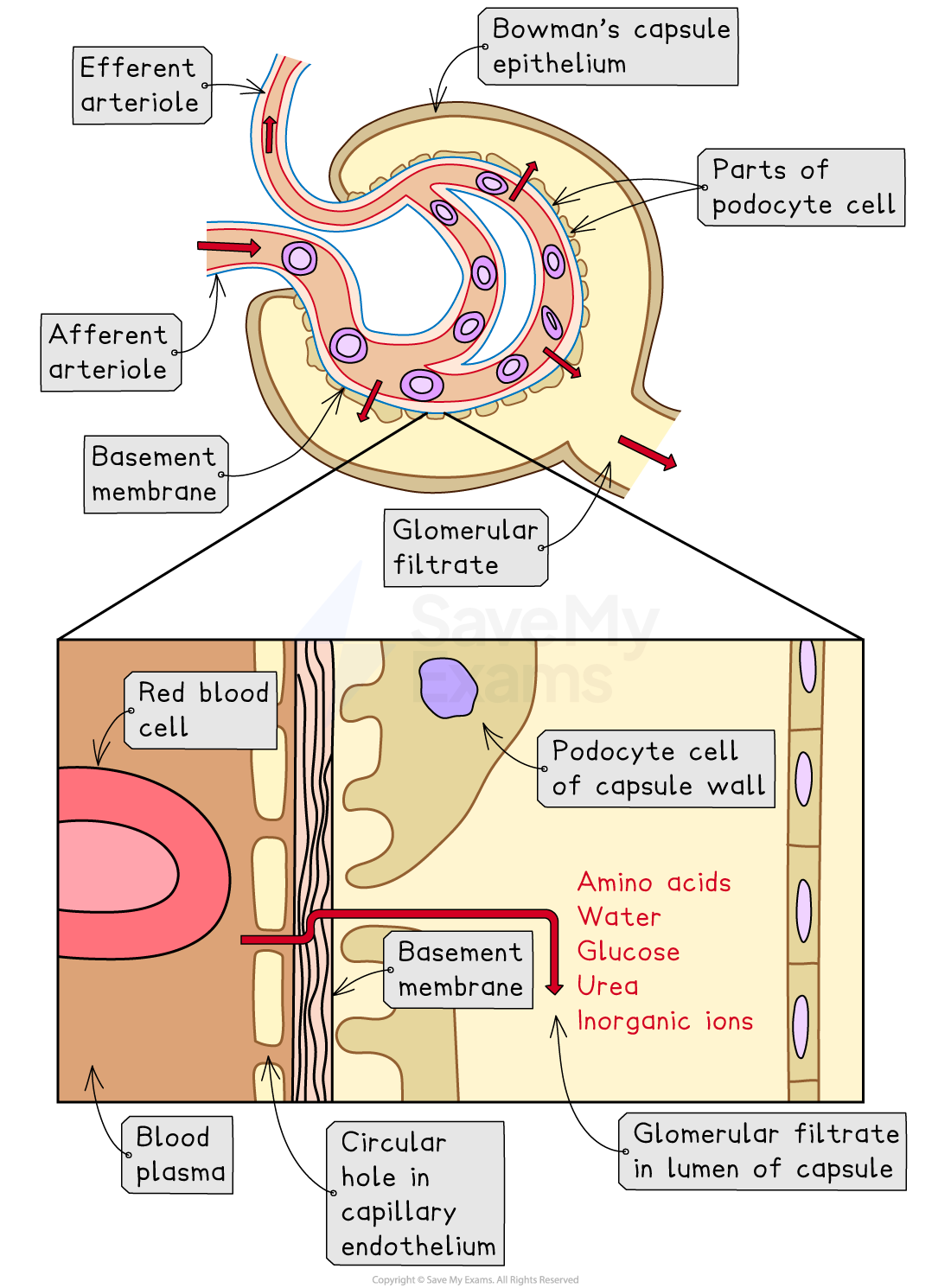
Arterioles branch off the renal artery and lead to each nephron, where they form a knot of capillaries known as the glomerulus, which sits inside the Bowman’s capsule
-
The afferent arteriole is wider in diameter than the efferent arteriole, resulting in high blood pressure within the glomerulus
-
This high blood pressure causes smaller molecules being carried in the blood to be forced out of the capillaries of the glomerulus and into the Bowman’s capsule, where they form the glomerular filtrate
-
The main substances that form the glomerular filtrate are:
-
amino acids
-
water
-
glucose
-
urea
-
inorganic ions, including Na+, K+ and Cl–
-
-
Blood cells and large proteins remain in the blood as they are too large to pass out of the capillaries

Features that aid ultrafiltration
-
The blood in the glomerular capillaries is separated from the lumen of the Bowman’s capsule by two cell layers and a basement membrane; these enable filtration of small molecules:
-
Capillary endothelium
-
Gaps between the endothelial cells allow small molecules to pass through
-
-
Basement membrane
-
A mesh of collagen and glycoproteins allows passage of small molecules
-
-
Bowman’s capsule epithelium
-
These epithelial cells have many finger-like projections known as podocytes, between which there are gaps for small molecules to pass through
-
-
Selective reabsorption
-
Many of the substances in the glomerular filtrate are needed by the body
-
These substances are reabsorbed into the blood as the filtrate passes along the nephron
-
This process is knowns as selective reabsorption
-
-
Reabsorbed substances include:
-
water
-
salts
-
glucose
-
amino acids
-
-
Most of this reabsorption occurs in the proximal convoluted tubule

-
The lining of the proximal convoluted tubule is composed of a single layer of epithelial cells, which are adapted to carry out reabsorption in several ways, e.g. they have:
-
microvilli
-
co-transporter proteins
-
many mitochondria
-
|
Adaptation of proximal convoluted tubule epithelial cell |
How adaptation aids reabsorption |
|---|---|
|
Many microvilli present on the luminal membrane |
This increases the surface area for reabsorption |
|
Many co-transporter proteins in the luminal membrane |
Each type of co-transporter protein transports a specific solute, e.g. glucose or a particular amino acid, across the luminal membrane |
|
Many mitochondria |
These provide energy for sodium-potassium pumps in the basal membranes of the cells |
Mechanisms of reabsorption
-
The mechanism by which reabsorption occurs differs between substances, e.g.:
-
sodium ions
-
(Na+) are transported from the proximal convoluted tubule into the surrounding tissues by active transport
-
-
chloride ions
-
The positively charged sodium ions creates an electrical gradient, causing chloride ions (Cl–) to follow by diffusion
-
-
water
-
The movement of ions into the surrounding tissues lowers the water potential of the tissues, so water leaves the proximal convoluted tubule by osmosis
-
-
urea
-
Urea moves out of the proximal convoluted tubule by diffusion
-
-
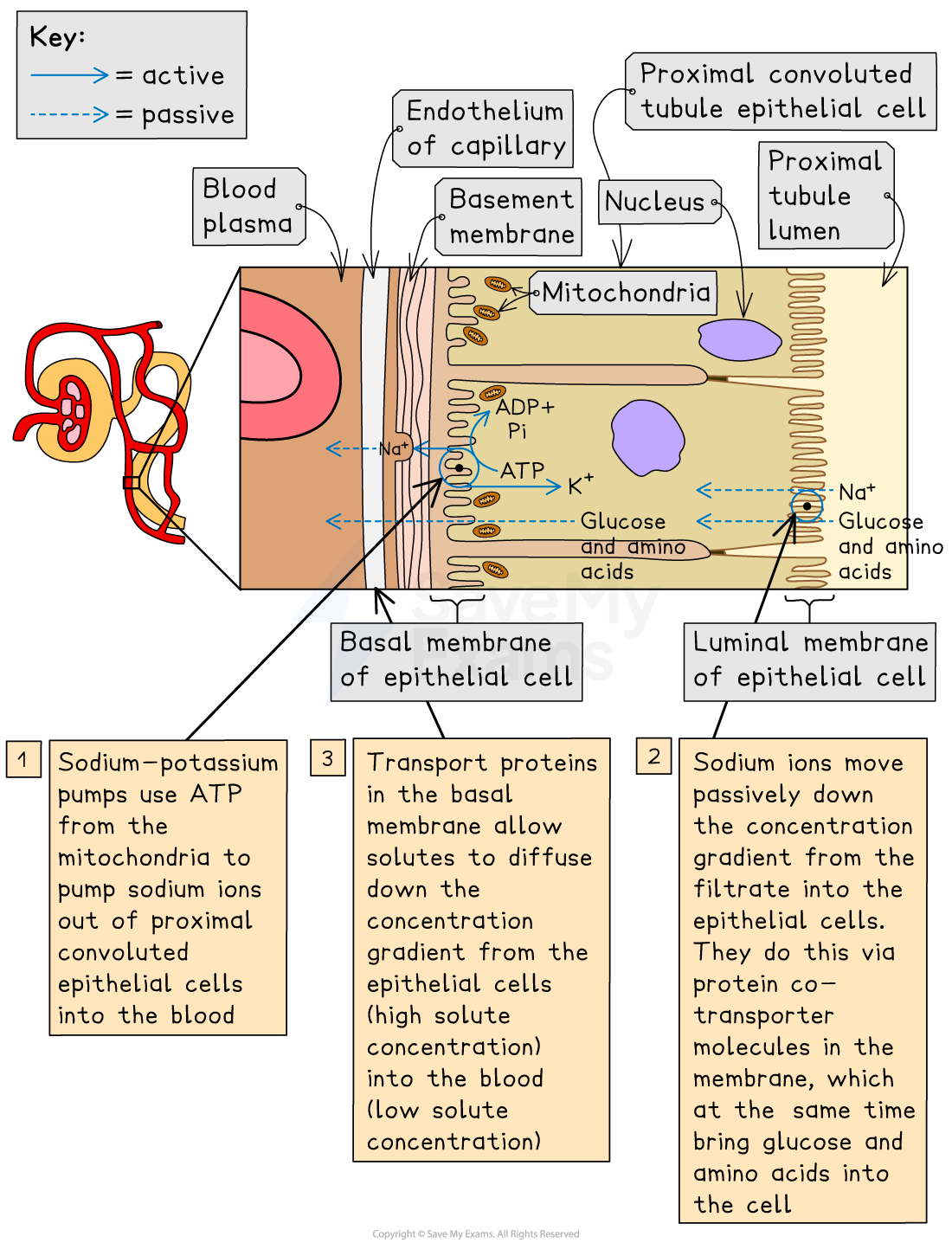
sugars and amino acids are transported into the surrounding tissues by co-transporter proteins, which also transport sodium ions, in the following process:
-
sodium-potassium pumps in the cells that line the proximal convoluted tubule actively transport sodium ions out of the epithelial cells and into the blood
-
this lowers the concentration of sodium ions inside the epithelial cells, causing sodium ions in the filtrate to diffuse down their concentration gradient into the epithelial cells
-
these sodium ions move via co-transporter proteins in the membrane, and as they move the proteins transport another solute at the same time, e. g. glucose or an amino acid
-
once inside the epithelial cells these solutes diffuse down their concentration gradients into the blood
-
-
-
All of the substances that leave the proximal convoluted tubule for the surrounding tissues eventually make their way into nearby capillaries down their concentration gradients
Examiner Tips and Tricks
Remember that the reabsorption of glucose and amino acids via cotransport is an active process.
Reabsorption of water and salts
-
While most water and salts are reabsorbed in the proximal convoluted tubule, the loop of Henle and collecting duct are also involved in the reabsorption of these substances
The loop of Henle
-
Reabsorption of ions and water in the loop of Henle takes place as follows:
-
Sodium and chloride ions are pumped out of the ascending limb of the loop of Henle into the surrounding medulla region
-
The water potential of the medulla is reduced
-
The ascending limb of the loop of Henle is impermeable to water, so water is unable to follow directly by osmosis, despite the water potential gradient
-
-
The neighbouring descending limb is permeable to water, so water moves out of the descending limb and into neighbouring capillaries by osmosis
-
Ions cannot move out of the descending limb to balance the water loss due to its low permeability to ions
-
-

The distal convoluted tubule and collecting duct
-
The loop of Henle generates a low water potential in the renal medulla; this results in reabsorption of water from the distal convol